Monday, May 7, 2012
Mystic River
For those of you who love this film as much as I do just thought I'd mention that my review of Jean Vigo's timeless classic L'Atalante can be read over at arts and pop culture magazine Oomska
Film Club Reviews #10
Terrific exploration of masculinity from Susanne Bier, the modern mistress of emotional filmmaking, the 21st century Nicholas Ray. Her films are about love in all its complicated shades, the devastation it can cause, how uncontrollable it is, how it can lead us into dangerous territory. In A Better World starts with Anton, a doctor working at a refugee camp in a dangerous African country where gangs mutilate girls and justice doesn't exist. Back home in civilised Denmark his marriage to Marianne is heading for divorce. They have two young sons, the eldest of which, ten-year-old Elias, is being bullied at school. Or he is until Christian, a new boy, defends him by threatening the bully with a knife. Christian's mother has died of cancer and he's a powderkeg of unresolved grief and resentment. When Anton stops a fight involving his younger son, the other father, a mechanic, slaps him in the face. Later he visits this man, with Elias and Christian, to show them he's not afraid. But the mechanic slaps him again, Anton refusing to respond, determined to prove he's the better man for rising above violence. But the children don't see it this way. Christian persuades Elias that if his father won't do something about this bully it's up to them to enact revenge. And so things escalate. Along the way the plot resolves itself in a somewhat contived fashion but the emotional journey earns it. These are children, after all, perilously close to destruction, and we should want them to survive. Bier and her regular screenwriter Anders Thomas Jensen delight in taking soap opera plots and infusing them with authentic detail. It's a tightrope walk that doesn't always work but when it does the result is vivid and engrossing filmmaking that asks questions of us few films get close to. How do we respond when our children suffer bullying and look to us for protection, for schoolyard justice? How do men deal with violence in a civilised society, the violence they're confronted by and the violence inside themselves? What is justice without retribution? How can we defend ourselves without descending to the level of our attackers? This is acutely observed cinema, filmed with big-budget panache and impossible not to be moved by if you’re a parent, a father especially.
Labels:
film club reviews,
In A Better World,
Susanne Bier
Film Club Review #9
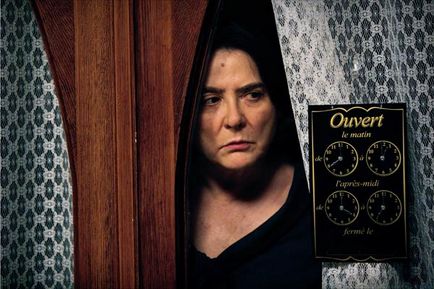
Based on the ''beloved'' bestseller, Mona Achache's The Hedgehog portrays the lonely existence of RenĂ©e, a middle-aged, dowdy concierge in a well-to-do Parisian apartment building and Paloma, the daughter of a wealthy family in the same building who records her life with a video camera and plans to kill herself on her twelfth birthday. In their own ways they've both stopped believing in life. Then mysterious new tenant Mr. Ozu arrives and they begin to see things differently. Ironically, for a film that's all about hidden depth The Hedgehog has all the intellectual riguor of a mind/body/spirit bestseller, full of thumpingly obvious symbolism, never really engaged with existential crisis, happy instead to set it up to be skittled by the power of love or the easy uplift of a good old cry. Togo Igawa does wonders with that cardboard paragon of Eastern virtue Mr Ozu, almost making him a flesh and blood character and Josiane Balasko is excellent as Renee, her wary, deadpan expression gradually revealing the sweet woman hidden beneath the grouchy exterior. Life is worth living, the film tells us, if you open yourself up to it, reveal the real you hidden inside. Which is fine, of course, but does it have to be made explicit by a secret room of books that constitute Renee’s true personality, a room with a door that’s always closed. Just like her heart. She’s a hedgehog, y'see, prickly on the outside, but inside ‘she’s as refined as that falsely lethargic, staunchly private, and terribly elegant creature’. (This from the mouth of an eleven-year-old). Appearances can be deceiving then. Like this film which prides itself on being philosophical, references the great art of Tolstoy and Yasujiro Ozu, but underneath the elegant surface it's just soft-headed trash dressed up in arty clothes, a so sad but so lovely experience for educated sentimentalists.
Sunday, April 8, 2012
Full Metal Boxes
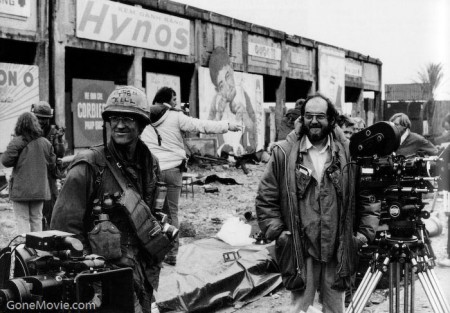
I was musing yesterday about how Jon Ronson's article on being allowed access to Stanley Kubrick's estate after his death would make a good basis for a film, and actually Ronson did turn it into a documentary in 2008 called Stanley Kubrick's Boxes. Here's a clip about how he found some old film cans in a stable that turned out to be eighteen hours of footage Kubrick's daughter shot on the set of Full Metal Jacket. We then see some of this footage, arguing over tea breaks, setting up and filming scenes, moments picked I think to show Kubrick as calm, practical and amused, in order to counteract the claim he was becoming increasingly unhinged at this time. Although, personally, I'd like to believe he really did eat all three courses of his dinner simultaneously in the manner of Napoleon.
Saturday, April 7, 2012
Operation Snafu
Been suffering one of my occassional non-verbal phases, a writer's block that gets worse as new ideas pile up on top of already unfinished or unstarted ones. As befits an epic dumb-show of this nature, I've taken to the visual therapy of Tumblr to keep sanity and momentum going. Anyway, in order to try getting out of this snafu, I've decided to do a ragbag post of recent film-related stuff.

Firstly there's this excellent article from 2004 by Jon Ronson called Citizen Kubrick about how he was invited to Stanley Kubrick's estate after his death and allowed roam through his archive of boxes. It's fascinating, makes you wish it was still there so you could go too. There's also a sense, as the Citizen Kane reference implies, that there's more here than simply a newspaper article; there's a short story, novel or film asking to be made, an exploration of a man's life, of cinema and obsession, through the immaculately-catalogued debris of his life. A kind of Krapp's Last Tape, maybe, except with boxes, personally designed, with easy-to-remove tops.

Another insight into a master director's work came from Jeff Desom, who atomised Alfred Hitchcock's Rear Window and then put it back together as a panoromic view of the film's famous courtyard. Originally a 20-minute loop, here it's been condensed into a three-minute timelapse. For an explanation of how it was made go here and for an interview with its maker here.

Sometimes not living in a city sucks, especially when it comes to film screenings. Like, for instance, London's Future Cinema, who are showing an interactive screening of Bugsy Malone where the audience get to dress up as gangsters and flappers in a mock-up of the film's Prohibition speakeasy, Fat Sam's, with the whole thing ending in a real custard pie fight. Looks like great fun.

Firstly there's this excellent article from 2004 by Jon Ronson called Citizen Kubrick about how he was invited to Stanley Kubrick's estate after his death and allowed roam through his archive of boxes. It's fascinating, makes you wish it was still there so you could go too. There's also a sense, as the Citizen Kane reference implies, that there's more here than simply a newspaper article; there's a short story, novel or film asking to be made, an exploration of a man's life, of cinema and obsession, through the immaculately-catalogued debris of his life. A kind of Krapp's Last Tape, maybe, except with boxes, personally designed, with easy-to-remove tops.
Another insight into a master director's work came from Jeff Desom, who atomised Alfred Hitchcock's Rear Window and then put it back together as a panoromic view of the film's famous courtyard. Originally a 20-minute loop, here it's been condensed into a three-minute timelapse. For an explanation of how it was made go here and for an interview with its maker here.

Sometimes not living in a city sucks, especially when it comes to film screenings. Like, for instance, London's Future Cinema, who are showing an interactive screening of Bugsy Malone where the audience get to dress up as gangsters and flappers in a mock-up of the film's Prohibition speakeasy, Fat Sam's, with the whole thing ending in a real custard pie fight. Looks like great fun.
Labels:
Bugsy Malone,
hitchcock,
Jon Ronson,
kubrick,
Operation Snafu,
Rear Window
Wednesday, February 8, 2012
Classic Scene #35

Arguably the greatest opening scene of any film, Squadron Leader Peter Carter (David Niven) redefines gentlemanly bravery in the face of impending death in Powell and Pressburger's A Matter of Life and Death. It's a little movie unto itself. Carter is heartbreaking, facing his fate with stoic good humour, quoting Walter Raleigh's The Pilgrimage and Andrew Marvell's To his Coy Mistress. He's an ideal of a certain kind of Englishness, of gentlemanly values, a chivalric echo. Throughout the war years in films like A Canterbury Tale and The Life and Death of Colonel Blimp, Powell was preoccupied with this English tradition, and here he gives us it's epitome in Peter Carter. Niven is fantastic but let's not underestimate what Kim Hunter brings to the scene. Her reactions are just as important to the connection they make. She provides American vitality and youth, the grave empathy of her peaches and cream complexion and not incidentally, all the information Peter needs to dream the rest of the film. And finally there's the technicolour which is like no other, a gorgeous burnished glow that's like life itself as seen for the last time.
Saturday, February 4, 2012
Hitchcock/Truffaut
Over twenty-five years ago (don't want to think too much about how long ago that was) a friend of mine went to America on holiday, still a reasonably exotic thing to do in those days, the mid 1980s. When he returned I called to his house to hear all about it and discovered that he'd brought me back a present, a book, this book.

Truffaut had died in October 1984 so looking back now it was probably why the book was in the shops and caught his attention. I have to admit I had no idea Truffaut was dead. I was still in the early days of my film education and huge swaths of cinema were a mystery to me (not to mention what it was like to live in a cultural backwater with no internet or anything else to keep you up to speed with things like the deaths of European film directors.) Hitchcock, on the other hand, was already an obsession. I still have the book and dip into it every now and again. Here is a clip from a interview Truffaut did in April 1984, his last TV appearance, on the show Apostrophe, in which he discusses the book and Hitchcock in general with host Bernard Pivot and fellow guest Roman Polanski.

Truffaut had died in October 1984 so looking back now it was probably why the book was in the shops and caught his attention. I have to admit I had no idea Truffaut was dead. I was still in the early days of my film education and huge swaths of cinema were a mystery to me (not to mention what it was like to live in a cultural backwater with no internet or anything else to keep you up to speed with things like the deaths of European film directors.) Hitchcock, on the other hand, was already an obsession. I still have the book and dip into it every now and again. Here is a clip from a interview Truffaut did in April 1984, his last TV appearance, on the show Apostrophe, in which he discusses the book and Hitchcock in general with host Bernard Pivot and fellow guest Roman Polanski.
Subscribe to:
Posts (Atom)