The undoubted highlight of West Side Story, Leonard Bernstein and Stephen Sondheim's America is not only one of the most thrilling song and dance routines in cinema history it's also a better critique of the American immigrant experience than a library-full of academic tomes or well-meaning documentaries. 'Skyscrapers bloom in America, cadillacs zoom in America, industry boom in America, twelve in a room in America.' Beneath the fun it's scathingly sardonic, a switchblade cutting through the platitudes of the American Dream, capturing the giddy schizophrenia of the place, hypocrisy and hope locked in a perpetual dance. And yet, the sheer vitality of the music is like a metaphor, something thrillingly American born out of immigrant anger and desire, metabolised from it, people released from backwards lethergy, from stifling convention or political oppression, channelling, at last, all their wit and talent, their teeming energy, into this new place, capitalism's engine room.
Wednesday, July 4, 2012
Classic Scene #36
The undoubted highlight of West Side Story, Leonard Bernstein and Stephen Sondheim's America is not only one of the most thrilling song and dance routines in cinema history it's also a better critique of the American immigrant experience than a library-full of academic tomes or well-meaning documentaries. 'Skyscrapers bloom in America, cadillacs zoom in America, industry boom in America, twelve in a room in America.' Beneath the fun it's scathingly sardonic, a switchblade cutting through the platitudes of the American Dream, capturing the giddy schizophrenia of the place, hypocrisy and hope locked in a perpetual dance. And yet, the sheer vitality of the music is like a metaphor, something thrillingly American born out of immigrant anger and desire, metabolised from it, people released from backwards lethergy, from stifling convention or political oppression, channelling, at last, all their wit and talent, their teeming energy, into this new place, capitalism's engine room.


Monday, July 2, 2012
Night Train To Munich (1940)

Carol Reed's Night Train To Munich is a very enjoyable film in the mold of Hitchcock's The Lady Vanishes but lacking that little something that proves why Hitchcock is a genius and Reed only a very good director. Nevertheless, the sense of hokum being made from yesterday's headlines is infectious. It begins with the Germans marching into Prague, forcing armour-plating scientist Dr Bomasch to flee to England leaving his daughter Anna (Margaret Lockwood) behind. She's arrested and sent to a camp but escapes with the aid of sympathetic Czech prisoner Karl Marsen (the always excellent Paul Henreid) and makes her way to England. However the Gestapo kidnap them back and British agent Dickie Randall (Rex Harrison) is despatched to follow them disguised as a German officer. It's as if Lady Vanishes writers Sydney Gilliat and Frank Launder decided to prove they didn't need Hitchcock now that he'd high-tailed it to America. And they do prove it. The film is fun and engrossing with good early detail of British seaside attractions and Nazi concentration camps. Admittedly Lockwood isn't as sexy as she was in the earlier film, Caldicott and Charters (Naunton Wayne and Basil Radford) are slightly less fun (as befits the fact that war has broken out since 1938) and Harrison is ridiculous as a Nazi officer but it doesn't matter, everyone is appealing and it rattles along to an exciting cable-car shoot-out finale. You do feel, though, that Hitchcock would've made slightly more of that, found a striking camera angle, had someone fall to their death. His big-bellied shadow hovers over proceedings which is a little unfair but it's so nearly a Hitchcock film it's hard not to look for that extra something that made him better than the rest; a greater eye for composition, a deeper instinct for mise-en-scene, a more piercing attitude to sex. You always feel Hitchcock has some inner compulsion at stake in his films as well as being a keen pupil of technique and its effect on audiences. Is this true of Reed? Why is he making this film? Isn't it Hitchcock-lite, just as The Third Man was Welles-lite? I don't mean to disparage Reed, he's done a fine job here and three or four of his later films are classics but it's hard to sense a unified intelligence behind his work, just as it's hard to imagine Hitchcock ending up making a faceless musical like Oliver! (Pauses. Thinks about the notion of a Hitchcock musical. Ignores the little-seen Walzes From Vienna (1934) because it was before Hitchcock had truly found his voice. A proper in-his-prime musical. What would that have been like? What if, just as he responded to Michael Powell's Peeping Tom with Psycho, he'd responded to Powell's The Red Shoes? What would a Hitchcock musical look like? Sweeney Todd maybe? How much better would that have been with Hitchcock instead of that tedious child Burton?) None of which should take away from the fact that Night Train To Munich is a frequently tense, amusing, well-written adventure with just enough from-the-headlines urgency and grit to keep it from silliness.
Saturday, May 12, 2012
Film Club Reviews #15

I've been trying to pinpoint where Cary Fukunaga's adaptation of Jane Eyre goes wrong. It's handsomely made with fine location work and composition of shots, the performances are all strong and it's properly cinematic. Upon reflection I think the screenplay is the problem. There's too much to get in. Screenwriter Moira Buffini's decision to start at a moment of dramatic crisis late in the book and flashback to Jane's childhood is a good one but by the end too many plot developments are left to get through in too short a time. It feels rushed, a cascade of improbable incident. Which is a pity because there's much to admire here. Mia Wasikowska is compelling as Jane, a study of inner strength, restraint and vulnerability, one of those performances that are all presence, the camera in thrall to her face. Michael Fassbender has presence to burn in any role but give him Victorian sideburns, riding breeches and a scowl and you're guarenteed the business. His Rochester is less gothically mysterious than the book, more distracted, burdened, a man made remote by the secrets he has to keep. Judi Dench is reliably kindly and humourous as Mrs. Fairfax and there's fine support too from Sally Hawkins as nasty Mrs. Reed and Amelia Clarkson as the young Jane. Add a great feel for landscape and you have a film well worth seeing despite the rushed later stages. I should add I was the only one who seemed to have a problem with it. Everyone else loved it.
Friday, May 11, 2012
Film Club Review #14

When is a documentary not a documentary? When it's made by Werner Herzog of course. There were rumblings of complaint after we screened Cave Of Forgotten Dreams from some members frustrated with its refusal to lay out all the facts in proper documentary style and thrown by its left-turn ending. The thing is, Herzog isn't a documentary-maker as such, he's more interested in the metaphyics than the facts, and the film should be seen as a meditation on what the caves might mean and the kinds of people they attract. The caves in question being the Chauvet caves in Southern France, home to the oldest known pictorial creations of mankind. As the public are unlikely to ever be allowed inside the caves Herzog's film is an invaluable record of the wonders they hold. It was truly spellbinding to see these drawings of horses, bison, lions and rhinos emerge out of the darkness or a human handprint from thousands of years ago, emblematic of human consciousness, the awakening of self awareness and the transformative power of art. Some members felt because we couldn't show it in 3D we shouldn’t have shown it at all, but really, it didn’t need that. If your imagination can’t process the wonder without the aid of visual Viagra then I’m sad for you. As usual Herzog found odd characters, coaxed revelatory admissions from people, and arrived at a conclusion involving albino alligators that was too much for some. A nearby nuclear power plant has raised the temperature of the local environment and caused evolutionary change in these alligators. This is the same, Herzog seems to say, as what happened in the caves, mankind made an evolutionary step forward, a mutation of consciousness, due to changes in the environment. Whether you buy this or not, there's no denying the experience of the caves, the sense of time as both impossibly distant and mysterious and yet also immediate and alive because of the way Herzog brings us close to the paintings and they bring us close to the people who made them.
Thursday, May 10, 2012
Film Club Review #13

How to explain the anomaly that is Midnight in Paris? Because lets be honest here, Allen has been in severe decline for over a decade now. The last two of his films I’ve seen where Match Point and Vicky Christina Barcelona, the former a travesty the latter mildly diverting but lightweight and forgettable. (And the trailer for To Rome With Love makes it look heart-sinkingly bad). And yet, here this is, a gem, a throwback to Allen’s heyday, a film that could have been made in the 1980s, sandwiched between The Purple Rose of Cairo and Radio Days. Sure it's cozy and soft-focused and doesn't engage with reality very much but none of that matters. The fantasy prevails. Owen Wilson was born to be an Allen surrogate and Adrian Brody’s Dali is arguably the best five minutes of his entire career. The message of the film, that every generation romantisises previous times, that these 'golden ages' almost certainly didn't feel special to the people living them, yearning as they were for their own idealised pasts, is undermined by the experience of the film itself. Paris of the 20s does seem golden here, an endless party, a moveable feast, full of larger-than-life characters and mysterious muses, a young man's dream of artistic nirvana revisited. It glows with sweet wonder.
Wednesday, May 9, 2012
Film Club Reviews #12
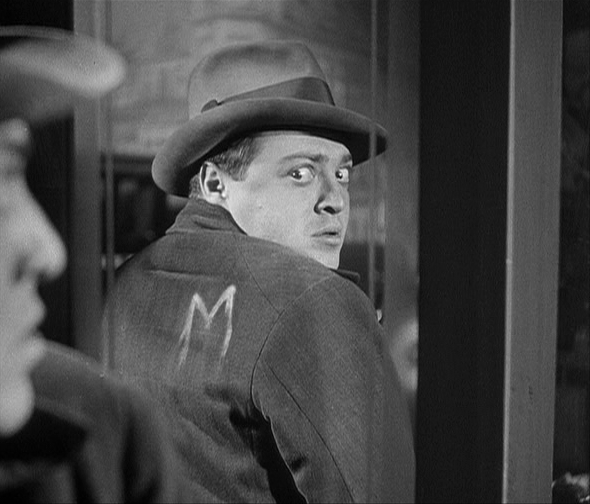
I rewatched M last year, Mark M For Murder, and was so struck by how modern it still seemed, not just thematically but visually as a thriller, I decided it would be perfect to show at the film club. And I was right. To see it on the big screen was a revelation. Watching it the way it was intended to be seen intensified its effect tenfold. It traps an audience as inexorably as the mob closes in on Hans Becker. There's nowhere to escape. A classic not embalmed in another time or place but still a live issue, a cinematic time-bomb.
Tuesday, May 8, 2012
Film Club Reviews #11

Is it possible to wipe the slate clean and start again, no matter how old you are or how many mistakes you've made. That's the question at the heart of Mike Mills' hopeful, bittersweet Beginners. Are we trapped by convention, age, sexuality, family history? When Oliver Fields' mother dies his father Hal shocks him by revealing his homosexuality. What follows is an education in tolerance and empathy. In the years left before he gets cancer Hal lives a life of freedom, true to himself at last, grabbing what happiness he can. It's an example his son struggles to follow. He meets Anna, a French actress, and embarks on a sweet if fraught relationship with her. It's funny, sad, slightly bewildered, people sabotaging their lives to avoid getting hurt. Nothing is easy for them. Mills fully understands the failure they're capable of, the emotional cages they've locked themselves into. Darkness is ready to flood in at any time. But the film's lightness of touch carries us through. It's visually witty, using Oliver's job as a graphic artist to break up the structure, give it narrative energy. This is how Oliver sees the world, looping memory, subtitled dogs, history as a series of rapid-fire montages. If it's undermined in places by hazy, liberal niceness and romantic scenes that flirt with tweeness, it gets away with it thanks to shaggy-dog charm and a seam of melancholy that runs through it like a grace note. Ewen McGregor's Oliver is a hurt child in a man's body, Christopher Plummer has the good grace to underplay a sure-fire Oscar role and Melanie Laurent's radiance carries Anna beyond the implausible. There are also brief flashbacks to childhood afternoons Oliver spent with his mother, Georgia, (Mary Page Keller) that are arguably the most effective and memorable in the film. So much hinted at, so much unsaid about a clearly talented woman going crazy with boredom, someone who didn't get a second chance.
Subscribe to:
Posts (Atom)