We began our new film club season with Marco Bellochio's extravagantly melodramatic Vincere, the story of fascist dictator Benito Mussolini's secret lover, Ida Dalser, who bankrolled his rise to power and conceived a son for him only to be denied once he'd achieved that power. A heady mix of sexual desire and political unrest at first, recreating the rise of fascism with newsreel footage and on-screen Futurist slogans, the film gradually resolves into a compelling study of one woman's bloody-minded refusal to let go of what she believes is her right and her son's. It's hard to know, though, whether to admire her or despair at her near-suicidal delusion. Giovanna Mezzogiorno can't quite generate the sympathy required to make us really care what happens to Ida. She seems spurned by power as much as love, robbed of her chance to lord it over the nation, to see her son heir to a new imperial dynasty. Which isn't to take away from Mezzogiorno's powerful performance or Filippo Timi's marvellous bug-eyed intensity as Mussolini. But for all the near-operatic passion of the story, its heightened emotions, what really stands out is Bellochio's bravura direction, mixing painterly composition with experimental daring to great effect.
I've
been trying to pinpoint where Cary Fukunaga's adaptation of Jane Eyre goes wrong. It's handsomely made with fine
location work and composition of shots, the performances are all strong
and it's properly cinematic. Upon reflection I think the screenplay is
the problem. There's too much to get in. Screenwriter Moira Buffini's
decision to start at a moment of dramatic crisis late in the book and
flashback to Jane's childhood is a good one but by the end too many plot
developments are left to get through in too short a time. It
feels rushed, a cascade of improbable incident. Which is a pity because
there's much to admire here. Mia Wasikowska is compelling as Jane, a
study of inner strength, restraint and vulnerability, one of those
performances that are all presence, the camera in thrall to her face.
Michael Fassbender has presence to burn in any role but give him
Victorian sideburns, riding breeches and a scowl and you're guarenteed
the business. His Rochester is less gothically mysterious than the book,
more distracted, burdened, a man made remote by the secrets he has to
keep. Judi Dench is reliably kindly and humourous as Mrs. Fairfax and there's fine support too from Sally Hawkins as nasty
Mrs. Reed and Amelia Clarkson as the young Jane. Add a great feel for
landscape and you have a film well worth seeing despite the rushed later
stages. I should add I was the only one who seemed to have a problem
with it. Everyone else loved it.
When
is a documentary not a documentary? When it's made by Werner Herzog of
course. There were rumblings of complaint after we screened Cave Of Forgotten Dreams
from some members frustrated with its refusal to lay out all the facts
in proper documentary style and thrown by its left-turn ending. The
thing is, Herzog isn't a documentary-maker as such, he's more interested
in the metaphyics than the facts, and the film should be seen as a
meditation on what the caves might mean and the kinds of people they
attract. The caves in question being the Chauvet caves in
Southern France, home to the oldest known pictorial creations of
mankind. As the public are unlikely to ever be allowed inside the caves
Herzog's film is an invaluable record of the wonders they hold. It was
truly spellbinding to see these drawings of horses, bison, lions and
rhinos emerge out of the darkness or a human handprint from thousands of
years ago, emblematic of human consciousness, the awakening of self
awareness and the transformative power of art. Some members felt because
we couldn't show it in 3D we shouldn’t have shown it at all, but
really, it didn’t need that. If your imagination can’t process the
wonder without the aid of visual Viagra then I’m sad for you. As usual
Herzog found odd characters, coaxed revelatory admissions from people,
and arrived at a conclusion involving albino alligators that was too
much for some. A nearby nuclear power plant has raised the temperature
of the local environment and caused evolutionary change in these
alligators. This is the same, Herzog seems to say, as what happened in
the caves, mankind made an evolutionary step forward, a mutation of
consciousness, due to changes in the environment. Whether you buy this
or not, there's no denying the experience of the caves, the sense of
time as both impossibly distant and mysterious and yet also immediate
and alive because of the way Herzog brings us close to the paintings and
they bring us close to the people who made them.
How to explain the anomaly that is Midnight in Paris?
Because lets be honest here, Allen has been in severe decline for over a
decade now. The last two of his films I’ve seen where Match Point and Vicky Christina Barcelona, the former a travesty the latter mildly diverting but lightweight and forgettable. (And the trailer for To Rome With Love
makes it look heart-sinkingly bad). And yet, here this is, a gem, a
throwback to Allen’s heyday, a film that could have been made in the
1980s, sandwiched between The Purple Rose of Cairo and Radio Days.
Sure it's cozy and soft-focused and doesn't engage with reality very
much but none of that matters. The fantasy prevails. Owen Wilson was
born to be an Allen surrogate and Adrian Brody’s Dali is arguably the
best five minutes of his entire career. The message of the film, that
every generation romantisises previous times, that these 'golden ages'
almost certainly didn't feel special to the people living them, yearning
as they were for their own idealised pasts, is undermined by the
experience of the film itself. Paris of the 20s does seem
golden here, an endless party, a moveable feast, full of
larger-than-life characters and mysterious muses, a young man's dream of
artistic nirvana revisited. It glows with sweet wonder.
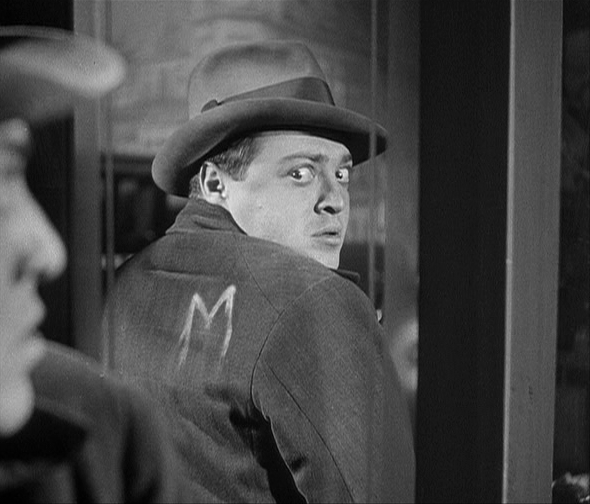
I rewatched M last year, Mark M For Murder,
and was so struck by how modern it still seemed, not just thematically
but visually as a thriller, I decided it would be perfect to show at the
film club. And I was right. To see it on the big screen was a
revelation. Watching it the way it was intended to be seen intensified
its effect tenfold. It traps an audience as inexorably as the mob closes
in on Hans Becker. There's nowhere to escape. A classic not embalmed in
another time or place but still a live issue, a cinematic time-bomb.
Is
it possible to wipe the slate clean and start again, no matter how old
you are or how many mistakes you've made. That's the question at the
heart of Mike Mills' hopeful, bittersweet Beginners. Are we trapped by
convention, age, sexuality, family history? When Oliver Fields' mother
dies his father Hal shocks him by revealing his homosexuality. What
follows is an education in tolerance and empathy. In the years left
before he gets cancer Hal lives a life of freedom, true to himself at
last, grabbing what happiness he can. It's an example his son struggles
to follow. He meets Anna, a French actress, and embarks on a sweet if
fraught relationship with her. It's funny, sad, slightly bewildered,
people
sabotaging their lives to avoid getting hurt. Nothing is easy for them.
Mills fully understands the
failure they're capable of, the emotional cages they've locked
themselves into. Darkness is ready to flood in at any time. But the
film's lightness of touch carries us through. It's visually witty, using
Oliver's job as a graphic artist to break up the structure, give it
narrative energy. This is how Oliver sees the world, looping memory,
subtitled dogs, history as a series of rapid-fire montages. If it's
undermined in places by hazy, liberal niceness and romantic scenes that
flirt with tweeness, it gets away with it thanks to shaggy-dog charm and
a seam of melancholy that runs through it
like a grace note. Ewen McGregor's Oliver is a hurt child in a man's
body, Christopher Plummer has the good grace to underplay a sure-fire
Oscar role and Melanie Laurent's radiance carries Anna beyond the
implausible. There are also brief flashbacks to childhood afternoons Oliver spent with his mother, Georgia, (Mary Page Keller) that are arguably the most effective and memorable in the film. So
much hinted at, so much unsaid about a clearly talented woman going crazy with boredom, someone who didn't get a second chance.
Terrific
exploration of masculinity from Susanne Bier, the modern mistress of
emotional filmmaking, the 21st century Nicholas Ray. Her films are about
love in all its complicated shades, the devastation it can cause, how
uncontrollable it is, how it can lead us into dangerous territory. In A Better World
starts with Anton, a doctor working at a refugee camp in a dangerous
African country where gangs mutilate girls and justice doesn't exist.
Back home in civilised Denmark his marriage to Marianne is heading for
divorce. They have two young sons, the eldest of which, ten-year-old
Elias, is being
bullied at school. Or he is until Christian, a new boy, defends him by
threatening the bully with a knife. Christian's mother has died of
cancer and he's a powderkeg of unresolved grief and resentment. When
Anton stops a fight involving his younger son, the other father, a
mechanic, slaps him in the face. Later he visits this man, with Elias
and
Christian, to show them he's
not afraid. But the mechanic slaps him again, Anton refusing to respond,
determined to prove he's the better man for rising above violence. But
the children don't see it this way. Christian persuades Elias that if
his father won't do something about this bully it's up to them to enact
revenge. And so things escalate. Along the way the plot resolves itself
in a somewhat contived fashion but the emotional journey earns it. These
are children, after all, perilously close to destruction, and we should
want them to survive. Bier and her regular screenwriter Anders Thomas
Jensen delight in taking
soap opera plots and infusing them with authentic detail. It's a
tightrope walk that doesn't always work but when it does the result is
vivid and engrossing filmmaking that asks questions of us few films get
close to. How do we
respond when our children suffer bullying and look to us for protection,
for schoolyard justice? How do men deal with violence in a civilised
society, the violence
they're confronted by and the violence inside themselves? What is
justice without retribution? How can we defend ourselves without
descending to the level of our attackers? This is acutely observed
cinema, filmed with big-budget panache and impossible not to
be moved by if you’re a parent, a father especially.
Based
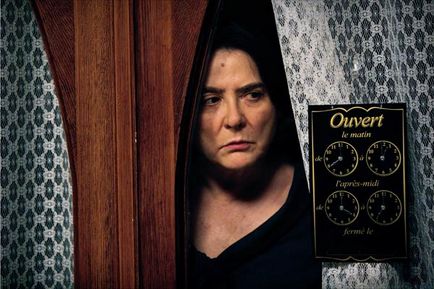
on the ''beloved'' bestseller, Mona Achache's The Hedgehog portrays the
lonely existence of Renée, a middle-aged, dowdy concierge in a
well-to-do Parisian apartment building and Paloma, the daughter of a
wealthy family in the same building who records her life with a video
camera and plans to kill herself on her twelfth birthday. In their own
ways they've both stopped believing in life. Then mysterious new tenant
Mr. Ozu arrives and they begin to see things differently. Ironically,
for a film that's all about hidden depth The Hedgehog has all the
intellectual riguor of a mind/body/spirit bestseller, full of
thumpingly obvious symbolism, never really engaged with existential
crisis, happy instead to set it up to be skittled by the power of love
or the easy uplift of a good old cry. Togo Igawa does wonders with that
cardboard paragon of Eastern virtue Mr Ozu, almost making him a flesh
and blood character and Josiane Balasko is excellent as Renee, her wary,
deadpan expression gradually revealing the sweet woman hidden beneath
the grouchy exterior. Life is worth living, the film tells us, if
you open yourself up to it, reveal the real you hidden inside. Which is
fine, of course, but does it have to be made explicit by a secret room
of books that constitute Renee’s true personality, a room with a door
that’s always closed. Just like her heart. She’s a hedgehog, y'see, prickly on the outside, but inside ‘she’s as refined as that falsely lethargic, staunchly private, and terribly elegant creature’.
(This from the mouth of an eleven-year-old). Appearances can be
deceiving then. Like this film which prides itself on being
philosophical, references the great art of Tolstoy and Yasujiro Ozu, but underneath the elegant surface it's just soft-headed trash dressed up in arty clothes, a so sad but so lovely experience for educated sentimentalists.
I'd like to think that the stunned silence that greeted the ending of Yorgos Lanthimos' Dogtooth wasn't just shock at its unpredictable violence and sex scenes but also that people were struggling to respond to a troublingly original film, one determined to confound expectations. This seemingly surreal story about a couple who keep their grown-up children isolated from the world in a walled compound on the outskirts of a city, has the unarguable clarity of a parable and the matter-of-fact courage of its low-budget convictions. It's about repression, social and family conditioning, language, trust, corruption, sex, violence and ultimately rebellion. It's a tribute to its marvellous deadpan that it could easily be used to argue opposing positions; that the parents are repressive monsters or that the introduction of outsiders into the controlled environment disrupts the previously blissful existence of the 'children'. Or possibly both. The one thing that's unarguable is the film's belief in the maleability of human mind, that without any frame of reference we are capable of believing anything, as easily conditioned and trained as dogs. However, throughout the film there are moments when emotional outbursts, sexual desires and natural curiosity find ways to express themselves. Not let out in normal ways, they find different, less socially acceptable ways to escape. It's nature vrs nurture as some kind of social experiment then, hinting at the contradictions and failures of Communist regimes or the repressiveness of closed religious communities. In this sense it has a lot in common with Haneke's The White Ribbon. But it's a very different film, funnier, stranger, a twenty-first century Bunuelian fable, as sharp and enigmatic as a razor blade, as hard to get rid of as a stubborn tooth.
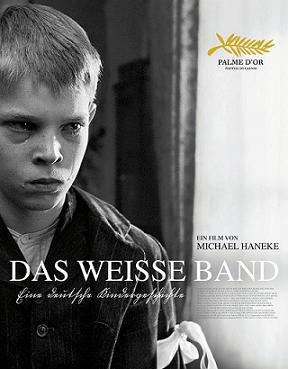
The second film of our winter season was in stark contrast to the first, (feelgood Irish documentary His & Hers). As always with Haneke much is left unsaid or hinted at with mysterious events threatening the status quo of seemingly normal society, in this case, a small village in Northern Germany on the eve of the First World War. Visually and thematically recalling the Scandinavian austerity of Dreyer and Bergman (but with a devastating frankness all its own), it also exudes a mise-en-scène mastery worthy of Hitchcock. And as with Hitchcock, at heart the mystery is a McGuffin, a means to darker moral ends. Haneke isn't interested in who kidnapped the children or burned down the barn, his real concern is in what these events reveal about family life and society at large. We watch religious repression and social conformity incubate violence and intolerance, ordinary youthful vitality and exuberance denounced in the name of idealised goodness. It's not too difficult to imagine these children twenty years later, conditioned by stern authority and desire for purity, voting for a regime promising them both. With stunning black and white photography capturing every child's face in vibrant close-up, faces brimming with confusion, hurt, trust and defiance, The White Ribbon will linger long in the mind.
1. Before I ever saw the film I saw this poster. A classic of graphic design. As soon as I laid eyes on it I knew I had to see the film. It radiated cool energy. And that title. At once a declaration of the film's style and the viewer's response to it. A promise and a boast. Stylish. Sexy. Breathless.
But its original title, A Bout de Souffle, translates as Out Of Breath. That's a B-movie title, slang for death, like Chandler's The Big Sleep. Consider if they'd used that as the English title instead. Would the film have attained such a cool reputation? Just imagine it on the poster. Stylish. Sexy. Out Of Breath. Suddenly it's not so much an intimation of awed wonder as middle-aged decline. My younger self probably wouldn't have been so impressed, but so what? Does it matter? A title's just a title, after all, a way of identifying one film from another. Sure, mostly, but it's not always that simple. Consider these titles for example: Stranger Than Paradise. Some Like It Hot. White Heat. Touch of Evil. Now each of these could, at a push, describe what happens in their respective films, but I don't think that's what's going on when we read them. They're not merely labels, they're suggestive, free-floating, haikus of compressed mood. Yes, a good title can define a film, capture its essence, but it can also add to it, deepen it, complicate it. It's a chemical reaction. Just think of the mysterious, symbiotic relationship we have with names and they have with us. Do they shape us, do we grow into them? If you don't believe this then consider these possible alternative titles for the films above; Losers. TransAmerica. Mother Love. The Mexican. Does it make a difference? It's hard to say, but this much is clear, the anonymous translator tasked with finding an English version for A Bout de Souffle clearly thought so.
2.The film of tomorrow will not be directed by civil servants of the camera, but by artists for whom shooting a film constitutes a wonderful and thrilling adventure. - Francois Truffaut
The famous dedication is to Monogram Pictures. Monogram were a poverty row studio specialising in cheap genre flicks, serials and westerns. So what was the attraction for serious French cinephiles like Truffaut and Godard?
Well, for starters, because they were largely ignored or unknown they were an undiscovered continent, ripe for reappraisal. They often relied on genre conventions, offering rich ground for theorising, for detecting encoded meanings, hidden ideas, themes build up across a body of work. Also because they had less to lose they could show the seemier side of existence more freely than bigger studio productions, the kind of exploitation subjects considered beneath proper art. The French saw passed all that bourgouis respectability, understood that the life of a petty thief could be as worthy of great art as the noblest king, that an absence of craft or style might represent a film's phychological meaning, its hard indifference to the lies of romance. They were the first to realise that serious artists could exist outside the mainstream, might find the fertile confines of genre more to their liking, might prefer playful indifference to highbrow pretention. But even the worst of these films taught them about innocent enjoyment, the pleasure of transformation, how much easier it was to bring the moves, clothes and dialogue into your life when they were ritualised, repeated, how cliches spoke to the yearnings inside ordinary people. By dedicating his film to Monogram Godard was sticking two fingers up at the industry, rejecting its middlebrow concerns with craft and rules, alligning himself with the outsiders, the dreamers, with those great American values of outrage, adventure and play. This is a game, he's telling us. We're playing here. So can you.
3. The famous opening line is: I'm an asshole, a provocation from the start, followed by a close up of a skantily clad girl on the front of a newspaper, lowered to reveal our hero, Michel, hat over his eyes, puffing on an enormous cigarette. He's cool, but posing too, a kid playing dress-up.
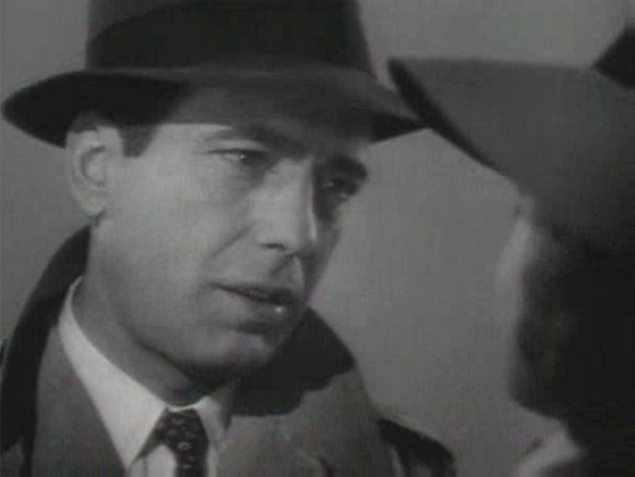
Then he runs the side of his thumb across his lips. It's a signal. To us. Thumb across lips. That's all it takes. Your Bogie. Your life is a movie. It's hard to appreciate now the impact of this message. A Bout de Souffle was the first film to acknowledge people's desire for movie grace in their lives, wanting their everyday existence transfigured by it, blessed with purpose and shape, ordinary personas imbued with unified glamour. You don't need to be famous, a star. The magic isn't out there somewhere, owned by producers, studios, agents, fans. It's in you now, once you've seen the film, it's yours, a gift, not a privilege. This is what cinema is, the democratisation of play. It's an evolutionary tool, teaching poor regional kids moves and gestures to help them escape impoverished lives, to face the twin terrors of adolescence and neighbourhood streets. After all, when you live in a non-verbal environment knowing how to stand on corners with cool indifference is a vital art. This is another thing the film is already telling us. The street is a movie set too.
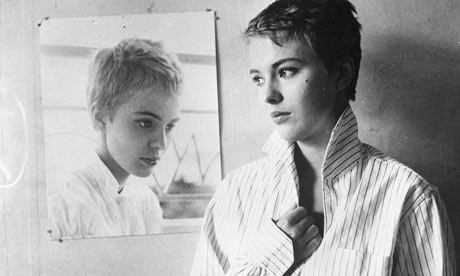
4. We first see Patricia ambling down the Champ-Elysees in her flat shoes, sweetly calling 'New York Herald Tribune! New York Herald Tribune!' She's played by Jean Seberg, proof that nationality is a notional concept at best. She's supposed to be the American chick but comes across, in her clothes, her manner, her cropped hair, as ineffably French. It's hard to imagine any other contemporary American actress playing the part, actually American but spiritually in tune with the Frenchness of the whole enterprise. (The film too is at once American in its conventions and French in its style and ideas.)
It was that way from the start. Her screen debut was as Saint Joan (1957), hand-picked from 18,000 hopefuls by Otto Preminger. It was Preminger again who brought her to France the following year to play the spoiled Celine in Bonjour Tristesse. The same year she married film director Francois Moreuil. By the time of A Bout de Souffle they were divorced and she'd taken up with French author Romain Gary, marrying him in 1962. Was it fate or inclination that drew her to the French and them to her? Or was it the hair? The gamine prettiness? Whatever it was, it went on, until her tragic, mysterious death in 1979, found dead in her car on the same Parisienne streets she'd watched Belmondo play dead on all those years before, back when they were all young enough to think of death as a romantic game, something to be bargained with.
5. Leaving Patricia behind Michel passes a poster for a film called Ten Seconds To Hell (1959), its tagline proclaiming 'Live dangerously till the end!'
It's a lovely moment, not just for the renegade cheek of using the poster without permission, but for the serendipity of it being there in the first place, articulating the film's key theme - defying death. (You know you're in the zone when the world starts to speak to you like this, send you secret messages, when you see connections everywhere, when you start to believe there's no such thing as a coincidence, that luck, in fact, is just fate in disguise).
6.Once you accept the rule of death thou shalt not kill is an easily and naturally obeyed commandment. But when a man is still in rebellion against death he has pleasure in taking to himself one of the Godlike attributes, that of giving it. This is one of the most profound feelings in those men who enjoy killing. - Ernest Hemingway, 'Death in the Afternoon'
'It is solely by risking life that freedom is obtained,' Hegel wrote, somehow defining the essence of A Bout de Souffle over a century before it was made. The spirit of the film may be its exhilerating sense of freedom, it's jazzy liberation from social, artistic and cinematic conventions, but it's also obsessed with death, from its title to its conclusion. Or rather, with invoking it in order to feel more alive. If the taking of life could, as Hemingway suggests, ward off your own death, than so could acting it out. In this sense, the film is as ritualistic as a bullfight, a bloodless rebellion against death. Just as ancient Greek rites evolved into formalised drama, the death of a tragic hero offered to the gods rather than the sacrifice of a goat, so too with cinema. It may be a game, Godard suggests, but it isn't frivilous. It's as serious as any religion, as vital to our happiness as freedom itself. It was a message that hit the new decade like a molotov cocktail, starting a creative blaze that lasted twenty years and engulfed the old Hollywood studio system in its wake.
7. 'What is your greatest ambition?' Patricia asks the novelist (played by director Jean-Pierre Melville) at the kind of pretentious press conference only the French would have. 'To become immortal', he replies, looking straight into the camera, 'and then to die'.
It's a joke, a contradiction. He might as well have said his ambition was 'to wake and then to dream'. It's an impossibility, mutually exclusive states, waking/dreaming, immortality/death. Except, of course, there is one place where the impossible can happen. When we watch a film, especially in the dark of a cinema, what else are we doing but dreaming while still awake? And when we watch the great stars of the silver screen like James Cagney, Bette Davis or Steve McQueen, what else are we doing but watching the dead walk again, forever alive in their films, made immortal by them?
8. Which is what Bogart represents in the film, not just a role model but an icon of immortality. Dead only three years when A Bout de Souffle was made, already he's becoming a cult, his moves, clothes and dialogue remembered, repeated and fetishised.
But why Bogie? What was it about him that so obsessed the French? Maybe he was, in some way, more French than other Hollywood stars, more ironic, fatalistic, ugly? Maybe the characters he played, men with secrets, with shadowy pasts, were more in keeping with a nation haunted by defeat, collaboration and existential dread? Whatever it was it went deep, just think of the hats and coats in Melville's own films like Le Samourai.
Of course, the Bogart of The Maltese Falcon, Casablanca and The Big Sleep was also the coolest man on the planet, a dream of tough grace under pressure. He crystallised the essence of cool long before Brando and Dean turned up, a man's cool, not a grumpy adolescent's, someone who's lived, seen things, been betrayed by events, by his own heart, hides his honour like a dirty secret. But we know it's there, we know he does care, does know which side is right, he just won't be played for a sap anymore. Being a man, he seems to say, is a moral act. If you don't know how to read people, if you don't know when to keep quiet, if you don't understand that sometimes cynicism is just the truth no one wants to hear, then you deserve what you get, you leave yourself wide open, cannon fodder for conmen, Nazis and certain kinds of women.
9. Then there's the lovely extended scene in Patricia's apartment. She arrives home to find Michel in her bed. What follows is spontaneity, calculation and natural light, cultural allusions everywhere. She poses before a poster of Renoir's Mlle Irene Cahen d'Anvers and asks who's the prettier. He caresses her bum and asks can he piss in her sink. She washes her feet and tell him she's pregant. He sits beneath a Picasso figure wearing a mask. She quotes from The Wild Palms by William Faulkner: 'Between grief and nothing, I will take grief.' Michel says he'd choose nothing. 'Grief', he adds, 'is a compromise'. They talk, flirt, test each other and eventually make love, fumbling under the covers like kids, not sure what their parents really do under there.
The claim that capturing Seberg's beauty on film matches Renoir's achievement on canvass is hardly worth noting now. But it's a reminder of a time before the triumph of popular culture when film was considered an upstart medium, devoid of true craft, a nickelodeon distraction for immigrant hordes and over-excited housewifes, not something to be taken seriously as high art. This was the fight Godard, Truffaut and the rest of the Cahiers du Cinéma critics were waging in the late 50s, rescuing great artists like Hitchcock and Hawks from the neglect this pompous snobbery had consigned them to.
And what about Michel's claim that grief is a compromise? Is it an existential statement, like Beckett's 'every word is like an unnecessary stain on silence and nothingness', or is he just trying to sound cool. Is he suggesting that emotions are a refuge, a refusal to accept the truth? It's an interesting idea in an age when personal grief has become everyday currency. Would Bogie give in to grief, cry and wail, take to his bed, sell his story to the tabloids? No, he wouldn't. He'd take it inside him, order a drink, light a cigarette, another lesson learned, another test passed. The cigarette is vital of course. Just consider how important they were in all this. Michel smokes non-stop throughout the film. Even his dying breath is a puff of smoke. Can you imagine a time when smoking was this cool? When things weren't ghosted by consequences, by health warnings, when people drank at work and smoked in cinemas, weren't constantly fretting about their health, short-changing their youth for a few extra years at the end? When looking cool now was more important than being alive then? It's all about how you look, y'see, masks, uniforms, encoded signs, the transformative power of objects and faces. 'The mystery of the world is in the visible, not the invisible,' as Oscar Wilde rightly pointed out. Open your eyes (and dream). We're being movie stars here. They're immortal. They never die of cancer or liver failure.
10. 'The film of tomorrow will be an act of love - Truffaut
Above all it's a film about love, love of cinema, love of life through cinema. There really was no difference to these young men. Cinema was life. Watching a beautiful woman and capturing her on film was the same thing to them. It was very chauvinistic, of course, but very romantic too (essentially the same thing). Romance has no time for feminist aspirations. It wants to be taken out of this crappy world, wants to idealise, heighten, improve. It's foolish, a youthful folly, but where would we be without it?
For a few brief years, as the world woke up from it's post-war slumber, a handful of young men believed that cinema was the new language of happiness and truth. A Bout de Souffle bottled that moment. It's a time machine. The spirit and energy of that moment can be revisited every time you watch it. You could even say it's immortal. Or to put it another way: Devil in the Flesh. Rififi. And God Created Woman. Scarface. A Bout de Souffle. The best film around.
1. Just think of the ways it could've gone wrong, the cheery lie it could've been, ticking all those lovely Oprah buzzwords along the way; feelgood, life-affirming, heart-warming. This is the danger you invite when making a film 'about' happiness of course. Isn't happiness shallow and delusional? Isn't the greatest art edgy and dark, gazing unflinchingly into the existential doom of it all? Happy films, by contrast, are for undemanding children and maiden aunts, those for whom life is merely a series of illustrated Hallmark slogans.
2. Notice, however, the subtle but crucial difference between happy and happy-go-lucky. One's a fleeting emotion, the other's a state of mind. One's something you aspire to, the other's a question of character. Poppy is thirty, no boyfriend, no kids, no mortgage. She lives with her best friend Zoe in a rented house, works as a primary school teacher. She's managed to avoid most of life's responsibilities up to now while retaining her independence of spirit. How can she carry this on into her 30s and beyond? Isn't it inevitable life will wear her down, that her youthful exuberance will wane? The film seems to ponder her on the cusp of all this. It's both a love letter to and a kind of elegy for a way of life that soon may disappear forever.
3. ''I think the bravest thing you can do in the world today is be happy...The people I most admire are those who’ve got the guts to face life, and deal with it, and live it completely down to their toes, and not escape anything....''
Bjork could be defining Poppy's world-view there. It's brave to be happy in a world that's trying to break your spirit every day, as long as you face life honestly that is. Being mindlessly happy, ignorant of life's complexities, unfairness and drudgery is, on the other hand, the delusional refuge of a prize ninny. Poppy isn't like that, although a lesser actress might have failed to find the moments of soulful doubt needed to offset the irreverence, those brief glimpses of wistful acknowledgment that let us know how hard it really is to keep this blithe optimism going.
4. ‘‘Real happiness comes from things that deserve gravity. There’s no punchline to those things. Moments of happiness aren’t light-hearted. If you watch people fucking, it doesn’t look like they’re trying on a joke.’’
It's a commonplace default position for many would-be intelligent people to view optimism and happiness as a kind of dereliction of duty, a failure to take THE TRUTH seriously. And they have a point of course but maybe there's a counter-argument to be made, as in the quote above by Kristen Hersh, that only taking dark subjects seriously is a pose, a crutch for immature minds. Maybe it's only the truly serious who appreciate what a grave business happiness can be, the pursuit of it, the experience of it, the preservation of it.
5. Don't get me wrong here, though. I enjoy being as grumpy as the next man. I'm not suggesting all the shiny happy people march on the Heartbreak Hotel and burn it to the ground. Oh no, far from it. I worked in a shop once where we had to endure some management consultant from the States trying to instill into us this idea of PMT, positive mental attitude. I couldn't imagine anything worse, still can't. It a fatuous lie, a way for the bosses to keep us in our place, happy with our lot, dreaming the American dream as our souls calcify. Being cynical, angry or fed up are all vital human emotions, it's just they're not necessarily better than the happy ones, don't automatically occupy the moral high ground.
6. I read a few years ago about a survey of American poets which found that the vast majority of them had never learned to drive, completely at odds with the general population. Poets, of course, are renowned for retaining a more childlike view of the world, necessarily seeing it as if for the first time. These two things then, retained innocence and refusal to learn to drive, are surely connected.
Notice we first see Poppy merrily riding through the city on her bike. She's never learned to drive either. But then her bike is stolen and finally she gives in, decides it's time to learn. It says a lot about the position cars have in our society that they've become so linked with our ideas about growing up. Your first car is a milestone, an initiation rite of passage, one of the first wrungs on the ladder of adulthood. Anyone who reaches their 30s and still hasn't learned to drive is viewed with, at best, bemused incomprehension. But instinctively some people avoid them because they don't want to climb that ladder, are perfectly happy where they are thank you very much. They don't want to grow up, or at least not in the way every one else does.
7. So Poppy starts driving lessons with a ball of barely suppressed rage called Scott, whose flimsy grasp of sanity rests on his belief in his abilities as a driving instructor. But Poppy doesn't take him seriously from the start, openly incredulous of his rules and rants. Poor Scott gets more wound-up with every lesson, bellowing En-ra-ha! at every turn, infuriated by her refusal to take anything he says seriously. Here, in fact, her blithe indifference is close to mockery.
It's a mark of the film's emotional intelligence that when Scott inevitably loses it, pulls Poppy's hair, explodes in an irrational, hate-filled rant, we kind of feel sorry for him. It doesn't negate how thoroughly wrong he is, how paranoid, racist and damaged he is, to see the bullied boy he once was/still is, how once we let grievance and self-pity in, it can eat us alive.
8. All this is funny of course. In fact, it's easy to imagine the Poppy/Scott scenes as a 30s screwball comedy set-up. Uptight, life-shy instructor has his world turned upside down when carefree hieress Poppy jumps into his car (by accident of course). Happy-Go-Lucky could be an exercise in seeing how a screwball heroine would cope in the real world. Carole Lombard, say, or Katherine Hepburn, could have played Poppy with that blithe indifference to consequence that is the hallmark of the screwball actress. Which would make Scott the kind of shy doofus usually played by Cary Grant or Gary Cooper, except with bad teeth and panicked eyes. This is what it means for men like this to really have their lives invaded by feminine chaos. Rage and fear are the secret subtext of all screwball comedies.
9. Poppy is concerned about the happiness of others. She's compassionate, wants to help people like the young boy in her class being bullied at home. It's a desire that can make her stray into areas she shouldn't, though, like her encounter with the homeless man. Coming home on her own at night she hears his mutterings and goes to investigate into a dark, deserted clearing behind some buildings.
It's crazy, halfway unbelievable, and ultimately mysterious. It's the heart of the film really. One of those rare scenes that don't tell you what to think. What does it mean? Is this her possible fate? The fate of all good-hearted people, to be broken by life, hiding in the shadows from the rubber knocker man?
10. Mike Leigh's created some annoying women in his career, a gallery of wittering, over-mannered characters going all the way back to Alison Steadman's iconic turn in Abigail's Party (1977). And Poppy could have been another one, to rank with the nadir of this tendency, Katrin Cartlidge and Lynda Steadman's epic competition to see who could out-quirk the other with headflicks and facial tics in Career Girls (1997). Seriously, I still wake in a cold sweat some nights thinking about it. But thankfully, the brilliant Sally Hawkins managed to take in all the usual Leigh characteristics while still creating a living, breathing human being, an intelligent woman determined not to take life too seriously, to laugh at it, take the piss, despite being perfectly aware of how truly serious it really is.
Here at the film club we've endevoured to show good documentaries from the off. My club compadre, in particular, is an enthusiastic advocate for them. And while I nearly always enjoy them, I have to admit they don't float my boat as much as a truly great fictional movie does. I don't really know why. But as we're showing three documentaries this season, it's made me think about my response to them which is, not ambivalent exactly, but certainly not as openly moved and provoked by them as others seem to be. So why is this? Well, maybe it's this strange place they occupy between reality and artifice. The first film we showed this season was a case in point, Anvil: The Story of Anvil.
As enjoyable and amusing as it undoubtedly is I came away with these nagging questions. For starters, was it all an elaborate hoax? No, it's clear Anvil were an 80s metal band who fell by the wayside. Oh good, so it's all real then. Well, hmmm, is it though, or were the filmmakers, under the cover of this reality, playing fast and loose with events, manipulating them to make a better narrative arc? Were they exploiting these guys for comic effect, either by editing it that way or setting up semi-improvised scenes of deadpan farce? And the question hovering over all others, if they were doing this, was that a bad thing? Didn't it result in a hugely enjoyable, uplifting film? Yes, it did. So what's the problem? I don't know exactly, mysterious accusatory voice in my head. Maybe this vague sense of being manipulated stops me fully giving myself up to films like this. The documentary form asks you to take what you see at face value, that's the unspoken contract of the genre, telling it like it is. But the truth is subjective at the best of times and film is an artful construction, edited for effect. But if it's not real then our emotions are being toyed with, right? In Anvil we're being asked to care about these people, their desperate last-chance attempts to make it big. Our response is naked, human, with no fictional safety net between us and it. Reacting like this is clearly more complicated than with the usual film experience.
Maybe that's a good thing, sure, but maybe in a culture hamstrung by human interest angles and you-too-can-achieve-your-dream cliches it invites us to indulge in the kind of easy emotional catharsis we haven't earned, disarmed under the guise of documentarian truth? I mean, what is Anvil saying? That the human story behind any phenomena is more important than the quality of that phenomena? Persist long enough and almost anything becomes loveable? Do we admire Lips and Robb? Aren't they just heavy metal versions of the deluded losers on X Factor, hanging on like those Japanese soldiers on islands still convinced the war is going on? Is it admirable they continue to follow their dream? If you knew them would you be proud or embarassed? We've clearly become a culture obsessed with 'reality', with true life stories, memoirs, reality TV. It's hardly a stretch to see the rise of the documentary as being part of this trend. It's like there's been some kind of collective failure of imagination in the world and a creative cowardice along with it. Here's what I think: if you have a good story, fictionalise it. It's what truly creative people do, as opposed to what exibitionists do. Fiction allows the reader/viewer to identify, enter in to, become part of the experience. The memoir/documentary often encourages passive gawping. It's a one-way system with only room for the people involved. It's their story, not yours. Maybe that's it. Either give me the banality of the truly real or the fully immersive artifice of fictional worlds where we can explore our fears, fantasies, ideas and so on rather than just being spectators at someone else's. (The exception to all this was Man on Wire. A film where the thriller aspect was up front and part of the package. Real life had taken on the contours of a film and the documentary exploited that brilliantly. Plus, the tiny figure of a man on a wire thousands of feet in the air is an image so pregnant with awe and metaphor it's beyond manipulation, like something from a Greek myth).
Jean Vigo was the first poet of modern cinema. Of course there were great directors of the silent era like Murnau and Lang, but their emotional range was rarely much above Victorian dime-store romances, morality plays or crime novels. Vigo was different. He brought a modern indifference to absolutes and types, a dreamer's knowledge of inner states, a realist's understanding of the complexity of desire and a romantic's eye for the beauty of industrial landscapes and plain country girls. And he did all this with just one full-length film, L'Atalante, the first film we showed when we began the film club in 2007. A statement of intent. Either you understood or you didn't. Not that we picked it for that reason but it worked out that way. Many of the 120 people who turned up clearly thought we were resurrecting the old film club and all the social implications of that. What they got were two relative nobodies with poor networking skills and absolutely no snob value at all. Oh and a film often voted one of the best ever made. Shouldn't that have been enough? Maybe they couldn't see passed the love of mood over contrived drama, maybe it didn't tell them what to think, or maybe it just didn't pander to the kind of romantic narrative we've become used to, the kind perfected at much the same time by Frank Capra in It Happened One Night.
Pretty heiress on the run meets tough-guy reporter and they bicker all the way to a happy ending. In fairness, it's a great film, but it ends where real life takes over, before the question can be asked. How could these two live together after the adventure of their 'meet cute' has ended? L'Atalante begins there. The happy couple, marching through the village on their wedding day. It's the kind of procession that would end a Jane Austen adaption. But it's part of this film's emotional realism to want to explore the difficulties of maintaining love after the inital flush of romance. The courtship has obviously been swift. This girl trapped in a small village dreaming of escape meets a handsome(ish) bargeman. It's surely part of the attraction for her. The excitement of escape. But soon the monotonous day to day routine of barge life begins to bore her and resentment grows towards her husband for not being whatever she imagined him to be. Add in the unsettling, brute presence of the old seadog, Jules, fascinating and frightening her with his tattoos and gruffness, and it's not surprising her head is turned by another man and dreams of big city life.
It's a river journey film, (name me a bad one), with water as a symbol of poetic vision, a metaphor for the search for love. And it's full of the shyness and yearning of desire. But unlike Murnau's Sunrise, say, L'Atalante locates sexuality within the marriage not outside it, another sign of it's modern sensibility. Tragically Vigo died soon after making this, the original DNA of European cinema, as if its perfection left him with nowhere else to go. We should all be so lucky to leave behind such a fitting epitaph.
One of the finest french films of recent years. It's a remake, of course, of James Tobruk's 1978 movie Fingers which starred the young Harvey Kietel. So why's this so good. Well, first, second and last, there's the star, Romain Duris. He's dynamite in this. It's a star-making turn. He's got to be convincing as a thug-for-hire, flushing illegal-immigrants and squattrers out of buildings and, at the same time, a former piano prodigy trying to rekindle his career. It's borderline absurd and only an actor seething with poetry and violence could pull it off. Kietel, of course, had it in his prime, wandering the mean streets with god and redemption in his soulful eyes. Duris is just as good, if not better. Moody and hypnotic, he gives a performance that's not only intensly physical, but also loaded with wary emotions, private thoughts and twitchy fingers. He's not likeable but you ache for him nonetheless as he can't quite reach the sensitivity required to be a great pianist. Maybe it's been brutalised out of him or maybe he never really had it. Maybe it's just a relic of his past, a way of keeping his dead mother's memory alive. Whatever it is, the anger inside won't let him relax. He insists on hounding the music into submission. Meanwhile his gangster life isn't going away either. Jacques Audiard's direction is superb, all smeary neon and late-night faces lit by muted, dashboard lights. Edited with loose-limbed brilliance, it's a cool urban noir and an engrossing meditation on the mystery of talent.
This just makes me happy. The sounds, the blissful atmosphere. Watching it makes me feel like I've been on a holiday, like I've spent a week in another carefree world, so perfectly does it create time and place. I feel refreshed and full of good cheer (ok, so not like a real holiday then, but you know what i mean.) After all, what more could you ask of a film, of any great art, than that it create a perfectly realised world, which exists in its own sweet bubble of eternity?And I haven't even mentioned how funny it is. Hulot's unique tennis serve, the animal rug caught on his boot spur, the numerous instances of simple but perfect slapstick, missed steps, squeeky doors, collapsing canoes. What Tati seems to have understood (unlike the Mr Bean ripoffs) is it's Hulot's sublime impeturbability, his oblivious good nature that makes it so funny. We're not laughing at him, it's not a film version of funniest home movies. We don't pity or dispise him (as i expect even his creators do of Mr Bean), we love Hulot. May he always be on holiday, pipe at a jaunty angle, funny car barping along country roads, pretty girls playing idyllic music from hotel windows, the sea whooshing dreamily in the background. And as long as this film exists, he always will.