
Edgar G. Ulmer is a fascinating character in film history, a talented man on the verge of a successful career exiled to the world of poverty-row b-pictures because he fell in love with the wrong woman. Could be a noir plot in itself, of course, which might explain why Detour stands up as one of the great noirs despite its manifest cheapness. 'No matter what you do, no matter where you turn, fate sticks out a foot to trip you up,' Tom Neal's hapless narrator tells us, and you can imagine Ulmer identifying with that. The film has the fevered compression and illogic of a nightmare married to location realism (cheap road-side diners, motels etc). Nobody in this film has star charisma. Ann Savage is an amazing presence but her Vera is every inch an ordinary woman driven to the edge by disappointment. Lord knows what she's had to endure but Savage manages to imply a world of desperation and pain. Like an animal mistreated once to often she'll bite the next hand that comes near. She's not going to let anyone get the better of her again, gonna take whatever chance comes her way. She's a monster, a rabid Bette Davis, the American Dream going crazy before our eyes, and the main reason (though far from the only one) to see this lo-fi cult classic.
2. Gun Crazy (1950)

Another unheralded actress delivers an even better performance in Joseph H. Lewis' Gun Crazy. Peggy Cummins isn't exactly a house-hold name, even for fans of classic movies, but she's sensational as carnival sharpshooter Annie Starr. We first see her haloed with fire, a warning if ever there was one. But gun-obsessed Bart Tarr (John Dall) fails to heed it. Instead he's like a horny moth to her flame. 'We go together, Annie,' he tells her later, 'I don't know why. Maybe like guns and ammunition go together'. It's noir fate then, but Gun Crazy is more than a standard noir and Cummins more than a femme fatale. She takes over the film, hijacks it. She's on fire, alive with heat and scheming energy, with outlaw lust, a hipster revolutionary out to play the system by its own game. She may say 'I've been kicked around all my life, and from now on, I'm gonna start kicking back', but you get the feeling grievance is only a small part of it. This is one dame who's been ready to go off for a long time, maybe forever. Sure she wants money, but more than that, she wants action. The sexual thrill of guns, of danger, of death. That's what's really turning them on, a death-wish so strong they can hardly resist it. It's the essense of American cinema; guns and cars, sex and death - living for the moment. And Lewis shoots it like that, with great verve and vérité energy. It's New Wave ten years before Godard, the camera hurrying through real locations, watching from the back seat of moving cars. It puts us right in the moment, especially during a one-take bank robbery that's arguably the greatest single-take scene in all of cinema, small-town streets a panicky blur as they screech around corners, the moment alive with giddy tension. By the end it's transcended its genre, no longer noir, but something more vital and tragic, a Freudian parable, an essential cinematic credo: Thrill crazy. Kill crazy. Gun Crazy.
3. The Big Combo (1955)

Five years later, Lewis delivered another cult gem, but this time the noir conventions are adhered to throughout. All the earlier film's energy and movement are gone, replaced by a stylized, shadowy mise-en-scene that comes close to abstraction. The cinematographer is John Alton, the Rembrandt of noir cinema, the man who literally wrote the book on lighting. It's hard to imagine Lewis daring to shoot on the hoof when Alton was painstakingly setting up the visual geometry of a shot. The result is weapons-grade noir, a world where it's always nighttime, where talk is hardboiled poetry and cops are dogged loners on a mission. It's lifted above the routine, though, not only by Alton's lighting but by the performance of noir-stalwart Richard Conte, fantastic as mouthy gang boss Mr. Brown. He's having a ball rattling out killer dialogue ('Joe, tell the man I'm gonna break him so fast he won't have time to change his pants,') high on his own sense of invincibility, smarter and more ruthless than the mugs around him. Cornel Wilde is suitably weary and dour as Brown's nemesis, Detective Leonard Diamond, but it's hard to warm to him. This is probably what denies the film classic status, the elevating persona of a star performance. (Compare Wilde, say, to Glenn Ford in Fritz Lang's The Big Heat, made two years earlier and very similar in plot and characterisation, where Ford brings a charismatic righteousness to his role that Wilde can't match, a sense of the film's moral universe flowing through him.) Unlike Lang, though, Lewis didn't seem interested in a moral universe. As in Gun Crazy, characters are motivated by instinct and desire. It's an amoral tone that sets the film apart even as it's undermining the plot. We don't really care about Diamond's crusade because Lewis doesn't either, he's having too much fun with the baddies, more alive and vital because they've embraced instinct instead of fighting it. There's an almost gleeful air of perversity, a nasty, unsettling edge that sets the film apart. Brown's henchmen, Fante (a super-cool Lee Van Cleef) and Mingo (Earl Holliman) are clearly meant to be homosexual and the crimelord's classy moll, Susan Lowell (Jean Wallace) stays with him mainly because she gets off on being treated rough. For Lewis, sex is at the heart of the action once again, characters are defined by it, their sexuality as inescapable as any noir fate.
4. Black Legion (1937)
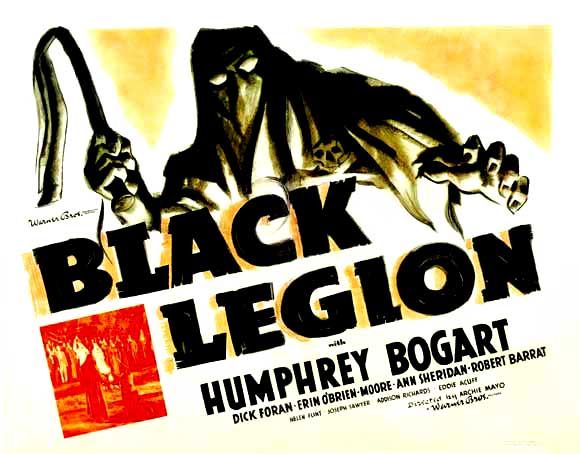
Interesting early Bogart. He plays a factory worker called Frank Taylor who joins a 'pro-American' secret society called the Black Legion when he loses out on becoming foreman to a Polish-born immigrant. The organization is a version of the Ku Klux Klan complete with mumbo-jumbo initiation rites and black robes who intimidate, torture and kill those they believe are taking their jobs. Behind them are shadowy right-wing industrialists hoping to use them for their own ends. As his involvement deepens Frank's marriage crumbles and he turns on his best friend. It's a cautionary tale fresh from the headlines that still retains its power today. There really was a Black Legion and the film is based on an actual killing that took place a few years earlier. Shot in real working class locations it's an unflinching look at the dark side of 30s America, the heart of fascism lurking, anti-foreigner agitation. (It would make a great double-bill with Lang's Fury.) While not a great film it is a fascinating one, a real eye-opener. You just don't expect 30s films to be this realistic, to face up to this kind of ugly truth. Archie Mayo is no-one's idea of a great director but he was a veteran of the cheap potent style of Warners pre-code films and brings an unfussy realism to proceedings, happy to follow the script and get as much in as the Hayes Code would allow, which turns out to be quite a lot. He also directed The Petrified Forest (1936) which saw Bogart make his debut as gangster Duke Mantee, so was possibly responsible for getting him the part (the producers originally wanted Edward G. Robinson). Whatever way he became involved it's a key film for Bogart. You can see him discover the satisfaction of exploring flawed characters, their meanness, paranoia and self-delusion, a seam he would continue in later films like The Treasure of Sierra Madre and The Caine Mutiny. And the film doesn't sugar-coat Frank's involement in this fascist group. For a while he relishes it, high on the power, the late-night adrenaline, admiring himself in the mirror as he holds a gun for the first time, imagining himself in a film (the pre-echoes of Travis Bickle are there). It's a tribute to Bogart's skill as an actor that we retain some semblance of sympathy for Frank by the end. The story received an Oscar nomination and the National Board of Review named it best film of 1937 and Bogart best actor. It should have been his breakthrough but he had to endure four more years of playing second fiddle to Cagney and Robinson before High Sierra finally made him a star. Black Legion should've been it. A must-see for all Bogie fans.
5. You Can't Take It With You (1938)

The Capra Problem was in full effect by 1938, a soft-headed belief in the folksy goodwill of 'ordinary' people. Capra the artist was always at war with Capra the idealist, so the bad things in the world were given their due, Capra understood full well the malign forces in the world, the small-mindedness and greed, (his films keep coming back to them) but he choose to believe that community could overcome it, that simple human empathy would set an example that would save the Republic from ruin. (By 1946, the nightmare seemed so much closer, it was called Pottersville, and the dream of community was so much more feverish and desperate). But this sentimentality always seemed at odds with the darker forces of his films, contrived, something willed and false, as if Capra himself didn't really believe it, or feared he didn't. Here powerful businessman Anthony P. Kirby (Edward Arnold) needs to buy one more house in a twelve block area to build a munitions factory in advance of the war that's coming. How's that for cynical. Only problem is the house belongs to Martin 'Grandpa' Vanderhof (Lionel Barrymore) and he isn't selling. This loveable eccentric has renounced the world of work and money and turned his home into a menagerie of impractical kooks and dreamers. The only 'normal' member of the family is his grand-daughter Alice (Jean Arthur) who works as secretary for Kirby's son Tony (James Stewart). Unaware of the conflict developing between their families Tony and Alice proceed to flirt and fall in love. And so the coming together of the Vanderhofs and the Kirbys is set in motion. It's the stuff of stage farce and romantic complication, sure, but it's also an essential American conflict, money versus freedom, conformity versus rebellion, those who believe in and profit from the system verses those who turn their backs on it, not so much the haves and the have-nots as the haves and the want-nots. Despite this ideological battle the film teeters on the edge of being 'quirky' or 'kooky' or any of those dread words. Only towards the end does it fall over that edge completely. And yet, there's a delicately played romance between Stewart and Arthur that's so good you'll wish there was more of it, some precient speeches about fear and a couple of genuinely funny scenes. As so often with Capra, there's much to like, much to chew over in his contradictions and failings. Live your life for yourself, be true to yourself, there's more to life than money. All these platitudes are true but they don't make great art. Telling a banker he's a bad father and getting him to play the harmonica will not change American capitalism no matter how much Capra wants it to. If only it was that easy.


