Showing posts with label last five films you've seen. Show all posts

Tuesday, October 25, 2011

Last Five Films...

1. Detour (1945)


Edgar G. Ulmer is a fascinating character in film history, a talented man on the verge of a successful career exiled to the world of poverty-row b-pictures because he fell in love with the wrong woman. Could be a noir plot in itself, of course, which might explain why Detour stands up as one of the great noirs despite its manifest cheapness. 'No matter what you do, no matter where you turn, fate sticks out a foot to trip you up,' Tom Neal's hapless narrator tells us, and you can imagine Ulmer identifying with that. The film has the fevered compression and illogic of a nightmare married to location realism (cheap road-side diners, motels etc). Nobody in this film has star charisma. Ann Savage is an amazing presence but her Vera is every inch an ordinary woman driven to the edge by disappointment. Lord knows what she's had to endure but Savage manages to imply a world of desperation and pain. Like an animal mistreated once to often she'll bite the next hand that comes near. She's not going to let anyone get the better of her again, gonna take whatever chance comes her way. She's a monster, a rabid Bette Davis, the American Dream going crazy before our eyes, and the main reason (though far from the only one) to see this lo-fi cult classic.

2. Gun Crazy (1950)


Another unheralded actress delivers an even better performance in Joseph H. Lewis' Gun Crazy. Peggy Cummins isn't exactly a house-hold name, even for fans of classic movies, but she's sensational as carnival sharpshooter Annie Starr. We first see her haloed with fire, a warning if ever there was one. But gun-obsessed Bart Tarr (John Dall) fails to heed it. Instead he's like a horny moth to her flame. 'We go together, Annie,' he tells her later, 'I don't know why. Maybe like guns and ammunition go together'. It's noir fate then, but Gun Crazy is more than a standard noir and Cummins more than a femme fatale. She takes over the film, hijacks it. She's on fire, alive with heat and scheming energy, with outlaw lust, a hipster revolutionary out to play the system by its own game. She may say 'I've been kicked around all my life, and from now on, I'm gonna start kicking back', but you get the feeling grievance is only a small part of it. This is one dame who's been ready to go off for a long time, maybe forever. Sure she wants money, but more than that, she wants action. The sexual thrill of guns, of danger, of death. That's what's really turning them on, a death-wish so strong they can hardly resist it. It's the essense of American cinema; guns and cars, sex and death - living for the moment. And Lewis shoots it like that, with great verve and vérité energy. It's New Wave ten years before Godard, the camera hurrying through real locations, watching from the back seat of moving cars. It puts us right in the moment, especially during a one-take bank robbery that's arguably the greatest single-take scene in all of cinema, small-town streets a panicky blur as they screech around corners, the moment alive with giddy tension. By the end it's transcended its genre, no longer noir, but something more vital and tragic, a Freudian parable, an essential cinematic credo: Thrill crazy. Kill crazy. Gun Crazy.

3. The Big Combo (1955)


Five years later, Lewis delivered another cult gem, but this time the noir conventions are adhered to throughout. All the earlier film's energy and movement are gone, replaced by a stylized, shadowy mise-en-scene that comes close to abstraction. The cinematographer is John Alton, the Rembrandt of noir cinema, the man who literally wrote the book on lighting. It's hard to imagine Lewis daring to shoot on the hoof when Alton was painstakingly setting up the visual geometry of a shot. The result is weapons-grade noir, a world where it's always nighttime, where talk is hardboiled poetry and cops are dogged loners on a mission. It's lifted above the routine, though, not only by Alton's lighting but by the performance of noir-stalwart Richard Conte, fantastic as mouthy gang boss Mr. Brown. He's having a ball rattling out killer dialogue ('Joe, tell the man I'm gonna break him so fast he won't have time to change his pants,') high on his own sense of invincibility, smarter and more ruthless than the mugs around him. Cornel Wilde is suitably weary and dour as Brown's nemesis, Detective Leonard Diamond, but it's hard to warm to him. This is probably what denies the film classic status, the elevating persona of a star performance. (Compare Wilde, say, to Glenn Ford in Fritz Lang's The Big Heat, made two years earlier and very similar in plot and characterisation, where Ford brings a charismatic righteousness to his role that Wilde can't match, a sense of the film's moral universe flowing through him.) Unlike Lang, though, Lewis didn't seem interested in a moral universe. As in Gun Crazy, characters are motivated by instinct and desire. It's an amoral tone that sets the film apart even as it's undermining the plot. We don't really care about Diamond's crusade because Lewis doesn't either, he's having too much fun with the baddies, more alive and vital because they've embraced instinct instead of fighting it. There's an almost gleeful air of perversity, a nasty, unsettling edge that sets the film apart. Brown's henchmen, Fante (a super-cool Lee Van Cleef) and Mingo (Earl Holliman) are clearly meant to be homosexual and the crimelord's classy moll, Susan Lowell (Jean Wallace) stays with him mainly because she gets off on being treated rough. For Lewis, sex is at the heart of the action once again, characters are defined by it, their sexuality as inescapable as any noir fate.

4. Black Legion (1937)
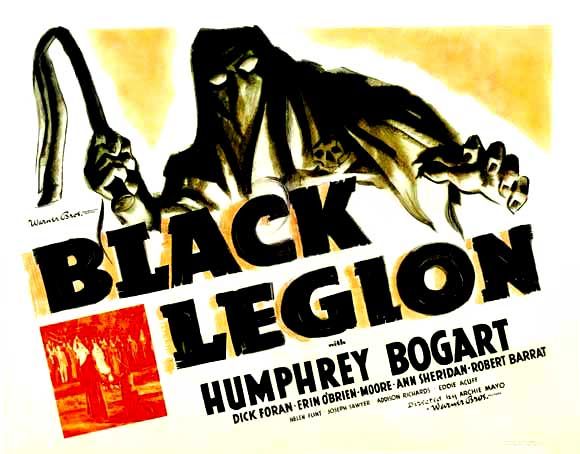


Interesting early Bogart. He plays a factory worker called Frank Taylor who joins a 'pro-American' secret society called the Black Legion when he loses out on becoming foreman to a Polish-born immigrant. The organization is a version of the Ku Klux Klan complete with mumbo-jumbo initiation rites and black robes who intimidate, torture and kill those they believe are taking their jobs. Behind them are shadowy right-wing industrialists hoping to use them for their own ends. As his involvement deepens Frank's marriage crumbles and he turns on his best friend. It's a cautionary tale fresh from the headlines that still retains its power today. There really was a Black Legion and the film is based on an actual killing that took place a few years earlier. Shot in real working class locations it's an unflinching look at the dark side of 30s America, the heart of fascism lurking, anti-foreigner agitation. (It would make a great double-bill with Lang's Fury.) While not a great film it is a fascinating one, a real eye-opener. You just don't expect 30s films to be this realistic, to face up to this kind of ugly truth. Archie Mayo is no-one's idea of a great director but he was a veteran of the cheap potent style of Warners pre-code films and brings an unfussy realism to proceedings, happy to follow the script and get as much in as the Hayes Code would allow, which turns out to be quite a lot. He also directed The Petrified Forest (1936) which saw Bogart make his debut as gangster Duke Mantee, so was possibly responsible for getting him the part (the producers originally wanted Edward G. Robinson). Whatever way he became involved it's a key film for Bogart. You can see him discover the satisfaction of exploring flawed characters, their meanness, paranoia and self-delusion, a seam he would continue in later films like The Treasure of Sierra Madre and The Caine Mutiny. And the film doesn't sugar-coat Frank's involement in this fascist group. For a while he relishes it, high on the power, the late-night adrenaline, admiring himself in the mirror as he holds a gun for the first time, imagining himself in a film (the pre-echoes of Travis Bickle are there). It's a tribute to Bogart's skill as an actor that we retain some semblance of sympathy for Frank by the end. The story received an Oscar nomination and the National Board of Review named it best film of 1937 and Bogart best actor. It should have been his breakthrough but he had to endure four more years of playing second fiddle to Cagney and Robinson before High Sierra finally made him a star. Black Legion should've been it. A must-see for all Bogie fans.

5. You Can't Take It With You (1938)


The Capra Problem was in full effect by 1938, a soft-headed belief in the folksy goodwill of 'ordinary' people. Capra the artist was always at war with Capra the idealist, so the bad things in the world were given their due, Capra understood full well the malign forces in the world, the small-mindedness and greed, (his films keep coming back to them) but he choose to believe that community could overcome it, that simple human empathy would set an example that would save the Republic from ruin. (By 1946, the nightmare seemed so much closer, it was called Pottersville, and the dream of community was so much more feverish and desperate). But this sentimentality always seemed at odds with the darker forces of his films, contrived, something willed and false, as if Capra himself didn't really believe it, or feared he didn't. Here powerful businessman Anthony P. Kirby (Edward Arnold) needs to buy one more house in a twelve block area to build a munitions factory in advance of the war that's coming. How's that for cynical. Only problem is the house belongs to Martin 'Grandpa' Vanderhof (Lionel Barrymore) and he isn't selling. This loveable eccentric has renounced the world of work and money and turned his home into a menagerie of impractical kooks and dreamers. The only 'normal' member of the family is his grand-daughter Alice (Jean Arthur) who works as secretary for Kirby's son Tony (James Stewart). Unaware of the conflict developing between their families Tony and Alice proceed to flirt and fall in love. And so the coming together of the Vanderhofs and the Kirbys is set in motion. It's the stuff of stage farce and romantic complication, sure, but it's also an essential American conflict, money versus freedom, conformity versus rebellion, those who believe in and profit from the system verses those who turn their backs on it, not so much the haves and the have-nots as the haves and the want-nots. Despite this ideological battle the film teeters on the edge of being 'quirky' or 'kooky' or any of those dread words. Only towards the end does it fall over that edge completely. And yet, there's a delicately played romance between Stewart and Arthur that's so good you'll wish there was more of it, some precient speeches about fear and a couple of genuinely funny scenes. As so often with Capra, there's much to like, much to chew over in his contradictions and failings. Live your life for yourself, be true to yourself, there's more to life than money. All these platitudes are true but they don't make great art. Telling a banker he's a bad father and getting him to play the harmonica will not change American capitalism no matter how much Capra wants it to. If only it was that easy.

Friday, March 18, 2011

Last Five Films #5

1. No Man Of Her Own (1932)


Likeable pre-code fare with Clark Gable in full virile mode as big city card sharp, Babe Stewart, wooing small-town librarian Connie Randall (Carole Lombard) with some full-on flirtation. ('Do your eyes bother you?' he says, leaning close to her in the library. 'No, why?' 'Because they bother me.') She resists him, but in truth it's all she can do to not buckle at the knees every time he comes near. 'The girl who lands him will say no and put an anchor on it,' she tells a friend, 'but isn't it tough when all you can think of is yes?' Which is exactly what makes the first half of this film so enjoyable. The aching knowledge that she wants to say yes, even though (or precisely because) he's a predatory heel who'll high-tail it back to New York as soon as he gets his way. There's an animal intensity between them in these scenes that's a pleasure to behold, a blatent sexiness that holds the film spellbound. Unfortunately, on the toss of a coin, ('I never go back on a coin') they get married instead, and he brings her to the big city. Despite some funny scenes the film peters out somewhat after this trying to redeem Gable, who goes from criminal badass to charming rogue to love-sick good guy willing to endure prison and even work for a living! In the process the film looses much of the heat that made it such good sexy fun. Still, well worth a look, if only to see Lombard in her undies!

2. Bombshell (1933)


Cheerfully cynical early screwball with everyone involved rattling off the zippy dialogue at breakneck speed. The plot is meta before its time with Jean Harlow playing Hollywood star Lola Burns, dragged down by mooching family and thieving employees, torn between tough-guy director Jim Brogan (Pat O'Brien), continental lothario Hugo (Ivan Lebedeff) and studio press agent E.J. Hanlon (Lee Tracy). Tracy is the engine of the film, an endlessly scheming Iago with an angle for everything, manipulating Lola at every turn while professing to love her. We're on the edge of a corrosive truth about the Hollywood machine here but the film never stops moving or talking long enough to admit it. You can see fact and fiction already beginning to blur in the Hollywood sun. Lola profits from the scandal Hanlon creates around her but she craves respectibility, the realness of domesticity (posing for kitchen photo-shoots), the ideal of motherhood (trying to adopt a baby), the sanity of being unknown (she runs away to a spa resort). All these fantasies end in failure. The idea is Hanlon is saving Lola from herself by sabotaging her desires for class and stability, helping her realise that where she really belongs, where she's really happy, is in the mad-house of vulgar chaos that is Hollywood. Fast and funny, Bombshell is a love letter to that vulgar chaos, a brazen celebration of deception and bullshit that can't entirely hide the truth in its meta twists and turns, the shadow of fame's devouring neon hovering over it all.

3. My Man Godfrey (1936)


'Life is but an empty bubble,' sighs Carole Lombard's spoilt socialite in Gregory La Cava's My Man Godfrey, casually summing up the philosophy at the heart of the screwball comedies of the '30s. In fact, this is probably the prototype '30s film, a Depression-fuelled screwball romance with all the blithe wit of a Broadway play leavened with scabrous contempt for the rich and blessed with that mysterious light touch that the best directors of the era seemed to have in abundance. It's a classic. William Powell plays homeless bum Godfrey Smith living at the city dump and minding his own business when snobby rich girl Cornelia Bullock turns up and offers him five dollars to be her 'forgotten man' for a scavenger hunt. He refuses and she storms off. But her younger sister Irene (Lombard) stays behind, intrigued by this strange man. Touched by something sweet-natured in her (and by a curiosity to see such an event at first hand) Godfrey offers to help her beat Cornelia. In the ballroom of the Waldorf-Ritz Hotel we're treated to a scene of undignified chaos as hundreds of socialites push and shove and argue over who gets to register their scavenger hunt items first. Irene's father Alexander (Eugene Pallette) observes, 'all you need to start an asylum is an empty room and the right kind of people'. And that's the film right there, the rich are crazy (with greed and boredom), American capitalism is teetering on the brink of savagery, but the poor, the forgotten men, have had all the crazy knocked out of them. It's touch and go as to who should be pitied more. Only Irene is absolved, she's a kind of holy innocent who offers Godfrey a job as their butler so she can have a protege like her empty-headed mother (Alice Brady), who has free-loading poet Carlo (Mischa Auer) as hers. As the new butler in the Bullock madhouse Godfrey is the most refined character in sight. No one had the elegant poise and knowing intelligence of William Powell. He moves through the film with the careful reserve of an adult trapped at a children's party. And Lombard is sensational, a ditzy dope with a big heart, a loveable child prone to funny moods and irrational fits of mania. There are twists and turns that ultimately let the rich off the hook somewhat, lessons learned, the social satire softened, but somehow it doesn't matter as the faultless direction pulls us through to the kind of perfectly delivered last-line closer most films would kill for.

4. Easy Living (1937)


Poor Mitchell Leisen. So many good films, so little credit for any of them. With Easy Living the reason is screenwriter Preston Sturges. The film feels so much like a forerunner of the Sturges style he has to get much of the kudos. Smart lines, farcical plot, slapstick shenanigans? It's all here along with several of the Sturges stock company. But then, Leisen trained as an architect before going into movies and surely he's responsible for the amazing rooms Jean Arthur is shown around by hotel owner Louis Louis. They're a dream of opulent elegance, the kind of insane luxury that makes it obvious why Louis is going bankrupt. The only possible response is Arthur's when left alone in this impossibly swish suite; a half-awed, half-appalled 'Golly!' Wealth here is like a fairy-tale. You are always only a lucky break away from riches. It's a lottery that can fall on anyone. There's little of the moral distain that fuels My Man Godfrey, no forgotten men, just a good girl struggling to get by whose life is changed forever when fate lands a fur coat on her head. The coat in question belongs to the third richest banker in New York, J.B. Ball (Edward Arnold), who throws it off the roof of his penthouse apartment in a row with his wife. It lands on Arthur as she passes by in an open-topped bus, breaking her hat. When J.B. tells her to keep the coat and takes her to buy a new expensive hat rumours spread that she's his mistress. As newspaperman Van Buren brilliantly puts it, 'the bull of broad street, with a girl, in the sable-est sable coat they ever sabled!' As a result she loses her job but gets offered the hotel suite by Louis as a way of insuring J.B. doesn't foreclose on the hotel. Suddenly everyone wants to cash in on her notoriety while she remains oblivious as to why. Add in a romance with J.B.'s cheerfully useless son (Ray Milland), a near riot in an automat, a run on the stock exchange and plenty of shouting, outrage and confusion and you have a cock-eyed cocktail to savour. The end is too neat (a Leisen failing) but Arnold's manic bluster, Milland's boyish charm and Arthur's sweet smile are what will stay with you afterwards.

5. Nothing Sacred (1937)


'For good clean fun, there's nothing like a wake,' declares newspaperman Wally Cook in William A. Wellman's Nothing Sacred, supplying this acid satire with the perfect tagline. In this case the wake is Hazel Flagg's (Carol Lombard) except she isn't dead yet, just dying (of radium poisoning). And, frankly, everyone couldn't be more pleased about it. There's just one thing; she isn't dying, she was misdiagnosed. But the chance to escape her small town, to enjoy the big city delights of New York, prove too tempting, so she lies to Cook (Fredric March), a once great reporter in need of a big story. She's exploiting everyone's sympathy while the newspaper exploits her, and the public get to bask in the glow of her 'bravery' and cry crocodile tears at her impending death. No one escapes in this savage film. You only have to think of the recent Jade Goody story (hated loud-mouth celebrity transformed by cancer into brave mother and national heroine) to see how on the money this was and is still. The only other film I can think of that displays the same contempt for the malign influence of the media and the baser instincts of its audience is Network (1976) but unlike that film's atmosphere of intense, shrill seriousness Nothing Sacred maintains its era's fast-paced, crazy spirit throughout. Ben Hecht's script zings with great lines while tough-guy director Wellman keeps all sentiment at bay. It doesn't waver for a second. As the man says to the Dutch girl; 'Show them the finger babe'. And it sure does.

Tuesday, October 26, 2010

Last Five Films...#4

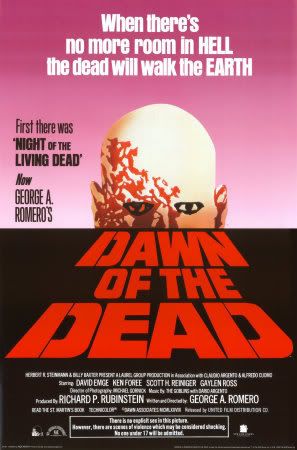
1. Dawn of the Dead (1979)


Shown in conjunction with A History of Horror, Mark Gatiss' excellent three-part series for BBC4, Dawn of the Dead is a classic despite its manifest flaws. The analogy I've come up with to explain this is the difference between Frank Sinatra's Songs For Swinging Lovers and Ramones by The Ramones. The first is the result of supremely talented people on the top of their game, Sinatra's voice and phrasing, Nelson Riddle's arrangements, the finest session musicians money could buy, not to mention The Great American Songbook of Cole Porter and George Gershwin. It's so evidently a high watermark of moden culture it doesn't need any special pleading.
The Ramones, on the other hand, the original three-cord punks, weren't even the best musicians in scummy New York dive CBGBs in 1975 (Television or Talking Heads if you're asking) and had only one basic idea, gonzo, speed-freak versions of 50s pop. But what an idea it was, especially when attacked with dumb-ass gusto on classics like Blitzkrieg Pop and Beat On The Brat.
The point is, taste and talent would never have given us this. Likewise, they would never have given us Dawn of the Dead. It took an instinctive amateur to go there. Romero's direction is borderline incompetent at times, especially with action sequences, and the actors are often all at sea, but there's no denying the moral intelligence behind it or the now-iconic images of zombies wandering through the shopping mall as cheery Muzak plays, filmmaking so savagely satirical and sweetly funny that no-one except maybe the Kubrick of Dr Strangelove would have dared go there.

2. The Quatermass Experiment (1955)


The Quatermass Experiment is a very effective early Hammer sci-fi/horror about a rocket ship returning to earth infected by a mysterious alien organism. Excellent location shooting and a haunting performance by Richard Wordsworth (as the only surviving astronaut slowly being taken over by this thing inside him), give this spin-off from a landmark TV series real bite. As maverick scientist Dr Quatermass, veteran American actor Brian Donlevy waltzes around 50s Britain like he owns it, ignoring or browbeating everyone from the military and the police to medical experts as if none of the rules apply to him (which may have been some kind of sly political statement of course).

3. Despicable Me (2010)


Another week another entertaining animated film. If only my kids realised what a golden age of childrens' cinema they're living through. Even sequel-fodder like Ice Age 3 offers more invention and wit than most adult films. In fact it's easy to take the visual flair and comic timing of a film like Despicable Me for granted. It may not be the latest ground-breaking animation from Pixar, criminal mastermind Gru may be a cross between Uncle Fester and Dr Evil, the plot a variation on The Grinch and the visual style half-inched from Henry Selick, but it doesn't matter. My kids loved it, the minions are funny and it manages the inevitable heartwarming ending with enough delicate skill to avoid mawkishness.

4. Army of Shadows (1969)


Superbly laconic account of the French Resistance showing how ordinary people became as ruthless as the enemy and as devious as criminals to survive the Occupation. There's an air of existential gloom over it all, from the closed, watchful faces, the dour overcast skies, the lonely sound of hard shoes on cobbled streets, the cowed eyes of men who know they're going to be killed. It's difficult to sympathise with anyone though, because the sense of honour and sacrifice is alien to us now, the idea of killing your own because they've betrayed you. It's hard to justify when they're just kids who made mistakes or women trying to protect their children. The film is unflinching in this and while the middle section in wartime London is a little unconvincing overall it's a compelling work.

5. Fool's Gold (2008)

I have a soft-spot for Matthew McConaughey (no not quicksand). I honestly think he could've been this generation's Errol Flynn if the roles had come his way. Only the enjoyable Sahara gave him a proper opportunity to show what a likeable wise-cracking hero he could be. Too often he's been tied down to lame rom-com plots opposite B-list actresses and Fool's Gold is no help; a half-baked treasure hunt plot shackled to contrived romantic fireworks opposite charisma-free Kate Hudson. Despite a few bright moments it doesn't work. And I really wanted to like it, I really did. But it just gets progressively worse as first Donald Sutherland and then Ray Winstone compete to see who can produce the worst accent in cinema history. Winstone wins by a nautical mile, his Southern-drawl-meets-East-London-snarl so toe-curlingly bad McConaughey should have taken it as a personal insult and challenged him to pistols at dawn and saved us all this witless waste of time.

Thursday, July 22, 2010

Last Five Films You've Seen #3

1. Kingdom of Heaven (2005)


Wasn't impressed with Kingdom Of Heaven on its initial release. It seemed overlong, confused and fatally undermined by the miscasting of Orlando Bloom. All of which is still true and yet, watching it now, I wasn't inclined to be as hard on it. Not that it's suddenly revealed as an unfairly maligned masterpiece or anything, far from it, but I think films, like people, can often grow into their flaws, or rather, the flaws can grow into them, becoming part of what they are. We end up accepting them like we'd accept the character failings of a relative or friend, eventually barely noticing them.
For example, as the political era it was made in recedes from us like a fevered dream, the film's many references to post 9/11 wars and attitudes now seem less thumpingly obvious and more part of an overall humanist thrust. Bloom remains anaemic at best, of course, but I did appreciate the film's visual style better this time around. It's ravishing at times, but all those burnished shots of desert armies, bustling sea ports and medieval villages do start to blend into each other after a while, like glossy illustrations in an expensive picture book, the images left increasingly empty as the human story suffers from simplistic gestures and choppy narrative. And yet, despite that, there's a rich sense of time and place, of religious and political tumult, of having been on an epic journey by the end.

2. In The Heat of the Night (1967)


The social and political times in which In The Heat Of The Night was made have receded too, of course. You've got to remind yourself while watching it now of what was happening in America at the time, that the notion of a black cop from the north joining forces with a Southern sheriff was more than just a good oppositional set-up, a buddy movie contrivance, like Eddie Murphy and Nick Nolte in 48 Hours. (Whatever the merits of that film, no-one's claiming it as a milestone in race relations). No, when this film came out there was real heat in the American night, the heat of Klan torches and race riot burnings. Which probably accounts for why it remains an absorbing thriller to this day. Beneath the routine murder mystery plot and the enjoyable sparring of Tibbs (Poitier) and Gillespie (Steiger) the dangerous energy of the times can still be felt. Norman Jewison's taut, unhurried direction helps, as does the acting, especially Steiger, in an Oscar-winning performance, making a belligerent sheriff sympathetic even as he's being racist and jumping to one wrong conclusion after another. That's star power for you. He's also having fun with the music of the southern accent. Just listen to the way he makes the line 'I've got the motive which is money and the body which is dead!' sing like found poetry. Liberal fantasy entertainment then, contrived to make the black cop win maybe but the set-up's so satisfying you'll happily watch it every time.

3. An Education(2009)


Although set in the drab, conformist world of post-war England, (just before the Swinging Sixties revolution swept it away), the question at the heart of An Education still resonates. University life or the university of life? That's the choice facing sixteen-year-old Jenny (Carey Mulligan), being fast-tracked to Oxford by her aspirational parents. In her bedroom though she listens to French pop songs and dreams of romance and adventure.
Then one day she accepts a lift from charming older man David (Peter Sarsgaard) and a different kind of education enters her life, one that involves fancy restaurants, glamorous clubs and goodnight kisses in expensive cars. Suddenly her life before David seems unbearably static and she's soon in open revolt against what's expected of her, that life of improving education mapped out by well-meaning parents. After all, if action is character, as her English teacher has told her, then what kind of character can come from a life of study? 'If we never did anything we wouldn't be anybody', she argues with some justification. That's the fascinating crux of this film. How to balance the benefits of education against what it asks of you. Is it worth it if, in order to have 'a future', you have to mortgage your youth away studying Latin?
And while the film follows this idea it's genuinely engaging. Unfortunately the filmmakers don't believe it. Like sensible adults they understand that if it's a choice between female empowerment or silly schoolgirl crushes then in the long run its better for the girl to fulfill her potential than throw her life away.
Obviously this is true, but that's not how the film plays for long stretches. In Jenny's empassioned speeches against her education you can feel her realising that living for the moment, feeling alive now is what matters, not the social status of an Oxford education. 'It's not enough to educate us anymore Ms. Walters,' she demands of her headmistress at one stage. 'You've got to tell us why you're doing it'. This is the question the film ultimately fudges.
You can't help feeling if it had been a French film they'd have had the courage of their convictions, allowing Jenny the full consequences of her actions rather than saving her (from herself) at the last minute, cowed back into line by betrayal (David's and the film's).
It's still a good film though, despite this. Carey Mulligan is clearly a star. Peter Sarsgard is all soft-spoken charm. Alfred Molina does a fine job as Jenny's Dad and Rosamund Pike steals every scene she's in as ditzy, good-time girl Helen. Ultimately though it's all let down somewhat by that compromised ending.

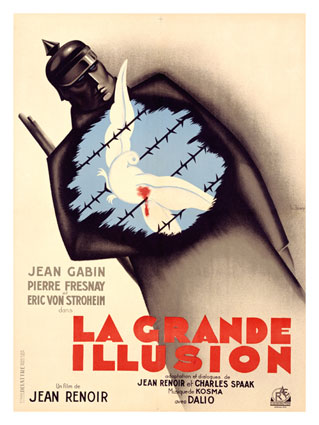
4. La Grande Illusion (1937)


Jean Renoir's La Grande Illusion is one of those imperishable classics everyone should see at least once. It's a POW movie, possibly the first, with all the ingredients we've come to expect from them; tunnel escapes, camp shows, etc. But it's also far more than that, a masterful study of human relations during wartime, of the way class and religious divisions may be put aside in times of mutual danger, but never really go away, always endure. So Captain De Boeldieu (Pierre Fresnay) is an aristocrat while Lieutenant Marechal (Jean Gabin) is a mechanic in civilian life. They're both officers, friends even, full of respect for each other but the wariness never goes away, the ghost of their respective social positions always between them. Compare this to De Boeldieu's relationship with Prison Commandant von Rauffenstein (Erich von Stroheim). Both aristocrats, both familiar with the same pre-war high society, both in truth a little distainful all this bourgouise warmongering. Here class trumps nationalism every time. Renoir weaves many more characters into this network of complex relationships: a wealthy Jew, a music hall actor, an intellectual, a black Senegalese prisoner and finally a widowed farmer's wife (played by the wonderful Dita Parlo, star of L'Atalante). Throughout he never puts a foot wrong, creating a compelling war movie and a humanist masterpiece grounded in realism. It leaves you feeling priviledged to have seen it.

5. Star Wars (1977)


The original. I refuse to call it Episode IV: A New Dawn because that's what Lucas wants me to do. This isn't the fourth film it's the first. My kids had been pestering me for ages to see it after they got The Clone Wars on DVD for Christmas. I didn't intend watching it myself but got sucked in. It's the physicality I like still, the sense of actual space and noise, much of it filmed in Tunisia, not created by computers. I've written here before about the camera moving through real space. I think we respond to that in a subconscious way. The sounds, the sense of space, the inescapable feeling of people playing dress-up about it all. Overrated yes, malign influence, undoubtedly, but still retains enough of the fun to be diverting.

Sunday, March 14, 2010

Last Five Films You've Seen #2

The last five films you saw, no matter what they were or where you saw them. Here are mine:

(1) We Live In Public (2009)


Excellent documentary from Ondi Timoner, director of classic rock doc Dig! (2004). Here she unearths another gem of a story about little-known internet pioneer and proto-Warholian figure Josh Harris, chronicling the late 90s love-in between dot-com nerds and New York's party/art scene. Through Harris it was suddenly difficult to tell where parties ended and art happenings began, what was a business venture and what an anthropoligical experiment. We Live In Public is a fascinatng look at the digital era in its infancy, ripe with optimism and unease, a lawless frontier where anything was possible and everything allowed. It couldn't last and now, a mere decade later, it all seems like something from another age.

(2) 500 Days Of Summer (2009)


I really liked this. Yeah, I know, it's too cutesy for its own good at times, tries too hard to sugar a bitter pill, but not many films challenge Hollywood's love is fate paradigm so I'm willing to cut it some slack. Joseph Gordon-Levitt is excellent as fool-for-love Tom, and Zooey Deschanel is perfect as the object of his infatuation, Summer. Yes, some killjoys find her too calculated and kooky for their tastes but then some people would be happier living in colour-free Stalinist misery, so what do they know. Besides, Summer might be cute but she's also self-centred, cold even. She can have sex and generally be intimate with someone while maintaining a distance from them, from the experience, like it’s a holiday, like she’s a tourist in other people’s feelings. Tom, on the other hand, is an open wound of romantic desire just waiting to be healed by the love of a perfect girl, saved by her. Salvation or damnation. At heart then, a very serious film. Pity about the ending though.

(3) Up In The Air (2009)


For two-thirds of the way a smart, sophisticated entertainment for grown-ups, made with breezy style. Then it betrays itself in the name of family and 'heart'. And then, even worse, it doesn't have the courage to follow through on this and tries to regain its integrity with a downbeat ending. This rings as false as any tacked on happy one. I mean does anyone know how to end a film anymore? Clooney is superb of course, making it look effortless as all the greats do. There's a lovely chemistry between him and Vera Farmiga while Anna Kendrick's young hot-shot novice is flat-out brilliant. Once the soppy indie songs appear on the soundtrack, though, you know the filmmakers have lost faith in their own ability to generate emotion. See it, it really is very good. Just a pity it couldn't keep it going all the way though.

(4) Sherlock Holmes (2009)


The art of the trailer is usually employed in making films look better than they really are, or funnier. The above trailer for Guy Ritchie's Sherlock Holmes is actually a pretty accurate summation of the film itself. It really is that much fun. An exciting romp that has all the gravitas and depth of a pancake but is the kind of undemanding film I would gladly watch again tomorrow. Robert Downey Jnr is in his element here, creating a lovely double-act with Jude Law. Silly nonesense but pulled off with surprising style and good cheer.

(5) Bad Day At Black Rock (1955)


Like 3D and other Hollywood gimmicks, Cinemascope was often used inappropriately, destroying the natural ratio aspect and composition of films that had no need for it. Bad Day At The Black Rock was a noble exception. Arguably the greatest pleasure to be found in John Sturges classic thriller is its widescreen look, its intelligent use of real locations (vast Western skies and jagged mountain ranges) to enhance the film's sense of isolation and entrapment. From the opening credits, over the Southern Pacific Streamliner making its way through the Californian desert, the eye is hooked by the colour and visual elegance of the film. And that's before one-armed Spencer Tracy steps off the train at the archtypal town-with-a-secret to take on the finest rogues gallery in movie history; racist ringleader Robert Ryan, sneering bully Ernst Borgnine and slouchy snake Lee Marvin.

Thursday, February 4, 2010

The Last Five Films You've Seen #1

Ok, what were the last five films you saw? Not just the best ones, not just the latest cinema or DVD releases, but also the ones you casually watched on TV when your brain was on standby, the films you rarely admit to seeing or simply forget to mention because they're too obvious or old or badly made.
It's an interesting exercise. With our list-obsessed, best of, worst of, hyped-up anticipatory culture, many fine movies get left in the margins, many average to bad movies might as well never have been made, while the vast history of world cinema lies beneath the surface of our attention, getting vaster and more ignored by the day as we merrily jet-ski our way through end-of-year lists, award ceremonies and teaser trailers towards a brighter tomorrow.
So, an old movie you discovered on TV, a recently-maligned blockbuster you caught up with, a DVD someone lent you, something you downloaded or even one you saw in a film club. They're all part of the rich pageantry of cinema. Here are the last five I saw:

1. White Mischief (1988):


Frightf'ly British tale of posh types in 1940s Kenya having affairs, cross-dressing and being fantastically decadent, bitchy and stiff-upper-lip about it all until the shooting starts. As one society gossip says of dashing womaniser Charles Dance: 'They say he can't get on with women, so he gets off with them instead!' Also has Gretta Scaachi looking amazing in a succession of fantastic 40s outfits and even better out of them, John Hurt wearing a funny hat and Sylvia Miles masturbating in a morgue. What more could you want?

2. National Treasure (2004):


Surprisingly enjoyable nonesense in the Da Vinci Code vein, but better than that lazily inept bore-fest. Of course, low expectations can sometimes be a film's best friend, and it's true I assumed this was going to be awful. To my surprise I found myself enjoying it, for the first half at least, as it sped along, tongue firmly in cheek, Nicholas Cage underplaying his oddball character nicely and Diane Kruger very appealing as the love interest sucked into the adventure. It outstays its welcome, too many protracted stunt and chase sequences, but as a family film, you could do a lot worse.

3. Inglourious Basterds (2009):

The usual from Tarantino; killer scenes, choppy structure, vivid performances. While Christoph Waltz has (rightly) gained all the plaudits for his turn as Nazi Colonel Hans Landa, there are equally fine performances from Diane Kruger (again), as German actress Bridget Von Hammersmark, Michael Fassbender as British agent Archie Hicox, Daniel Bruhl as German war hero/movie star Fredrick Zoller and Mélanie Laurent as Jewish cinema owner Shosanna Dreyfus. All are superb. So what if the basterds side of the story is a bit half-backed? Wouldn't it be churlish to find fault in something so cine-literate and entertaining? Yes, it would.

4. Everlasting Moments (2009):


Perfect example of the vast unseen world of cinema. This fine Swedish film's director, Jan Troell, has been making films for more than forty years, garnering five Oscar nominations along the way, and yet I'm sure I'm not alone in having never heard of him before. Everlasting Moments is the kind of immersive, emotionally complex saga European cinema used to make as a matter of course, and is, in its own quiet way, a masterpiece.

5. Office Space (1999):


Great comedy from Mike Judge that didn't set the world on fire when it came out first but has since gained a well-deserved cult status. The special tedium of office jobs is mined for comedy gold. Great cast, lots of quoteable lines and a major plot idea stolen from Superman 3. Also Jennifer Anniston's only good film. For everyone whose dream in life is to do nothing.