Showing posts with label bogart. Show all posts

Tuesday, October 25, 2011

Last Five Films...

1. Detour (1945)


Edgar G. Ulmer is a fascinating character in film history, a talented man on the verge of a successful career exiled to the world of poverty-row b-pictures because he fell in love with the wrong woman. Could be a noir plot in itself, of course, which might explain why Detour stands up as one of the great noirs despite its manifest cheapness. 'No matter what you do, no matter where you turn, fate sticks out a foot to trip you up,' Tom Neal's hapless narrator tells us, and you can imagine Ulmer identifying with that. The film has the fevered compression and illogic of a nightmare married to location realism (cheap road-side diners, motels etc). Nobody in this film has star charisma. Ann Savage is an amazing presence but her Vera is every inch an ordinary woman driven to the edge by disappointment. Lord knows what she's had to endure but Savage manages to imply a world of desperation and pain. Like an animal mistreated once to often she'll bite the next hand that comes near. She's not going to let anyone get the better of her again, gonna take whatever chance comes her way. She's a monster, a rabid Bette Davis, the American Dream going crazy before our eyes, and the main reason (though far from the only one) to see this lo-fi cult classic.

2. Gun Crazy (1950)


Another unheralded actress delivers an even better performance in Joseph H. Lewis' Gun Crazy. Peggy Cummins isn't exactly a house-hold name, even for fans of classic movies, but she's sensational as carnival sharpshooter Annie Starr. We first see her haloed with fire, a warning if ever there was one. But gun-obsessed Bart Tarr (John Dall) fails to heed it. Instead he's like a horny moth to her flame. 'We go together, Annie,' he tells her later, 'I don't know why. Maybe like guns and ammunition go together'. It's noir fate then, but Gun Crazy is more than a standard noir and Cummins more than a femme fatale. She takes over the film, hijacks it. She's on fire, alive with heat and scheming energy, with outlaw lust, a hipster revolutionary out to play the system by its own game. She may say 'I've been kicked around all my life, and from now on, I'm gonna start kicking back', but you get the feeling grievance is only a small part of it. This is one dame who's been ready to go off for a long time, maybe forever. Sure she wants money, but more than that, she wants action. The sexual thrill of guns, of danger, of death. That's what's really turning them on, a death-wish so strong they can hardly resist it. It's the essense of American cinema; guns and cars, sex and death - living for the moment. And Lewis shoots it like that, with great verve and vérité energy. It's New Wave ten years before Godard, the camera hurrying through real locations, watching from the back seat of moving cars. It puts us right in the moment, especially during a one-take bank robbery that's arguably the greatest single-take scene in all of cinema, small-town streets a panicky blur as they screech around corners, the moment alive with giddy tension. By the end it's transcended its genre, no longer noir, but something more vital and tragic, a Freudian parable, an essential cinematic credo: Thrill crazy. Kill crazy. Gun Crazy.

3. The Big Combo (1955)


Five years later, Lewis delivered another cult gem, but this time the noir conventions are adhered to throughout. All the earlier film's energy and movement are gone, replaced by a stylized, shadowy mise-en-scene that comes close to abstraction. The cinematographer is John Alton, the Rembrandt of noir cinema, the man who literally wrote the book on lighting. It's hard to imagine Lewis daring to shoot on the hoof when Alton was painstakingly setting up the visual geometry of a shot. The result is weapons-grade noir, a world where it's always nighttime, where talk is hardboiled poetry and cops are dogged loners on a mission. It's lifted above the routine, though, not only by Alton's lighting but by the performance of noir-stalwart Richard Conte, fantastic as mouthy gang boss Mr. Brown. He's having a ball rattling out killer dialogue ('Joe, tell the man I'm gonna break him so fast he won't have time to change his pants,') high on his own sense of invincibility, smarter and more ruthless than the mugs around him. Cornel Wilde is suitably weary and dour as Brown's nemesis, Detective Leonard Diamond, but it's hard to warm to him. This is probably what denies the film classic status, the elevating persona of a star performance. (Compare Wilde, say, to Glenn Ford in Fritz Lang's The Big Heat, made two years earlier and very similar in plot and characterisation, where Ford brings a charismatic righteousness to his role that Wilde can't match, a sense of the film's moral universe flowing through him.) Unlike Lang, though, Lewis didn't seem interested in a moral universe. As in Gun Crazy, characters are motivated by instinct and desire. It's an amoral tone that sets the film apart even as it's undermining the plot. We don't really care about Diamond's crusade because Lewis doesn't either, he's having too much fun with the baddies, more alive and vital because they've embraced instinct instead of fighting it. There's an almost gleeful air of perversity, a nasty, unsettling edge that sets the film apart. Brown's henchmen, Fante (a super-cool Lee Van Cleef) and Mingo (Earl Holliman) are clearly meant to be homosexual and the crimelord's classy moll, Susan Lowell (Jean Wallace) stays with him mainly because she gets off on being treated rough. For Lewis, sex is at the heart of the action once again, characters are defined by it, their sexuality as inescapable as any noir fate.

4. Black Legion (1937)
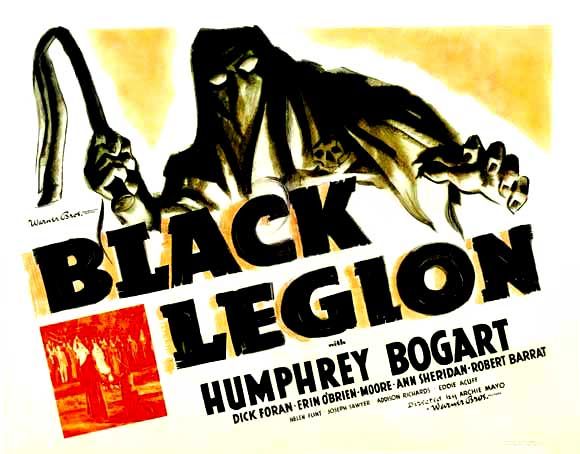


Interesting early Bogart. He plays a factory worker called Frank Taylor who joins a 'pro-American' secret society called the Black Legion when he loses out on becoming foreman to a Polish-born immigrant. The organization is a version of the Ku Klux Klan complete with mumbo-jumbo initiation rites and black robes who intimidate, torture and kill those they believe are taking their jobs. Behind them are shadowy right-wing industrialists hoping to use them for their own ends. As his involvement deepens Frank's marriage crumbles and he turns on his best friend. It's a cautionary tale fresh from the headlines that still retains its power today. There really was a Black Legion and the film is based on an actual killing that took place a few years earlier. Shot in real working class locations it's an unflinching look at the dark side of 30s America, the heart of fascism lurking, anti-foreigner agitation. (It would make a great double-bill with Lang's Fury.) While not a great film it is a fascinating one, a real eye-opener. You just don't expect 30s films to be this realistic, to face up to this kind of ugly truth. Archie Mayo is no-one's idea of a great director but he was a veteran of the cheap potent style of Warners pre-code films and brings an unfussy realism to proceedings, happy to follow the script and get as much in as the Hayes Code would allow, which turns out to be quite a lot. He also directed The Petrified Forest (1936) which saw Bogart make his debut as gangster Duke Mantee, so was possibly responsible for getting him the part (the producers originally wanted Edward G. Robinson). Whatever way he became involved it's a key film for Bogart. You can see him discover the satisfaction of exploring flawed characters, their meanness, paranoia and self-delusion, a seam he would continue in later films like The Treasure of Sierra Madre and The Caine Mutiny. And the film doesn't sugar-coat Frank's involement in this fascist group. For a while he relishes it, high on the power, the late-night adrenaline, admiring himself in the mirror as he holds a gun for the first time, imagining himself in a film (the pre-echoes of Travis Bickle are there). It's a tribute to Bogart's skill as an actor that we retain some semblance of sympathy for Frank by the end. The story received an Oscar nomination and the National Board of Review named it best film of 1937 and Bogart best actor. It should have been his breakthrough but he had to endure four more years of playing second fiddle to Cagney and Robinson before High Sierra finally made him a star. Black Legion should've been it. A must-see for all Bogie fans.

5. You Can't Take It With You (1938)


The Capra Problem was in full effect by 1938, a soft-headed belief in the folksy goodwill of 'ordinary' people. Capra the artist was always at war with Capra the idealist, so the bad things in the world were given their due, Capra understood full well the malign forces in the world, the small-mindedness and greed, (his films keep coming back to them) but he choose to believe that community could overcome it, that simple human empathy would set an example that would save the Republic from ruin. (By 1946, the nightmare seemed so much closer, it was called Pottersville, and the dream of community was so much more feverish and desperate). But this sentimentality always seemed at odds with the darker forces of his films, contrived, something willed and false, as if Capra himself didn't really believe it, or feared he didn't. Here powerful businessman Anthony P. Kirby (Edward Arnold) needs to buy one more house in a twelve block area to build a munitions factory in advance of the war that's coming. How's that for cynical. Only problem is the house belongs to Martin 'Grandpa' Vanderhof (Lionel Barrymore) and he isn't selling. This loveable eccentric has renounced the world of work and money and turned his home into a menagerie of impractical kooks and dreamers. The only 'normal' member of the family is his grand-daughter Alice (Jean Arthur) who works as secretary for Kirby's son Tony (James Stewart). Unaware of the conflict developing between their families Tony and Alice proceed to flirt and fall in love. And so the coming together of the Vanderhofs and the Kirbys is set in motion. It's the stuff of stage farce and romantic complication, sure, but it's also an essential American conflict, money versus freedom, conformity versus rebellion, those who believe in and profit from the system verses those who turn their backs on it, not so much the haves and the have-nots as the haves and the want-nots. Despite this ideological battle the film teeters on the edge of being 'quirky' or 'kooky' or any of those dread words. Only towards the end does it fall over that edge completely. And yet, there's a delicately played romance between Stewart and Arthur that's so good you'll wish there was more of it, some precient speeches about fear and a couple of genuinely funny scenes. As so often with Capra, there's much to like, much to chew over in his contradictions and failings. Live your life for yourself, be true to yourself, there's more to life than money. All these platitudes are true but they don't make great art. Telling a banker he's a bad father and getting him to play the harmonica will not change American capitalism no matter how much Capra wants it to. If only it was that easy.

Sunday, April 18, 2010

The Film Club Reviews #6: Ten Thoughts Inspired By: A Bout de Souffle

1. Before I ever saw the film I saw this poster. A classic of graphic design. As soon as I laid eyes on it I knew I had to see the film. It radiated cool energy. And that title. At once a declaration of the film's style and the viewer's response to it. A promise and a boast. Stylish. Sexy. Breathless.


But its original title, A Bout de Souffle, translates as Out Of Breath. That's a B-movie title, slang for death, like Chandler's The Big Sleep. Consider if they'd used that as the English title instead. Would the film have attained such a cool reputation? Just imagine it on the poster. Stylish. Sexy. Out Of Breath.
Suddenly it's not so much an intimation of awed wonder as middle-aged decline. My younger self probably wouldn't have been so impressed, but so what? Does it matter? A title's just a title, after all, a way of identifying one film from another. Sure, mostly, but it's not always that simple. Consider these titles for example: Stranger Than Paradise. Some Like It Hot. White Heat. Touch of Evil. Now each of these could, at a push, describe what happens in their respective films, but I don't think that's what's going on when we read them. They're not merely labels, they're suggestive, free-floating, haikus of compressed mood. Yes, a good title can define a film, capture its essence, but it can also add to it, deepen it, complicate it. It's a chemical reaction. Just think of the mysterious, symbiotic relationship we have with names and they have with us. Do they shape us, do we grow into them? If you don't believe this then consider these possible alternative titles for the films above; Losers. TransAmerica. Mother Love. The Mexican. Does it make a difference? It's hard to say, but this much is clear, the anonymous translator tasked with finding an English version for A Bout de Souffle clearly thought so.

2. The film of tomorrow will not be directed by civil servants of the camera, but by artists for whom shooting a film constitutes a wonderful and thrilling adventure. - Francois Truffaut

The famous dedication is to Monogram Pictures. Monogram were a poverty row studio specialising in cheap genre flicks, serials and westerns. So what was the attraction for serious French cinephiles like Truffaut and Godard?


Well, for starters, because they were largely ignored or unknown they were an undiscovered continent, ripe for reappraisal. They often relied on genre conventions, offering rich ground for theorising, for detecting encoded meanings, hidden ideas, themes build up across a body of work. Also because they had less to lose they could show the seemier side of existence more freely than bigger studio productions, the kind of exploitation subjects considered beneath proper art. The French saw passed all that bourgouis respectability, understood that the life of a petty thief could be as worthy of great art as the noblest king, that an absence of craft or style might represent a film's phychological meaning, its hard indifference to the lies of romance. They were the first to realise that serious artists could exist outside the mainstream, might find the fertile confines of genre more to their liking, might prefer playful indifference to highbrow pretention.
But even the worst of these films taught them about innocent enjoyment, the pleasure of transformation, how much easier it was to bring the moves, clothes and dialogue into your life when they were ritualised, repeated, how cliches spoke to the yearnings inside ordinary people. By dedicating his film to Monogram Godard was sticking two fingers up at the industry, rejecting its middlebrow concerns with craft and rules, alligning himself with the outsiders, the dreamers, with those great American values of outrage, adventure and play. This is a game, he's telling us. We're playing here. So can you.

3. The famous opening line is: I'm an asshole, a provocation from the start, followed by a close up of a skantily clad girl on the front of a newspaper, lowered to reveal our hero, Michel, hat over his eyes, puffing on an enormous cigarette. He's cool, but posing too, a kid playing dress-up.


Then he runs the side of his thumb across his lips. It's a signal. To us. Thumb across lips. That's all it takes. Your Bogie. Your life is a movie. It's hard to appreciate now the impact of this message. A Bout de Souffle was the first film to acknowledge people's desire for movie grace in their lives, wanting their everyday existence transfigured by it, blessed with purpose and shape, ordinary personas imbued with unified glamour. You don't need to be famous, a star. The magic isn't out there somewhere, owned by producers, studios, agents, fans. It's in you now, once you've seen the film, it's yours, a gift, not a privilege. This is what cinema is, the democratisation of play. It's an evolutionary tool, teaching poor regional kids moves and gestures to help them escape impoverished lives, to face the twin terrors of adolescence and neighbourhood streets. After all, when you live in a non-verbal environment knowing how to stand on corners with cool indifference is a vital art. This is another thing the film is already telling us. The street is a movie set too.

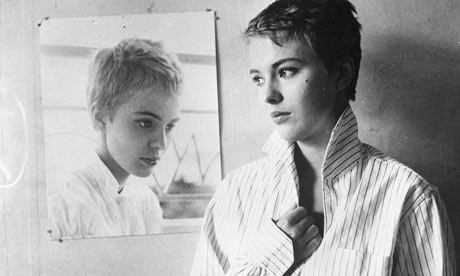
4. We first see Patricia ambling down the Champ-Elysees in her flat shoes, sweetly calling 'New York Herald Tribune! New York Herald Tribune!' She's played by Jean Seberg, proof that nationality is a notional concept at best. She's supposed to be the American chick but comes across, in her clothes, her manner, her cropped hair, as ineffably French. It's hard to imagine any other contemporary American actress playing the part, actually American but spiritually in tune with the Frenchness of the whole enterprise. (The film too is at once American in its conventions and French in its style and ideas.)


It was that way from the start. Her screen debut was as Saint Joan (1957), hand-picked from 18,000 hopefuls by Otto Preminger. It was Preminger again who brought her to France the following year to play the spoiled Celine in Bonjour Tristesse. The same year she married film director Francois Moreuil. By the time of A Bout de Souffle they were divorced and she'd taken up with French author Romain Gary, marrying him in 1962. Was it fate or inclination that drew her to the French and them to her? Or was it the hair? The gamine prettiness? Whatever it was, it went on, until her tragic, mysterious death in 1979, found dead in her car on the same Parisienne streets she'd watched Belmondo play dead on all those years before, back when they were all young enough to think of death as a romantic game, something to be bargained with.

5. Leaving Patricia behind Michel passes a poster for a film called Ten Seconds To Hell (1959), its tagline proclaiming 'Live dangerously till the end!'


It's a lovely moment, not just for the renegade cheek of using the poster without permission, but for the serendipity of it being there in the first place, articulating the film's key theme - defying death. (You know you're in the zone when the world starts to speak to you like this, send you secret messages, when you see connections everywhere, when you start to believe there's no such thing as a coincidence, that luck, in fact, is just fate in disguise).

6. Once you accept the rule of death thou shalt not kill is an easily and naturally obeyed commandment. But when a man is still in rebellion against death he has pleasure in taking to himself one of the Godlike attributes, that of giving it. This is one of the most profound feelings in those men who enjoy killing. - Ernest Hemingway, 'Death in the Afternoon'

'It is solely by risking life that freedom is obtained,' Hegel wrote, somehow defining the essence of A Bout de Souffle over a century before it was made. The spirit of the film may be its exhilerating sense of freedom, it's jazzy liberation from social, artistic and cinematic conventions, but it's also obsessed with death, from its title to its conclusion. Or rather, with invoking it in order to feel more alive. If the taking of life could, as Hemingway suggests, ward off your own death, than so could acting it out. In this sense, the film is as ritualistic as a bullfight, a bloodless rebellion against death.
Just as ancient Greek rites evolved into formalised drama, the death of a tragic hero offered to the gods rather than the sacrifice of a goat, so too with cinema. It may be a game, Godard suggests, but it isn't frivilous. It's as serious as any religion, as vital to our happiness as freedom itself. It was a message that hit the new decade like a molotov cocktail, starting a creative blaze that lasted twenty years and engulfed the old Hollywood studio system in its wake.

7. 'What is your greatest ambition?' Patricia asks the novelist (played by director Jean-Pierre Melville) at the kind of pretentious press conference only the French would have. 'To become immortal', he replies, looking straight into the camera, 'and then to die'.


It's a joke, a contradiction. He might as well have said his ambition was 'to wake and then to dream'. It's an impossibility, mutually exclusive states, waking/dreaming, immortality/death. Except, of course, there is one place where the impossible can happen. When we watch a film, especially in the dark of a cinema, what else are we doing but dreaming while still awake? And when we watch the great stars of the silver screen like James Cagney, Bette Davis or Steve McQueen, what else are we doing but watching the dead walk again, forever alive in their films, made immortal by them?

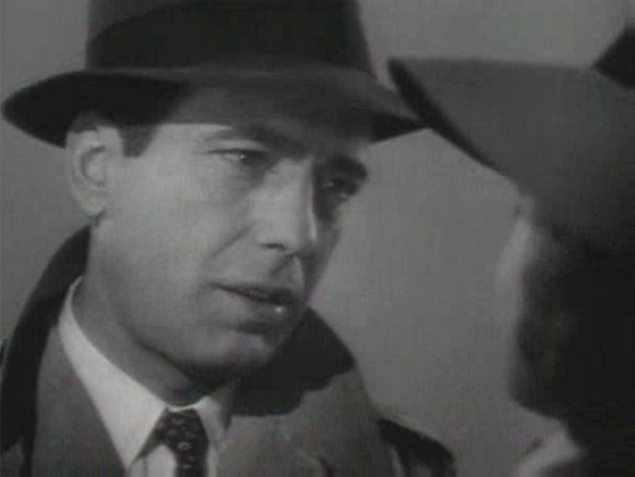
8. Which is what Bogart represents in the film, not just a role model but an icon of immortality. Dead only three years when A Bout de Souffle was made, already he's becoming a cult, his moves, clothes and dialogue remembered, repeated and fetishised.


But why Bogie? What was it about him that so obsessed the French? Maybe he was, in some way, more French than other Hollywood stars, more ironic, fatalistic, ugly? Maybe the characters he played, men with secrets, with shadowy pasts, were more in keeping with a nation haunted by defeat, collaboration and existential dread? Whatever it was it went deep, just think of the hats and coats in Melville's own films like Le Samourai.


Of course, the Bogart of The Maltese Falcon, Casablanca and The Big Sleep was also the coolest man on the planet, a dream of tough grace under pressure. He crystallised the essence of cool long before Brando and Dean turned up, a man's cool, not a grumpy adolescent's, someone who's lived, seen things, been betrayed by events, by his own heart, hides his honour like a dirty secret. But we know it's there, we know he does care, does know which side is right, he just won't be played for a sap anymore. Being a man, he seems to say, is a moral act. If you don't know how to read people, if you don't know when to keep quiet, if you don't understand that sometimes cynicism is just the truth no one wants to hear, then you deserve what you get, you leave yourself wide open, cannon fodder for conmen, Nazis and certain kinds of women.

9. Then there's the lovely extended scene in Patricia's apartment. She arrives home to find Michel in her bed. What follows is spontaneity, calculation and natural light, cultural allusions everywhere. She poses before a poster of Renoir's Mlle Irene Cahen d'Anvers and asks who's the prettier. He caresses her bum and asks can he piss in her sink. She washes her feet and tell him she's pregant. He sits beneath a Picasso figure wearing a mask. She quotes from The Wild Palms by William Faulkner: 'Between grief and nothing, I will take grief.' Michel says he'd choose nothing. 'Grief', he adds, 'is a compromise'. They talk, flirt, test each other and eventually make love, fumbling under the covers like kids, not sure what their parents really do under there.


The claim that capturing Seberg's beauty on film matches Renoir's achievement on canvass is hardly worth noting now. But it's a reminder of a time before the triumph of popular culture when film was considered an upstart medium, devoid of true craft, a nickelodeon distraction for immigrant hordes and over-excited housewifes, not something to be taken seriously as high art. This was the fight Godard, Truffaut and the rest of the Cahiers du Cinéma critics were waging in the late 50s, rescuing great artists like Hitchcock and Hawks from the neglect this pompous snobbery had consigned them to.


And what about Michel's claim that grief is a compromise? Is it an existential statement, like Beckett's 'every word is like an unnecessary stain on silence and nothingness', or is he just trying to sound cool. Is he suggesting that emotions are a refuge, a refusal to accept the truth? It's an interesting idea in an age when personal grief has become everyday currency. Would Bogie give in to grief, cry and wail, take to his bed, sell his story to the tabloids? No, he wouldn't. He'd take it inside him, order a drink, light a cigarette, another lesson learned, another test passed.
The cigarette is vital of course. Just consider how important they were in all this. Michel smokes non-stop throughout the film. Even his dying breath is a puff of smoke. Can you imagine a time when smoking was this cool? When things weren't ghosted by consequences, by health warnings, when people drank at work and smoked in cinemas, weren't constantly fretting about their health, short-changing their youth for a few extra years at the end? When looking cool now was more important than being alive then? It's all about how you look, y'see, masks, uniforms, encoded signs, the transformative power of objects and faces. 'The mystery of the world is in the visible, not the invisible,' as Oscar Wilde rightly pointed out. Open your eyes (and dream). We're being movie stars here. They're immortal. They never die of cancer or liver failure.

10. 'The film of tomorrow will be an act of love - Truffaut

Above all it's a film about love, love of cinema, love of life through cinema. There really was no difference to these young men. Cinema was life. Watching a beautiful woman and capturing her on film was the same thing to them. It was very chauvinistic, of course, but very romantic too (essentially the same thing). Romance has no time for feminist aspirations. It wants to be taken out of this crappy world, wants to idealise, heighten, improve. It's foolish, a youthful folly, but where would we be without it?


For a few brief years, as the world woke up from it's post-war slumber, a handful of young men believed that cinema was the new language of happiness and truth. A Bout de Souffle bottled that moment. It's a time machine. The spirit and energy of that moment can be revisited every time you watch it. You could even say it's immortal. Or to put it another way: Devil in the Flesh. Rififi. And God Created Woman. Scarface. A Bout de Souffle. The best film around.