Showing posts with label hitchcock. Show all posts

Monday, July 2, 2012

Night Train To Munich (1940)


Carol Reed's Night Train To Munich is a very enjoyable film in the mold of Hitchcock's The Lady Vanishes but lacking that little something that proves why Hitchcock is a genius and Reed only a very good director. Nevertheless, the sense of hokum being made from yesterday's headlines is infectious. It begins with the Germans marching into Prague, forcing armour-plating scientist Dr Bomasch to flee to England leaving his daughter Anna (Margaret Lockwood) behind. She's arrested and sent to a camp but escapes with the aid of sympathetic Czech prisoner Karl Marsen (the always excellent Paul Henreid) and makes her way to England. However the Gestapo kidnap them back and British agent Dickie Randall (Rex Harrison) is despatched to follow them disguised as a German officer. It's as if Lady Vanishes writers Sydney Gilliat and Frank Launder decided to prove they didn't need Hitchcock now that he'd high-tailed it to America. And they do prove it. The film is fun and engrossing with good early detail of British seaside attractions and Nazi concentration camps. Admittedly Lockwood isn't as sexy as she was in the earlier film, Caldicott and Charters (Naunton Wayne and Basil Radford) are slightly less fun (as befits the fact that war has broken out since 1938) and Harrison is ridiculous as a Nazi officer but it doesn't matter, everyone is appealing and it rattles along to an exciting cable-car shoot-out finale. You do feel, though, that Hitchcock would've made slightly more of that, found a striking camera angle, had someone fall to their death. His big-bellied shadow hovers over proceedings which is a little unfair but it's so nearly a Hitchcock film it's hard not to look for that extra something that made him better than the rest; a greater eye for composition, a deeper instinct for mise-en-scene, a more piercing attitude to sex. You always feel Hitchcock has some inner compulsion at stake in his films as well as being a keen pupil of technique and its effect on audiences. Is this true of Reed? Why is he making this film? Isn't it Hitchcock-lite, just as The Third Man was Welles-lite? I don't mean to disparage Reed, he's done a fine job here and three or four of his later films are classics but it's hard to sense a unified intelligence behind his work, just as it's hard to imagine Hitchcock ending up making a faceless musical like Oliver! (Pauses. Thinks about the notion of a Hitchcock musical. Ignores the little-seen Walzes From Vienna (1934) because it was before Hitchcock had truly found his voice. A proper in-his-prime musical. What would that have been like? What if, just as he responded to Michael Powell's Peeping Tom with Psycho, he'd responded to Powell's The Red Shoes? What would a Hitchcock musical look like? Sweeney Todd maybe? How much better would that have been with Hitchcock instead of that tedious child Burton?) None of which should take away from the fact that Night Train To Munich is a frequently tense, amusing, well-written adventure with just enough from-the-headlines urgency and grit to keep it from silliness.

Saturday, April 7, 2012

Operation Snafu

Been suffering one of my occassional non-verbal phases, a writer's block that gets worse as new ideas pile up on top of already unfinished or unstarted ones. As befits an epic dumb-show of this nature, I've taken to the visual therapy of Tumblr to keep sanity and momentum going. Anyway, in order to try getting out of this snafu, I've decided to do a ragbag post of recent film-related stuff.


Firstly there's this excellent article from 2004 by Jon Ronson called Citizen Kubrick about how he was invited to Stanley Kubrick's estate after his death and allowed roam through his archive of boxes. It's fascinating, makes you wish it was still there so you could go too. There's also a sense, as the Citizen Kane reference implies, that there's more here than simply a newspaper article; there's a short story, novel or film asking to be made, an exploration of a man's life, of cinema and obsession, through the immaculately-catalogued debris of his life. A kind of Krapp's Last Tape, maybe, except with boxes, personally designed, with easy-to-remove tops.


Another insight into a master director's work came from Jeff Desom, who atomised Alfred Hitchcock's Rear Window and then put it back together as a panoromic view of the film's famous courtyard. Originally a 20-minute loop, here it's been condensed into a three-minute timelapse. For an explanation of how it was made go here and for an interview with its maker here.


Sometimes not living in a city sucks, especially when it comes to film screenings. Like, for instance, London's Future Cinema, who are showing an interactive screening of Bugsy Malone where the audience get to dress up as gangsters and flappers in a mock-up of the film's Prohibition speakeasy, Fat Sam's, with the whole thing ending in a real custard pie fight. Looks like great fun.

Saturday, February 4, 2012

Hitchcock/Truffaut

Over twenty-five years ago (don't want to think too much about how long ago that was) a friend of mine went to America on holiday, still a reasonably exotic thing to do in those days, the mid 1980s. When he returned I called to his house to hear all about it and discovered that he'd brought me back a present, a book, this book.


Truffaut had died in October 1984 so looking back now it was probably why the book was in the shops and caught his attention. I have to admit I had no idea Truffaut was dead. I was still in the early days of my film education and huge swaths of cinema were a mystery to me (not to mention what it was like to live in a cultural backwater with no internet or anything else to keep you up to speed with things like the deaths of European film directors.) Hitchcock, on the other hand, was already an obsession. I still have the book and dip into it every now and again. Here is a clip from a interview Truffaut did in April 1984, his last TV appearance, on the show Apostrophe, in which he discusses the book and Hitchcock in general with host Bernard Pivot and fellow guest Roman Polanski.

Thursday, September 16, 2010

Great Title Sequences #1

We have to start with the grandaddy of all title sequences, the Saul Bass-designed credits for Alfred Hitchcock's Vertigo. They're so good, in fact, they have us hooked even before they begin. In the darkness we hear the first strains of Bernard Herrmann's music, instantly invoking that state of heightened dreaming that is cinema. Then the Paramount logo appears, in black and white, from which a huge V looms towards us, for all the world like a plunging scissors, becoming the centre of the word VistaVision (rarely can a brand name have seemed so ominous). Already, even before the titles have started, we're enveloped in the uneasy dream-mood of the film to come. This is no accident. As Bass explained, 'my initial thoughts about what a title can do was to set mood and the prime underlying core of the film's story, to express the story in some metaphorical way. I saw the title as a way of conditioning the audience, so that when the film actually began, viewers would already have an emotional resonance with it.' So the titles proper begin. The camera roams across a woman's face, from the pallor of her cheek to her pursed lips, from both eyes nervously looking askance to a close-up of one, liquid-dark eye. Feminine allure and mystery established we enter the spiraling world of that eye. 'Design is thinking made visual,' Bass declared, and somehow this sequence seems more than just visually striking. It's metaphor and hypnosis, endlessly mysterious and suggestive. When it ends our emotional resonance is well and truly primed for what's to come.

Sunday, August 29, 2010

The Archetype Abides

For psychologist Carl Jung his patients' dreams were to be taken as seriously as any waking experience they may have had. If one described a dream about traveling to India, Jung would get a map and ask him to point out exactly where in India he had been.


Taking the dream experience seriously, as an arena of symbolic clues, led him to believe that the psyche contained common archetypes, recurrent images that could be found in cultures all over the world, past or present, primitive or modern.


Studying ancient texts and traveling the world, spending time in African villages and American-Indian reservations, he came to believe people saw these images in dreams or visions, that these states were a way for our minds to access a reservoir of shared knowledge, what he variously called universal consciousness or the collective unconscious.


BRYSON: I understand that the geology confirms the images. The images are your private images in Dali's head but painted out they correspond to a reality.

DALI: Exactly...my delirium is injected and sublimate in these rocks and in this geology. There's many kinds of imagination, [such as] the Romantic imagination, almost never exist in rock. It's only fog, music, evanescent visions of Nordic countries [where] everything is completely musical. This also is very clear in my moustache because my moustache is the contrary of the moustache of Friedrich Nietzsche. Friedrich Nietzsche is the depressive moustache, plenty of music and fog and romanticism and the Dalí moustache is exactly the same que two erected scissors completely metallic.

Salvador Dalí, interview with David Bryson, BBC Third Programme, 1962


In his autobiography Dali told a story about how he used to go walking with a girl to whom he showed off with copies of L'Esprit Nouveau, a magazine edited by Le Corbusier and Fernand Leger: 'she would humbly bow her forehead in an attentive attitude over the Cubist paintings. At this period I had a passion for what I called Juan Gris' 'Categorical imperative of mysticism'. I remember often speaking to my mistress in enigmatic pronouncements, such as, 'Glory is a shiny, pointed, cutting thing, like an open pair of scissors'...'


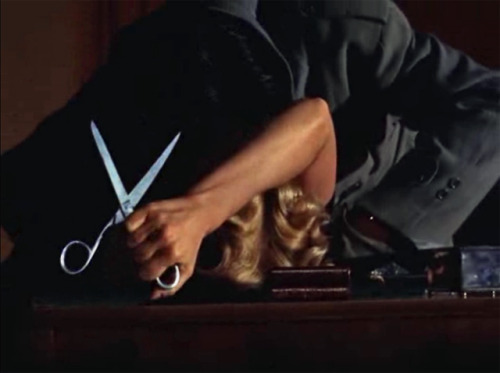
Before the age of digital editing suites, the link between film and scissors was always strong. It was the chief implement in the editing process, that destructive act of cutting that gave birth to the language of cinema, montage. Alfred Hitchcock was a passionate believer in the manipulative power of montage, so it's no surprise he held the humble scissors in such high regard.
In his book The Hitchcock Murders, Peter Conrad tells of a Lincoln Centre tribute to Hitchcock in 1974, during which the great man watched a compilation of clips from his films. The anthology of abreviated killings concluded with Grace Kelly stabbing her attacker in Dial M for Murder. 'The best way to do it,' Hitchcock commented, 'is with scissors.'


The idea of the scissors predictably stimulated Hitchcock's taste buds. For him, murder was aesthetic, erotic, but also appetitive. He rejected a shot from Dial M for Murder because the blades of the scissors did not flash as they arched through the air. 'A murder without gleaming scissors,' he reasoned, 'is like asparagus without the Hollandaise sauce - tasteless.'

Peter Conrad, The Hitchcock Murders


When Hitchcock and Dali came together to collaborate on the dream sequence for Spellbound (1945), it's no surprise to see scissors playing such a prominent role, a giant pair slicing through eyeballs, not only in homage to Bunuel's Un Chien Andalou (1928) but also in symbolic allusion to the editing process itself, its power to do violence to our minds via our eyes. Cinema, this moment implies, is the unconscious incarnate, a shining implement to access those archetypal images buried deep in our dreams.


Fifty years later and those same giant scissors made another appearance in a dream sequence. Everyone remembers the feelgood gutterball sequence in The Big Lebowski, but possibly tend to forget how it ends, the Dude being chased by three nihilists in orange body-suits brandishing enormous, threatening scissors.
Is this an example of Jung's archetypal unconscious at work? Did one or both of the Coen's dream those scissors, or see them in a vision? Or were they found in a studio cupboard, left there ever since filming on Spellbound finished? Or is it simply that the Coens know their film history so well that they wanted to pay homage to Hitchcock's dream-image in much the same way he did to Bunuel's all those years before? You decide.

Tuesday, November 3, 2009

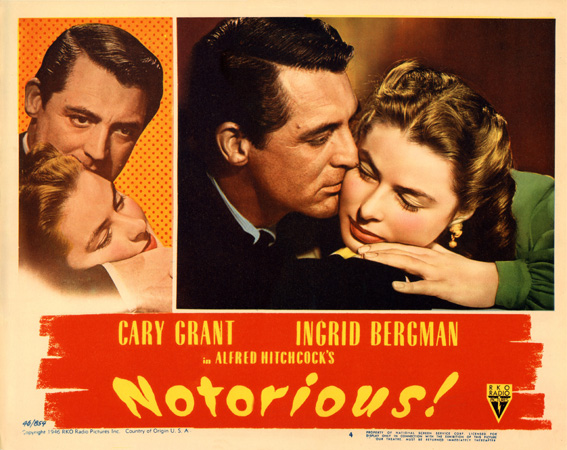
Ten thoughts inspired by: Notorious


1. First of all, there's the symbiotic dance between directors and actors. Many of the best directors, those interested in psychological states, often struggle if they haven't got the right actors. Look at how often Hitchcock's lesser films are saddled with actors ill-suited to the roles, actors with no depth to begin with or whose guarded personas don't allow him anything to mine. (Think of Paul Newman in Torn Curtain). Look at how his well-known yen for beautiful actresses is matched in every respect by actors who brought the best out of him, Cary Grant and James Stewart mainly, but also Joseph Cotten,(Shadow of a Doubt) Robert Walker,(Strangers on a Train) and Barry Foster (Frenzy) to name just a few.

2. Look at how Hitchcock brings out things in these actors no-one else did, but equally, look at the riches flowing the other way too. He needed them, these conduits into transgressive areas. When he was lucky enough to get them he was brilliant at finding their hidden dark sides, all that alienation, misanthropy and self-hatred not far from the surface of charming exteriors (Cotten, Walker & Foster), how easily Stewart's pious do-goodery, his martyr's passion for justice could tip over into obsessiveness and destruction.


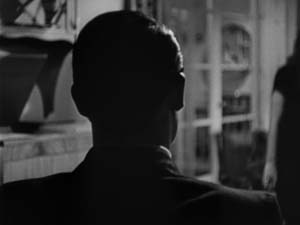
3. In Notorious he strips away Grant's easy charm, strips away 'Cary Grant' really, leaving this sauve husk, this dangerous void, (think of the first time we see Devlin in the film, just the back of his head, ominously watching the other party revellers). As an Englishman Hitchcock would have been more aware than most of the constructed nature of Grant's Hollywood persona, of the real Cockney hiding behind it, the slum-dog acrobat Archibald Leach. Surely the day he met Grant was the day he began to be fascinated by what's hidden behind charming exteriors?


4. Hitchcock's relationship with his screen women is no less fascinating and collaborative. Sure it graduated towards sadism in his later years but in the 40s it was romantic, an exploration of emotional complexity and a product of the natures of the actresses he worked with, mainly Ingrid Bergman.


5. No actress gave herself up to suffering like Bergman. Vulnerability, defiance, self-hatred, sadness, bravery, watch her take on all of these and more in Notorious, from drunken floozy to endangered heroine, beautiful all the way. You can sense Hitchcock's spellbound fascination with her, not just visually, but emotionally too, the way she's leading the film into places it might not have gone without her. Imagine what kind of film it would've been with a different actress, Rita Hayworth, say, or Jean Arthur?


6. Then there are those poor forgotten puppies of the movie business, the writers. Consider that Notorious was written by Ben Hecht, probably the geatest screenwriter of the golden age of Hollywood. He seems to have brought a new seriousness to Hitchcock, a grown-up respect for emotional terrain, for the classical marriage of form and content. You feel that everyone's on their game because Hecht has given them something better than usual. You also feel that part of what makes Notorious work so well are the details. Hitchcock was frequently sloppy when it came to details, openly deriding the plot devices (the famous McGuffins) at the centre of his movies. You sense that Hecht, that good newspaper man at heart, researched his locations and made sure the McGuffin here, uranium hidden in wine bottles, had a hint of truth to it (a year before the first atomic bomb was detonated.)

7. And don't forget the sly pleasures of Claude Rains. He's every bit as complex a character as the leads. With a little tweaking it could easily be his film, poor man, trapped by evil Nazi cronies who'll kill him at the slightest hint of betrayal, in love with a woman who turns out to be a spy and in thrall to a vicious, manipulative mother, forced to be a Nazi when all he really wants to be is a playboy, as charming and witty as Claude Rains.


8. And then there's patriotism, the last refuge of the scoundral. Devlin is seemingly willing to let the woman he loves whore herself for a greater cause, for the greater good. Is he right or wrong to do this? If this was post 9/11 rather than post WW11 would it look any better? And is it really patriotism or something else entirely, a desire to punish her for all those men she's slept with before him. Notice the cold way he looks at her sometimes. She's making him weak and he hates her for it, complicating everything, the simple certainties of good and evil, of allegience to job and country, of knowing who the enemies are. He looks at her and all certainty disappears. Only love can do this. It's superbly complicated, the kind of love rarely seen in Hollywood movies, then or now.


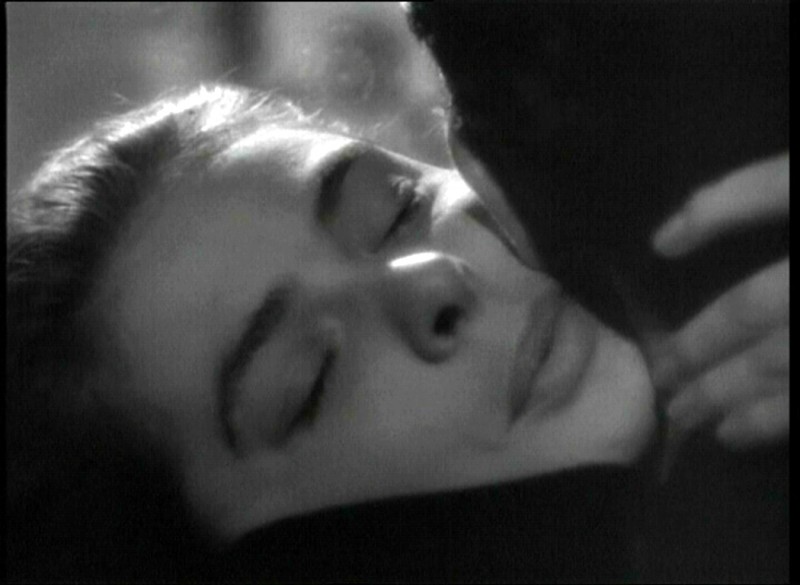
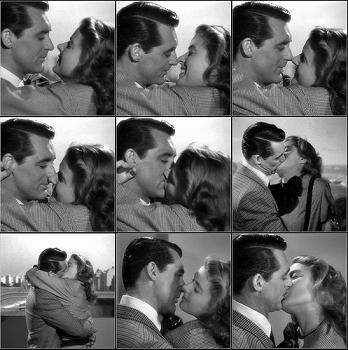
9. But it is love, and despite all its noir darkness this is a very romantic film. So let's not forget the famous, Hay's Code defying, extended kiss, a genius scene capturing the true carnal pleasure of lovers, all nuzzling little kisses and the addiction of closeness.


10. And finally, there's the truth of the camera, Hitchcock's eternal belief in movement for its own sake, for the pleasure of it, yes, but also for the way it could illustrate thoughts, feelings and situations better than anything Ben Hecht or anyone else could conjure up in words. So see it give you set-up and secret in one elegant swoop from staircase longshot to key-in-hand close-up or watch it thrillingly capture the heart-in-mouth shock of discovering your husband and his mother have been poisoning you by zooming into their smug, conniving faces.