Showing posts with label dali. Show all posts

Thursday, February 24, 2011

Hollywood Surreal


Mentioning Dali and Disney yesterday reminded me that they did actually collaborate once. The two met at a Hollywood party while Dali was working with Hitchcock on the dream sequences for Spellbound (1945). Dali was a huge Disney fan, considering him one of America's great surrealists along with Cecil B. De Mille and Harpo Marx. (He'd clearly never seen a Fleischer cartoon). In fact Dali's first links with Hollywood went back to 1936 when he'd met Harpo at a party in Paris. (Someone really should do a thesis on the importance of parties to the development of 20th century art).


After sending him a present of a barbed-wire harp Dali came to Hollywood the following year to paint Harpo and wrote a typically bonkers screenplay while he was there for a proposed Marx Brothers film to be called Giraffes on Horseback Salad. Not surprisingly it was never made. There was also a sadly-aborted project with Fritz Lang around 1940 before he teamed up with Hitchcock four years later and finally got something on screen.


And then he met Disney. By January 1946 he was working under contract with studio artist John Hench on storyboarding a six-minute sequence for the film Destino. Every morning he'd go to work at Disney's studio (on Dopey Avenue!) just like a regular employee. Can you imagine Dali turning up at your work place every day? Eating his melty cheese in the canteen, waxing his moustache in the tiolets? This unlikely scenario must have seemed pretty surreal in itself. But Dali really was there to work. He produced paintings, sketches and guide images on lined paper. Unfortunately, like many of his Hollywood ventures, it never came to fruition. Disney's financial problems at the time meant the film was mothballed indefinately.


But in 1999, during work on Fantasia 2000, Disney rediscovered the lost project and decided to bring it back to life using the original storyboards. Finished in 2003 (and given a limited theatrical release with, of all things, Calendar Girls - now that's surreal) it tells the story of the Greek god of time, Chronos, and his love for a mortal woman who dances through a virtual compendium of classic Dalí images. The song, by composer Armando Dominguez, sung by his Mexican compatriot Dora Luz, casts a moodily romantic spell. 'This heart of mine is thrilled now, my empty arms are filled now, as they were meant to be' she sings as if in a reverie. 'For you came along, out of a dream I recall...to answer my call, I know now that you are my destino.' The dream of love triumphs then, in classic Hollywood style, over surrealism's Freudian nightmares, over time itself. Destiny, it seems to say, is time's DNA, forever with us, ready to spring from our dreams and save us, if only we can decipher it.


Dali's stock may have fallen greatly in his latter years, and his Hollywood ventures may well have been the start of his decline, but they were also a genuine, if star-struck, engagement with the dream factory, an attempt to bring his surreal ethos to a mass audience. In Destino, though, it feels like the opposite happened, that nearly a decade after he first followed Harpo to Hollywood, it was Dali who was being taken over by its ethos, undone by the high romance of popular song, the heady power of princess dresses and wild hair.

Wednesday, February 23, 2011

Swing You Sinners!


More wonderful Fleischer madness, this time from 1930. Swing You Sinners is based around a reworking of a popular gospel song of the time called Sing You Sinners, which it jazzifies and scats to great effect. Once again an ordinary situation, dog tries to steal chicken, quickly evolves into a surreal, nightmarish tour de force like nothing you've ever seen before. The Fleischer world is alive with the mutability of forms, booby-trapped with malevolent or mischievous intent, everything in danger of changing at a moment's notice. It's like what would've happened if Salvador Dali had secretly replaced Walt Disney, except it has a primitive power closer to the superstitions of folk art or the medieval biomorphic weirdness of Hieronymus Bosch than to Dali's arid dreamscapes. In fact the latter stages of Swing You Sinners are Bosch-like in spirit, with all the demented Dutch master's hellish glee in the damnation of sinners. Unlike Bosch though, it also has gallows humour, slapstick charm and the swinging rhythm of the music. A strange little masterpiece.

Sunday, August 29, 2010

The Archetype Abides

For psychologist Carl Jung his patients' dreams were to be taken as seriously as any waking experience they may have had. If one described a dream about traveling to India, Jung would get a map and ask him to point out exactly where in India he had been.


Taking the dream experience seriously, as an arena of symbolic clues, led him to believe that the psyche contained common archetypes, recurrent images that could be found in cultures all over the world, past or present, primitive or modern.


Studying ancient texts and traveling the world, spending time in African villages and American-Indian reservations, he came to believe people saw these images in dreams or visions, that these states were a way for our minds to access a reservoir of shared knowledge, what he variously called universal consciousness or the collective unconscious.


BRYSON: I understand that the geology confirms the images. The images are your private images in Dali's head but painted out they correspond to a reality.

DALI: Exactly...my delirium is injected and sublimate in these rocks and in this geology. There's many kinds of imagination, [such as] the Romantic imagination, almost never exist in rock. It's only fog, music, evanescent visions of Nordic countries [where] everything is completely musical. This also is very clear in my moustache because my moustache is the contrary of the moustache of Friedrich Nietzsche. Friedrich Nietzsche is the depressive moustache, plenty of music and fog and romanticism and the Dalí moustache is exactly the same que two erected scissors completely metallic.

Salvador Dalí, interview with David Bryson, BBC Third Programme, 1962


In his autobiography Dali told a story about how he used to go walking with a girl to whom he showed off with copies of L'Esprit Nouveau, a magazine edited by Le Corbusier and Fernand Leger: 'she would humbly bow her forehead in an attentive attitude over the Cubist paintings. At this period I had a passion for what I called Juan Gris' 'Categorical imperative of mysticism'. I remember often speaking to my mistress in enigmatic pronouncements, such as, 'Glory is a shiny, pointed, cutting thing, like an open pair of scissors'...'


Before the age of digital editing suites, the link between film and scissors was always strong. It was the chief implement in the editing process, that destructive act of cutting that gave birth to the language of cinema, montage. Alfred Hitchcock was a passionate believer in the manipulative power of montage, so it's no surprise he held the humble scissors in such high regard.
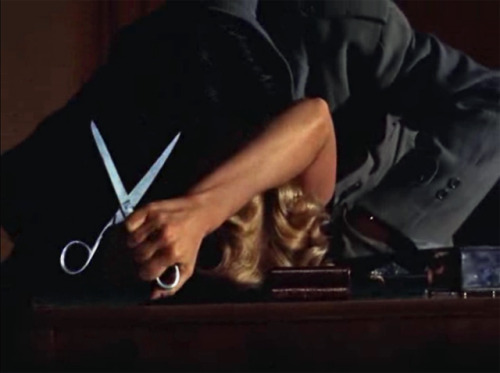
In his book The Hitchcock Murders, Peter Conrad tells of a Lincoln Centre tribute to Hitchcock in 1974, during which the great man watched a compilation of clips from his films. The anthology of abreviated killings concluded with Grace Kelly stabbing her attacker in Dial M for Murder. 'The best way to do it,' Hitchcock commented, 'is with scissors.'


The idea of the scissors predictably stimulated Hitchcock's taste buds. For him, murder was aesthetic, erotic, but also appetitive. He rejected a shot from Dial M for Murder because the blades of the scissors did not flash as they arched through the air. 'A murder without gleaming scissors,' he reasoned, 'is like asparagus without the Hollandaise sauce - tasteless.'

Peter Conrad, The Hitchcock Murders


When Hitchcock and Dali came together to collaborate on the dream sequence for Spellbound (1945), it's no surprise to see scissors playing such a prominent role, a giant pair slicing through eyeballs, not only in homage to Bunuel's Un Chien Andalou (1928) but also in symbolic allusion to the editing process itself, its power to do violence to our minds via our eyes. Cinema, this moment implies, is the unconscious incarnate, a shining implement to access those archetypal images buried deep in our dreams.


Fifty years later and those same giant scissors made another appearance in a dream sequence. Everyone remembers the feelgood gutterball sequence in The Big Lebowski, but possibly tend to forget how it ends, the Dude being chased by three nihilists in orange body-suits brandishing enormous, threatening scissors.
Is this an example of Jung's archetypal unconscious at work? Did one or both of the Coen's dream those scissors, or see them in a vision? Or were they found in a studio cupboard, left there ever since filming on Spellbound finished? Or is it simply that the Coens know their film history so well that they wanted to pay homage to Hitchcock's dream-image in much the same way he did to Bunuel's all those years before? You decide.