Showing posts with label 1930s. Show all posts

Thursday, March 3, 2011

The Strange World Of Charley Bowers


In his 2002 novel, The Book of Ilusions, Paul Auster invented his own silent movie comedian, a once celebrated figure forgotten by all but a few archival specialists. Hector Mann had disappeared in mysterious circumstances in 1929 and over the years his star had faded to obscurity. Then, in the early 1980s, canisters of his lost films began turning up in archives around the world.
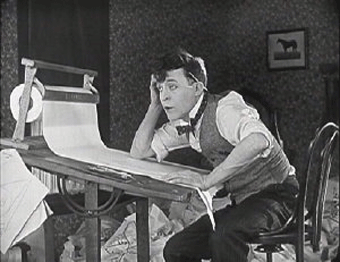
It's hard not to think of Mann when confronted by the real-life story of Charley Bowers, a silent movie comedian/cartoonist who made his last proper film in 1930 and essentially disappeared too, although his vanishing act wasn't total or mysterious. He just went to live in New Jersey where he drew cartoons for the local paper until his death in 1946. But if it wasn't for a chance find of French copies of some of his films in the 1970s he would still be entirely unknown.
Although his screen persona was reminiscent of Buster Keaton, Bowers was only an average performer. What makes his films interesting today are their stop-motion flights of fancy. He's closer in temperament to someone like Georges Melies than to any of his contemporary comedians. His strange imagination was so pronounced that even Andre Breton, the principal founder of Surrealism, championed his first sound film It's A Bird (1930). In it, a comical, metal-eating bird consumes some car parts before laying an egg which proceeds to hatch a small, dark object that transforms into a full-sized car before our eyes. It's a little marvel of technical skill and private imagination following its own oddball reveries.


And then there's this madness. One of his twelve silent films, There It Is is a bizarre tale in which a house is terrorised by a little bald man called the Fuzz-Faced Phantom and a Scotland Yard detective is sent to investigate along with his assistant, an animated insect. If that sounds weird it's nothing to the actual film. It may not be very funny but that hardly matters when the actions of the Fuzz-Faced Phantom amount to nothing less than an attack on rationality itself, an exercise in epic randomness that has the illogic of a nightmare.


But my favourite Bowers moment happens near the end of probably his most successful film, Now You Tell One from 1926. In it, members of a Liars Club are competing to see who can tell the tallest tale. This section has some nice moments, especially the forty-seven elephants streaming into Capitol Hill, but then Charley tells them about a potion he's invented that allows him to graft anything onto anything else. Setting out to sell this potion he arrives at a farm overrun by mice where he grafts a much-needed cat from a plant. The result is a protoplasmic effusion of cats growing from this plant like balloons, bodies forming in seconds. It's a surrealistic image worthy of Rene Magritte or Max Ernst.

Wednesday, February 23, 2011

Swing You Sinners!


More wonderful Fleischer madness, this time from 1930. Swing You Sinners is based around a reworking of a popular gospel song of the time called Sing You Sinners, which it jazzifies and scats to great effect. Once again an ordinary situation, dog tries to steal chicken, quickly evolves into a surreal, nightmarish tour de force like nothing you've ever seen before. The Fleischer world is alive with the mutability of forms, booby-trapped with malevolent or mischievous intent, everything in danger of changing at a moment's notice. It's like what would've happened if Salvador Dali had secretly replaced Walt Disney, except it has a primitive power closer to the superstitions of folk art or the medieval biomorphic weirdness of Hieronymus Bosch than to Dali's arid dreamscapes. In fact the latter stages of Swing You Sinners are Bosch-like in spirit, with all the demented Dutch master's hellish glee in the damnation of sinners. Unlike Bosch though, it also has gallows humour, slapstick charm and the swinging rhythm of the music. A strange little masterpiece.

Saturday, February 19, 2011

Minnie The Moocher


Before Disney annexed it to colonise the imagination of children forever more animation was a place of anarchic possibility. Take that troubling minx Betty Boop. Always cavorting half-dressed through life, Betty was the 1930s most unlikely sex symbol. Originally Bimbo the dog was the star with Betty only making cameo appearances, unnamed and not even really human. Before she was a woman, Betty was a dog, a cat and even a fish. It was evolution cartoon-style and the man responsible was Max Fleischer, the greatest rival to the early Disney empire, an audacious pioneer also responsible for the first Popeye and Superman cartoons.
As film archivist Dennis Nyback explains, Max and his brothers, Dave and Leonard, had a unique way of making their films, working backwards from music to drawings in exactly the opposite way most other animation outfits work. Jazz fan Leonard would bring in the latest hot records from black artists and the animators essentially improvised to the music. The results were often surreal and revelatory. Take Minnie The Moocher from 1932. It starts off with real footage of Cab Calloway and his orchestra performing the song, Calloway doing his super-cool (and much-imitated) dance moves. Dennis Nyback explains the reason for this live-action footage:

...the head of the New York musician’s union...didn’t like the use of records without paying royalties. Max invited him to the studio and made him a deal. He offered to have the musicians come to the studio and be paid for performing. He would then film and record them. The filmed images of the jazz performers would appear in a Fleischer cartoon based on their record, exposing them to wider audiences...As a result we can see Cab Calloway...and other jazz greats of the early thirties in Fleischer cartoons. (This did not sit well with bigots. The appearance of black performers with white Betty Boop elicited threats from the Ku Klux Klan.)
The film starts with Betty getting into a fight with her parents. Upset, she decides to run away. She calls Bimbo, they meet up and begin their escape. Soon though it gets dark and the strains of Minnie The Moocher begin. Frightened, they duck into a cave where a strange walrus creature appears and sings the song to them. This is clearly Calloway. The Fleischers used their own invention, rotoscope, to animate his movements by tracing frames of the live action film. (It was one of the many innovations they were responsible for. They also pioneered the use of synchronised sound three years before The Jazz Singer). What follows is a nightmare vision of skeletons, ghosts, dead-eyed cats and the scariest witch to ever fly towards a camera from out of nowhere. Even the Calloway-infused walrus is disturbing, with its weirdly distended and fleshy body. Soon a terrified Betty is running home to hide under her bed covers. As would any of us if confronted by this night of the dead. It's creepy enough as a cartoon. Hi-dee-hi-dee-ho indeed.