Showing posts with label animation. Show all posts
Showing posts with label animation. Show all posts
Friday, August 9, 2013
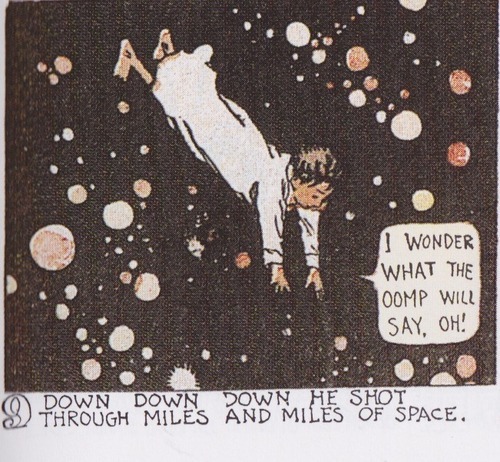
Watch Me Move - Little Nemo (1911)
There had been earlier forays into animation, James Stuart Blackton's chalk-drawn Humorous Phases of Funny Faces (1906) or Emile Cohl's Fantasmagorie (1908) before Winsor McCay got in on the act. By 1911 McCay was the most famous cartoonist in America, creator of two hugely popular comic strips, Dream of a Rarebit Fiend and Little Nemo in Slumberland when, apparently inspired by his son's flip books, he decided movement was the logical next step. He hooked up with Blackton at Vitagraph Studios and they set about constructing a film around this process. Winsor McCay, the Famous Cartoonist of the N.Y. Herald and his Moving Comics, as it was called (usually referred to now as Little Nemo) begins with live-action sequences in some kind of club where McCay showcases his quick drawing skills (he was famous from a young age for this) to his artist buddies. He makes a wager that, in just one month, he can create the four thousand drawings required to make these comic characters move. They laugh good-naturedly at this madness. (Note that Cohl used 700 drawings over a four to five month period to make Fantasmagorie). Next we see him hard at work surrounded by cartoon-like props, comically large containers for paper and ink. Finally he's finished. A projector is set up in the club and we see the three famous characters from the strip - Little Nemo, Flip and The Imp - come to life, forming magically out of thin air. What follows is a moment of freedom, liberation. They contort, fight, expand like fair ground mirrors, draw other characters (that's McCay animating a character speed drawing another character) until finally Nemo rides off in the jaws of a dragon with a princess. These are not just chalk drawings but finely-rendered characters, in colour, moving through space with anarchic glee. It's the true birth of animation. Although McCay would go on to more ambitious projects like Gertie the Dinosaur, these two minutes of plotless transformation retain the magic of first moments, the breakthrough wonder of discovery.



Thursday, March 3, 2011
The Strange World Of Charley Bowers
In his 2002 novel, The Book of Ilusions, Paul Auster invented his own silent movie comedian, a once celebrated figure forgotten by all but a few archival specialists. Hector Mann had disappeared in mysterious circumstances in 1929 and over the years his star had faded to obscurity. Then, in the early 1980s, canisters of his lost films began turning up in archives around the world.
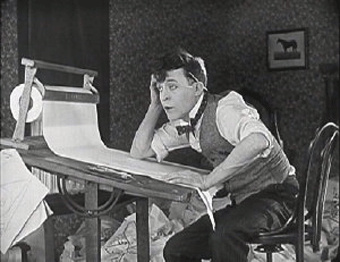
It's hard not to think of Mann when confronted by the real-life story of Charley Bowers, a silent movie comedian/cartoonist who made his last proper film in 1930 and essentially disappeared too, although his vanishing act wasn't total or mysterious. He just went to live in New Jersey where he drew cartoons for the local paper until his death in 1946. But if it wasn't for a chance find of French copies of some of his films in the 1970s he would still be entirely unknown.
Although his screen persona was reminiscent of Buster Keaton, Bowers was only an average performer. What makes his films interesting today are their stop-motion flights of fancy. He's closer in temperament to someone like Georges Melies than to any of his contemporary comedians. His strange imagination was so pronounced that even Andre Breton, the principal founder of Surrealism, championed his first sound film It's A Bird (1930). In it, a comical, metal-eating bird consumes some car parts before laying an egg which proceeds to hatch a small, dark object that transforms into a full-sized car before our eyes. It's a little marvel of technical skill and private imagination following its own oddball reveries.
And then there's this madness. One of his twelve silent films, There It Is is a bizarre tale in which a house is terrorised by a little bald man called the Fuzz-Faced Phantom and a Scotland Yard detective is sent to investigate along with his assistant, an animated insect. If that sounds weird it's nothing to the actual film. It may not be very funny but that hardly matters when the actions of the Fuzz-Faced Phantom amount to nothing less than an attack on rationality itself, an exercise in epic randomness that has the illogic of a nightmare.
But my favourite Bowers moment happens near the end of probably his most successful film, Now You Tell One from 1926. In it, members of a Liars Club are competing to see who can tell the tallest tale. This section has some nice moments, especially the forty-seven elephants streaming into Capitol Hill, but then Charley tells them about a potion he's invented that allows him to graft anything onto anything else. Setting out to sell this potion he arrives at a farm overrun by mice where he grafts a much-needed cat from a plant. The result is a protoplasmic effusion of cats growing from this plant like balloons, bodies forming in seconds. It's a surrealistic image worthy of Rene Magritte or Max Ernst.
Subscribe to:
Posts (Atom)