Showing posts with label ingrid bergman. Show all posts

Monday, June 20, 2011

Clip Joint Round-Up: Pianos


Hello. It's been a while. Been busy with proper life stuff and general brain freeze. To get back in the groove I thought I might do a round-up of last weeks's Clip Joint over at The Guardian, one of the few things I've had the attention span to contribute to recently. So, the task, choose five from all the suggested clips. This week's theme was pianos, which turned out to be an inspired one. As the great clips kept coming I thought to myself, god, I wouldn't want to have to pick five from this lot. And then I thought, but if I had to, what would they be? So here I am, doing that. The five chosen by Tess can be found here, just scroll down a bit to see them.


First up for me has to be Jean Arthur and Cary Grant in Only Angels Have Wings. It was hard picking just one Howard Hawks scene as I've had to leave out Hoagy Carmichael and Lauren Bacall's iconic double-act from To Have And Have Not but in the end that undulating thing Arthur does with her arm and Grant yelling PEA-NUT! swung the deal. In two minutes the piano tells us plenty about her; that she's a tougher cookie than she first appears, a practised performer who's been around plenty of those disreputable rogues, musicians. And the brief bit of introspective noodling tells us she's been hurt in love too, almost certainly by one of those musicians. Here then, we not only have the Hawksian world-view encapsulated in one scene but also an example of the way pianos act as social hubs, focal points for gathering around, starting parties, lining up shots glasses. A piano, this scene tells us, is more than an instrument, it's a test of character, a hurt unlocker, a standing invitation.


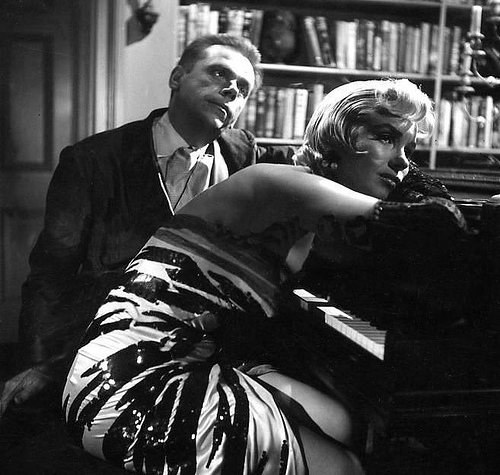
Or, in the case of The Seven Year Itch, a libido unlocker. That's certainly how Tom Ewell sees it, or imagines it. This was the scene posted, but we forgot about an earlier one, where Ewell fantasises about the effect Rachmaninoff will have on Monroe, how its deep romantic seriousness will induce shakes and quakes and goosebumps, leaving her helpless putty in his arms. Here we have the less exalted reality. Instead of Rachmaninoff we get chopsticks, instead of a fantasy sex goddess there's a girl having thoughtless fun. Marilyn still gets goosebumps, though. And how! But Ewell ends up flat on his face. Monroe's girlish enjoyment is infectious. She's not some pretentious siren of desire, classical dream-cords reverberating through her body. She's the simple, surface fun of chopsticks. The piano, in this case, is a personality decoder, an arena of (would-be) seduction, a reservoir of lost childhood pleasure.


As I said above, the piano is a standing invitation. Especially in an empty room. And double-especially in an empty bar. It seems to call to certain people, to tempt them away from reality, like Alain Delon in this scene from Jean Pierre Melville's Un Flic. It's a homage I'm sure to Sinatra, who invented (or crystalised) this tough-guy-reveals-sensitive-side-playing-piano-in-an-empty-bar schtick. It's a moment of private reverie, time holding its breath, Delon playing an introspective, jazzy piece, cigarette in his mouth, Catherine Deneuve listening unseen in the shadows, falling for him with every note. The piano, this tells us, is an interzone, a world unto itself, touchstone of timeless cool, summoner of goddesses from the dark.


'It hurts', Ingrid Bergman explains to Liv Ulmann, 'but he doesn't show it.' The film is Ingmar Bergman's Autumn Sonata, the he is Chopin, the piece is his Prelude No. 2. which Ulmann has been playing just before this, every halting note clearly torture to her concert pianist mother, who is now going to show how it should be played. What follows is a lesson and a humiliation. As she plays, Ulmann gazes at her. The look is mesmerising, total; need, resentment, love, hurt, all held in sway by those hypnotic, mysterious notes. Just look at me, notice me. It's almost unbearable, the longing for her mother to pay her the same attention she does the piano, to touch her with the same tenderness, the same care. 'Total restraint the whole time,' Bergman emphasises, surely aware of the naked gaze, but refusing to acknowledge it. 'Feeling is very far from sentimentality,' she lectures, as her daughter sits meekly, saying nothing, craving sentimental connection, reduced to a mousy nothing by her elegant, brilliant mother. This piano is a cuckoo in the nest, an all-consuming lover, an instrument of pain, both exalted and plain.


And finally, I've gone for this old gag from Ballot Box Bunny, so good Looney Tunes used it more than once. I like this one best mainly because Yosemite Sam says pie-anna but also because his volcanic temper makes what he does in the end wonderfully inevitable. It's all in the timing. Get that right and it'll be funny forever. I've watched this ten times in the last week and laughed every time. Why when I know what's coming? Well, partly because I do know it's coming and partly it's the rhythm of it. Bugs plays the tune slow, Sam plays it fast. That's part of it too. So, what does this scene tell us about the pie-anna? That it's a potential booby-trap, a punisher of impatience, and comedy's favourite slapstick musical instrument.

Tuesday, November 3, 2009

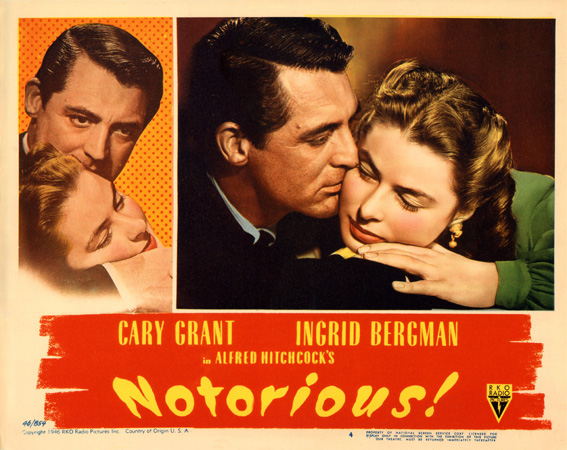
Ten thoughts inspired by: Notorious


1. First of all, there's the symbiotic dance between directors and actors. Many of the best directors, those interested in psychological states, often struggle if they haven't got the right actors. Look at how often Hitchcock's lesser films are saddled with actors ill-suited to the roles, actors with no depth to begin with or whose guarded personas don't allow him anything to mine. (Think of Paul Newman in Torn Curtain). Look at how his well-known yen for beautiful actresses is matched in every respect by actors who brought the best out of him, Cary Grant and James Stewart mainly, but also Joseph Cotten,(Shadow of a Doubt) Robert Walker,(Strangers on a Train) and Barry Foster (Frenzy) to name just a few.

2. Look at how Hitchcock brings out things in these actors no-one else did, but equally, look at the riches flowing the other way too. He needed them, these conduits into transgressive areas. When he was lucky enough to get them he was brilliant at finding their hidden dark sides, all that alienation, misanthropy and self-hatred not far from the surface of charming exteriors (Cotten, Walker & Foster), how easily Stewart's pious do-goodery, his martyr's passion for justice could tip over into obsessiveness and destruction.


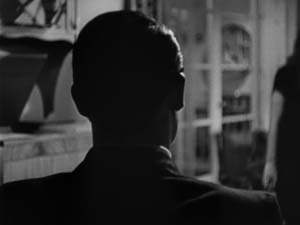
3. In Notorious he strips away Grant's easy charm, strips away 'Cary Grant' really, leaving this sauve husk, this dangerous void, (think of the first time we see Devlin in the film, just the back of his head, ominously watching the other party revellers). As an Englishman Hitchcock would have been more aware than most of the constructed nature of Grant's Hollywood persona, of the real Cockney hiding behind it, the slum-dog acrobat Archibald Leach. Surely the day he met Grant was the day he began to be fascinated by what's hidden behind charming exteriors?


4. Hitchcock's relationship with his screen women is no less fascinating and collaborative. Sure it graduated towards sadism in his later years but in the 40s it was romantic, an exploration of emotional complexity and a product of the natures of the actresses he worked with, mainly Ingrid Bergman.


5. No actress gave herself up to suffering like Bergman. Vulnerability, defiance, self-hatred, sadness, bravery, watch her take on all of these and more in Notorious, from drunken floozy to endangered heroine, beautiful all the way. You can sense Hitchcock's spellbound fascination with her, not just visually, but emotionally too, the way she's leading the film into places it might not have gone without her. Imagine what kind of film it would've been with a different actress, Rita Hayworth, say, or Jean Arthur?


6. Then there are those poor forgotten puppies of the movie business, the writers. Consider that Notorious was written by Ben Hecht, probably the geatest screenwriter of the golden age of Hollywood. He seems to have brought a new seriousness to Hitchcock, a grown-up respect for emotional terrain, for the classical marriage of form and content. You feel that everyone's on their game because Hecht has given them something better than usual. You also feel that part of what makes Notorious work so well are the details. Hitchcock was frequently sloppy when it came to details, openly deriding the plot devices (the famous McGuffins) at the centre of his movies. You sense that Hecht, that good newspaper man at heart, researched his locations and made sure the McGuffin here, uranium hidden in wine bottles, had a hint of truth to it (a year before the first atomic bomb was detonated.)

7. And don't forget the sly pleasures of Claude Rains. He's every bit as complex a character as the leads. With a little tweaking it could easily be his film, poor man, trapped by evil Nazi cronies who'll kill him at the slightest hint of betrayal, in love with a woman who turns out to be a spy and in thrall to a vicious, manipulative mother, forced to be a Nazi when all he really wants to be is a playboy, as charming and witty as Claude Rains.


8. And then there's patriotism, the last refuge of the scoundral. Devlin is seemingly willing to let the woman he loves whore herself for a greater cause, for the greater good. Is he right or wrong to do this? If this was post 9/11 rather than post WW11 would it look any better? And is it really patriotism or something else entirely, a desire to punish her for all those men she's slept with before him. Notice the cold way he looks at her sometimes. She's making him weak and he hates her for it, complicating everything, the simple certainties of good and evil, of allegience to job and country, of knowing who the enemies are. He looks at her and all certainty disappears. Only love can do this. It's superbly complicated, the kind of love rarely seen in Hollywood movies, then or now.


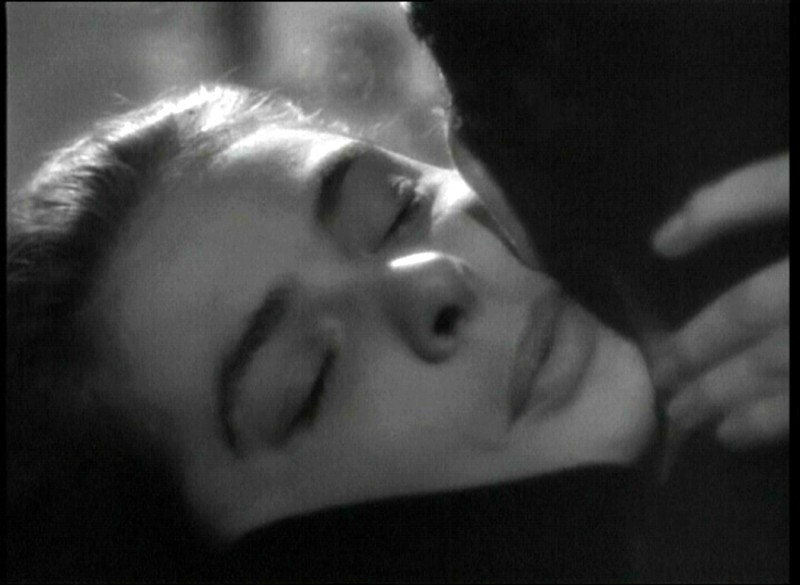
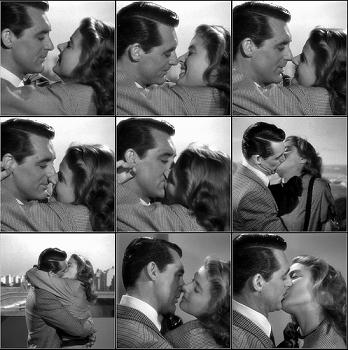
9. But it is love, and despite all its noir darkness this is a very romantic film. So let's not forget the famous, Hay's Code defying, extended kiss, a genius scene capturing the true carnal pleasure of lovers, all nuzzling little kisses and the addiction of closeness.


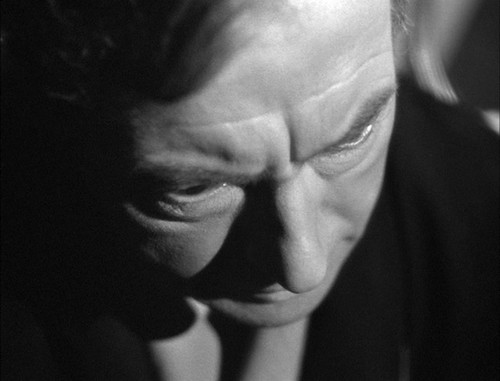
10. And finally, there's the truth of the camera, Hitchcock's eternal belief in movement for its own sake, for the pleasure of it, yes, but also for the way it could illustrate thoughts, feelings and situations better than anything Ben Hecht or anyone else could conjure up in words. So see it give you set-up and secret in one elegant swoop from staircase longshot to key-in-hand close-up or watch it thrillingly capture the heart-in-mouth shock of discovering your husband and his mother have been poisoning you by zooming into their smug, conniving faces.