Monday, October 31, 2011

Happy Halloween Little Pigs!


What makes The Shining stand out is its all-pervading atmosphere. It has its shocks and creepy moments but what really gets you is that slow, pulsing dread. Very few horror movies are genuinely scary, especially as you get older, but The Shining does it still. It's also got Jack Nicholson letting loose the Big Bad Wolf inside, the giddy release of it, especially in the famous 'Here's Johnny!' scene below.
'Little pigs, little pigs, let me come in', he calls, returning the nursery rhyme to its original fear setting, unleashing its allegorical power. It's not just scary though, it's funny, hysterical, in both meanings of the word, pure grand guignol ham. Maybe it's this tension, this close-to-the-edge quality, that inspires butterflies in the stomach every time I watch it. Every time.


And then there's the original trailer, a masterclass in less is more. Of course, when you've got an image as good as this, with all the deadpan clarity of a nightmare, what more do you need? Imagine seeing this in the cinema at the time, having no idea what's coming. Can you imagine the impact it must've had?


And finally, the mournful, unsettling theme by Wendy Carlos and Rachel Elkind, based on Hector Berlioz' interpretation of the Dies Irae, a medieval poem about the day of judgment, the last trumpet summoning souls before the throne of God, where some are saved and some are cast into eternal flames. It's grave music, complete with eerie electronic wailing, the souls of those unsaved no doubt, and it sets a suitably desolate mood for this Halloween night. Enjoy!

Tuesday, October 25, 2011

Last Five Films...

1. Detour (1945)


Edgar G. Ulmer is a fascinating character in film history, a talented man on the verge of a successful career exiled to the world of poverty-row b-pictures because he fell in love with the wrong woman. Could be a noir plot in itself, of course, which might explain why Detour stands up as one of the great noirs despite its manifest cheapness. 'No matter what you do, no matter where you turn, fate sticks out a foot to trip you up,' Tom Neal's hapless narrator tells us, and you can imagine Ulmer identifying with that. The film has the fevered compression and illogic of a nightmare married to location realism (cheap road-side diners, motels etc). Nobody in this film has star charisma. Ann Savage is an amazing presence but her Vera is every inch an ordinary woman driven to the edge by disappointment. Lord knows what she's had to endure but Savage manages to imply a world of desperation and pain. Like an animal mistreated once to often she'll bite the next hand that comes near. She's not going to let anyone get the better of her again, gonna take whatever chance comes her way. She's a monster, a rabid Bette Davis, the American Dream going crazy before our eyes, and the main reason (though far from the only one) to see this lo-fi cult classic.

2. Gun Crazy (1950)


Another unheralded actress delivers an even better performance in Joseph H. Lewis' Gun Crazy. Peggy Cummins isn't exactly a house-hold name, even for fans of classic movies, but she's sensational as carnival sharpshooter Annie Starr. We first see her haloed with fire, a warning if ever there was one. But gun-obsessed Bart Tarr (John Dall) fails to heed it. Instead he's like a horny moth to her flame. 'We go together, Annie,' he tells her later, 'I don't know why. Maybe like guns and ammunition go together'. It's noir fate then, but Gun Crazy is more than a standard noir and Cummins more than a femme fatale. She takes over the film, hijacks it. She's on fire, alive with heat and scheming energy, with outlaw lust, a hipster revolutionary out to play the system by its own game. She may say 'I've been kicked around all my life, and from now on, I'm gonna start kicking back', but you get the feeling grievance is only a small part of it. This is one dame who's been ready to go off for a long time, maybe forever. Sure she wants money, but more than that, she wants action. The sexual thrill of guns, of danger, of death. That's what's really turning them on, a death-wish so strong they can hardly resist it. It's the essense of American cinema; guns and cars, sex and death - living for the moment. And Lewis shoots it like that, with great verve and vérité energy. It's New Wave ten years before Godard, the camera hurrying through real locations, watching from the back seat of moving cars. It puts us right in the moment, especially during a one-take bank robbery that's arguably the greatest single-take scene in all of cinema, small-town streets a panicky blur as they screech around corners, the moment alive with giddy tension. By the end it's transcended its genre, no longer noir, but something more vital and tragic, a Freudian parable, an essential cinematic credo: Thrill crazy. Kill crazy. Gun Crazy.

3. The Big Combo (1955)


Five years later, Lewis delivered another cult gem, but this time the noir conventions are adhered to throughout. All the earlier film's energy and movement are gone, replaced by a stylized, shadowy mise-en-scene that comes close to abstraction. The cinematographer is John Alton, the Rembrandt of noir cinema, the man who literally wrote the book on lighting. It's hard to imagine Lewis daring to shoot on the hoof when Alton was painstakingly setting up the visual geometry of a shot. The result is weapons-grade noir, a world where it's always nighttime, where talk is hardboiled poetry and cops are dogged loners on a mission. It's lifted above the routine, though, not only by Alton's lighting but by the performance of noir-stalwart Richard Conte, fantastic as mouthy gang boss Mr. Brown. He's having a ball rattling out killer dialogue ('Joe, tell the man I'm gonna break him so fast he won't have time to change his pants,') high on his own sense of invincibility, smarter and more ruthless than the mugs around him. Cornel Wilde is suitably weary and dour as Brown's nemesis, Detective Leonard Diamond, but it's hard to warm to him. This is probably what denies the film classic status, the elevating persona of a star performance. (Compare Wilde, say, to Glenn Ford in Fritz Lang's The Big Heat, made two years earlier and very similar in plot and characterisation, where Ford brings a charismatic righteousness to his role that Wilde can't match, a sense of the film's moral universe flowing through him.) Unlike Lang, though, Lewis didn't seem interested in a moral universe. As in Gun Crazy, characters are motivated by instinct and desire. It's an amoral tone that sets the film apart even as it's undermining the plot. We don't really care about Diamond's crusade because Lewis doesn't either, he's having too much fun with the baddies, more alive and vital because they've embraced instinct instead of fighting it. There's an almost gleeful air of perversity, a nasty, unsettling edge that sets the film apart. Brown's henchmen, Fante (a super-cool Lee Van Cleef) and Mingo (Earl Holliman) are clearly meant to be homosexual and the crimelord's classy moll, Susan Lowell (Jean Wallace) stays with him mainly because she gets off on being treated rough. For Lewis, sex is at the heart of the action once again, characters are defined by it, their sexuality as inescapable as any noir fate.

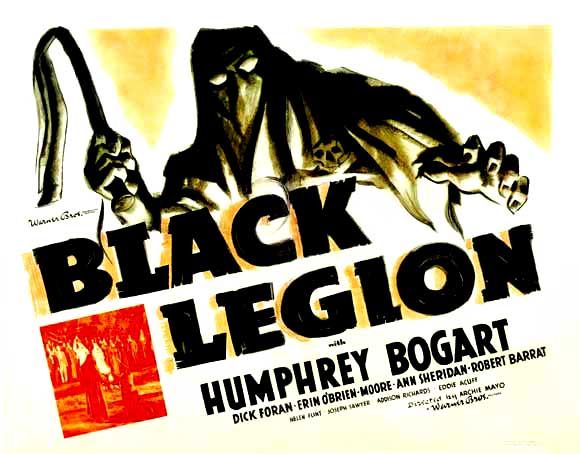
4. Black Legion (1937)


Interesting early Bogart. He plays a factory worker called Frank Taylor who joins a 'pro-American' secret society called the Black Legion when he loses out on becoming foreman to a Polish-born immigrant. The organization is a version of the Ku Klux Klan complete with mumbo-jumbo initiation rites and black robes who intimidate, torture and kill those they believe are taking their jobs. Behind them are shadowy right-wing industrialists hoping to use them for their own ends. As his involvement deepens Frank's marriage crumbles and he turns on his best friend. It's a cautionary tale fresh from the headlines that still retains its power today. There really was a Black Legion and the film is based on an actual killing that took place a few years earlier. Shot in real working class locations it's an unflinching look at the dark side of 30s America, the heart of fascism lurking, anti-foreigner agitation. (It would make a great double-bill with Lang's Fury.) While not a great film it is a fascinating one, a real eye-opener. You just don't expect 30s films to be this realistic, to face up to this kind of ugly truth. Archie Mayo is no-one's idea of a great director but he was a veteran of the cheap potent style of Warners pre-code films and brings an unfussy realism to proceedings, happy to follow the script and get as much in as the Hayes Code would allow, which turns out to be quite a lot. He also directed The Petrified Forest (1936) which saw Bogart make his debut as gangster Duke Mantee, so was possibly responsible for getting him the part (the producers originally wanted Edward G. Robinson). Whatever way he became involved it's a key film for Bogart. You can see him discover the satisfaction of exploring flawed characters, their meanness, paranoia and self-delusion, a seam he would continue in later films like The Treasure of Sierra Madre and The Caine Mutiny. And the film doesn't sugar-coat Frank's involement in this fascist group. For a while he relishes it, high on the power, the late-night adrenaline, admiring himself in the mirror as he holds a gun for the first time, imagining himself in a film (the pre-echoes of Travis Bickle are there). It's a tribute to Bogart's skill as an actor that we retain some semblance of sympathy for Frank by the end. The story received an Oscar nomination and the National Board of Review named it best film of 1937 and Bogart best actor. It should have been his breakthrough but he had to endure four more years of playing second fiddle to Cagney and Robinson before High Sierra finally made him a star. Black Legion should've been it. A must-see for all Bogie fans.

5. You Can't Take It With You (1938)


The Capra Problem was in full effect by 1938, a soft-headed belief in the folksy goodwill of 'ordinary' people. Capra the artist was always at war with Capra the idealist, so the bad things in the world were given their due, Capra understood full well the malign forces in the world, the small-mindedness and greed, (his films keep coming back to them) but he choose to believe that community could overcome it, that simple human empathy would set an example that would save the Republic from ruin. (By 1946, the nightmare seemed so much closer, it was called Pottersville, and the dream of community was so much more feverish and desperate). But this sentimentality always seemed at odds with the darker forces of his films, contrived, something willed and false, as if Capra himself didn't really believe it, or feared he didn't. Here powerful businessman Anthony P. Kirby (Edward Arnold) needs to buy one more house in a twelve block area to build a munitions factory in advance of the war that's coming. How's that for cynical. Only problem is the house belongs to Martin 'Grandpa' Vanderhof (Lionel Barrymore) and he isn't selling. This loveable eccentric has renounced the world of work and money and turned his home into a menagerie of impractical kooks and dreamers. The only 'normal' member of the family is his grand-daughter Alice (Jean Arthur) who works as secretary for Kirby's son Tony (James Stewart). Unaware of the conflict developing between their families Tony and Alice proceed to flirt and fall in love. And so the coming together of the Vanderhofs and the Kirbys is set in motion. It's the stuff of stage farce and romantic complication, sure, but it's also an essential American conflict, money versus freedom, conformity versus rebellion, those who believe in and profit from the system verses those who turn their backs on it, not so much the haves and the have-nots as the haves and the want-nots. Despite this ideological battle the film teeters on the edge of being 'quirky' or 'kooky' or any of those dread words. Only towards the end does it fall over that edge completely. And yet, there's a delicately played romance between Stewart and Arthur that's so good you'll wish there was more of it, some precient speeches about fear and a couple of genuinely funny scenes. As so often with Capra, there's much to like, much to chew over in his contradictions and failings. Live your life for yourself, be true to yourself, there's more to life than money. All these platitudes are true but they don't make great art. Telling a banker he's a bad father and getting him to play the harmonica will not change American capitalism no matter how much Capra wants it to. If only it was that easy.

Friday, September 30, 2011

Building A Statue Of Snow


"LAWRENCE!" O'Toole spat out, swallowing his Scotch. "I became obsessed by that man, and it was bad. A true artist should be able to jump into a bucket of shit and come out smelling of violets, but I spent two years and three months making that picture, and it was two years, three months of thinking about nothing but Lawrence, and you were him, and that's how it was day after day, and it became bad for me, personally, and it killed my acting later. After Lawrence...I did BAAL and a close friend of mine, after my dress rehearsal, came back and said, `What's the matter, Peter, what is it?' I asked what the hell he meant, and he said, `There's no give!'...Christ, his words struck terror in me. Oh, it was bad acting! I was flabby, diffuse...Later I said, 'You're in trouble daddy,' and I felt it in my fucking toes. I was emotionally bankrupt after that picture.


"Oh a BBC show...I said that after LAWRENCE I was afraid of being mutilated. That filming for that length of time, two years, three months, and having all the responsibility for the performance but none of the control...Christ, in one scene of the film I saw a close-up of me when I was 27 years old, and then 8 seconds later, there was another close-up of me when I was 29 years old! 8 goddamn seconds! and two years of my life had gone from me!


Oh, it's painful seeing it all there on the screen, solidified, embalmed," he said, staring straight ahead toward the rows of bottles. "Once a thing is solidified it stops being a living thing. That's why I love the theatre. It's the Art of the Moment. I'm in love with ephemera and I hate permanence. Acting is making words into flesh, and I love classical acting because...because you need the vocal range of an opera singer...the movement of a ballet dancer..you have to be able to act...it's turning your whole body into a muscial instrument on which you yourself play...It's more than behaviorism, which is what you get in the movies...Chrissake, what are movies anyway? Just fucking moving photographs, that's all. But the theatre! Ah, there you have the impermanence that I love. It's a reflection of life somehow. It's...it's...like building a statue of snow...."

Peter O'Toole looked at his watch. Then he paid the barman and waved good-bye to the drunks in the corner. It was 1:15 P.M.--time to be getting to the track.

- from FAME AND OBSCURITY by Gay Talese

Thursday, September 8, 2011

Classic Scene #32

Hello! Haven't had time for blogging recently as our third child arrived in the world last Friday, nearly five weeks early. His sudden appearance has left me feeling much like Martin Blank in this scene from Grosse Point Blank; ambushed, perplexed, awestruck. 'Love dares you to care...' Bowie sings as Martin begins to feel the earth move beneath his feet. To hold that little life in your hands is to feel self-interest dissolve, to find yourself, yes, under pressure, but in a good way, undone by relief and stupid happiness, by responsibility for something fragile and mysterious and greater than you. How has this creature ended up in my arms, Martin's expression tells us, and why can't I stop looking at him? That's been me for the last six days.

Wednesday, August 24, 2011

I'm Ready For My Close-Up Mr Steichen!

An amazing portrait of Gloria Swanson by Edward Steichen from 1924. The eyes behind the veil are amazing, those of a seer, a prophetess, a hypnotiser of silent movie audiences.


Thursday, August 18, 2011

Clip Joint Round-Up: Voice-Over


I love a good voiceover. It's always annoyed me when people (like Robert McKee) dismiss them as a failure of cinematic storytelling, as if cinema was a pure art form and not a mongrel one made up of all the others, plus that little bit extra, that cinema magic, that alchemy. There are plenty of sloppy voice-overs, of course, but the best add mood, poetry, depth and complication to the cinema experience. I liked this Clip Joint because it laid out, in clip after clip, how essential the voice-over/narration has been to so many great films and filmmakers, how the history and development of the medium would be immeasurably poorer without it. Once again, picking favourites was tough, but I ultimately choose the five below. Steenbeck's well thought-out choices are here below the main article.

It's clear now the theatrical soliloquy was always a frustrated voice-over, the only way dramatists had to let audiences know what characters were thinking. But cinema solved this problem. Now we were inside their minds, their inner voice somehow speaking in our minds, a new form of telepathy. It's one of cinema's great weapons of seduction, the intimacy of that disembodied voice, especially if delivered in the velvet purr of a great actor. Laurence Olivier used it in his Hamlet (1948) to emphasise certain lines in the 'to be or not to be' speech, but couldn't resist the actorly chance to declaim much of it as he would have on stage. It was left to Orson Welles (as it so often was) to fully merge the theatrical with the cinematic in his Shakespeare films, especially Othello (1952) where he seems to have realised the soliloquy was a natural voice-over, that it added that air of brooding self-absorption required for acts of tragic folly.


Noir captured that late '40s mood of existential dread, a generation's collective hangover from the traumas of war, its uneasy awareness of how the forces of history and politics could sweep people away. So if you could die at any minute, if you were merely an expendable pawn in someone else's game, what did anything matter? (This was the seed from which cool was born, of course. Not caring being the essence of it). This fatalism was inextricably linked to the laconic tone of the voice-over. Think of Robert Mitchum in Out Of the Past (1947) watching Jane Greer enter La Mar Azul. 'And then I saw her', he tells us, 'coming out of the sun.' That line's no accident I think. We're in Mexico, Acapulco, home of the Aztecs, whose sun gods demanded human sacrifice as tribute or they'd refuse to move across the sky. So here comes Kathie Moffat, out of the sun, demanding a human sacrifice of her own. And Jeff Bailey is it. He doesn't know it yet but his voice-over does. That's no woman coming towards him in a cool white dress, face hidden in the shadows, it's fate.


As noir prospered and matured it was inevitable that someone would take the genre's fatalism to its logical conclusion. And that someone was Billy Wilder. In Sunset Blvd (1950) his narrator, Joe Gillis, isn't on a trolley-car to the end of the line, he's already there, face down in a Hollywood swimming pool. Listen to the bright, cynical tone of the voice-over, the disembodied voice of Gillis' soul mockingly declaring 'poor dope' to his corporeal self, floating in the water with three bullets in him, press cameras flashing in a grotesque parody of the Hollywood dream of fame. Wilder brilliantly realised the analogous link between noir and fame, both were ritualised traps, and when fame was gone, the living might as well be dead. Norma Desmond's mansion is, after all, little more than a fancy mausoleum, a ghost house where silent movie stars like Mabel Norman and John Gilbert once swam in the pool 'ten thousand midnights ago...' Time is different in Hollywood, stars disappear in the dark, ghosts flicker in projector light and the dead speak to us in voice-over.


Contrary to popular opinion, cinema isn't a visual medium. It's a hybrid one that synthesises all the other art forms into itself. Take this scene from Badlands (1973) where music, words and images work together in perfect harmony. There's even the musical quality in Holly's accent. Her voice-over is like the narration of a girl's book, a story she's telling herself. They're like the Swiss Family Robinson, building underground tunnels and tree houses on a desert island. But the images play off this, like the gun beside Kit as he sleeps. The mood this sequence captures is almost exactly what Holly imagines is happening, an idyll, timeless revery. They've taken two steps to the left and are in an adventure, inventing passwords and watching the clouds go by. Even the casual way she says 'they hadn't found but one set of bones in the ashes of the house' betrays nothing of the fact that those bones belong to her father, murdered by Kit. It's like none of it is real to her, or rather, that reality can't compete with the yearning fantasy set free by the arrival of Kit, that adolescent desire to feel like you're in a book or film. Imagine the feeling if your life started to resemble one? Wouldn't that seem real to you, inevitable, a fulfilment of some kind? Don't we all want to escape the random drift of our lives and enter a world shaped by plot, by the rhythmic certainty of sentences? Aren't we all telling the story of our lives to ourselves in our minds, increasingly disappointed by its refusal to take shape into any recognisable narrative? Holly's voice-over tells us how a girl could end up on a killing spree with a boy she hardly knows. Kit is like a character from a movie who's materialised out of nowhere to take her through the looking glass. Twirling her baton in the Texas dust his appearance has the inevitability of a dream, of a promise foretold.


With Taxi Driver (1976) we're back to noir, to the insularity cities can provoke, the loneliness, to what it sounds like when that loneliness edges towards madness. In other words, welcome to the mind of Travis Bickle. While the loner is a hero of fiction, in the real world, as Philip Larkin once observed, 'virtue is social', and the loner/misfit is generally not liked or trusted. But inside most people there's a yearning for self-reliance, a sneaky admiration for those who refuse to take the daily compromises required to exist in society. 'Hell is other people,' as Sartre said, and we seek the escape of fantasy worlds to release this tension inside us, worlds where men stand alone against a corrupt world. 'Down these mean streets a man must go who is not himself mean,' Raymond Chandler famously wrote, 'who is neither tarnished nor afraid..a man of honor...with...a disgust for sham, and a contempt for pettiness.' That's Travis Bickle, a hero out of time, a social misfit who takes girls to porno movies and talks to himself in mirrors, but who, in a different context, could easily be a hero, a man of honour. It's just his fate to exist in a world where heroism is a myth and honour an anachronism, where loneliness isn't a manly virtue but a slow disease, an inner voice telling you crazy things. Betsy, his would-be heroine, calls him '...partly truth, partly fiction. A walking contradiction,' quoting Kris Kristofferson's song The Pilgrim. (A pilgrim, of course, is someone on a quest for the sacred, like the Pilgrim Fathers, those English Separatists who founded the first American colony. Travis is like one of these puritans, these outsider/outcasts in search of a shining city, finding himself instead in '70s New York, fascinated, disgusted and confused). He writes in his notebook and we hear these thoughts. We could see the words on the page instead, of course, which would make Robert McKee happy, but would, obviously, be stupid. These thoughts are, after all, in his head before they end up on the page. We hear them forming as he rides the night streets, watching New York in its vibrancy and breakdown (possibly the same thing). It's seductive, the poetry of it, 'whores, skunk pussies, buggers, queens, fairies, dopers, junkies', how easily it makes us identify with the confused voice, how righteous it makes his thoughts sound, all that externalised self-hatred passing for moral purity. Good and evil. Salvation and damnation. God's lonely man and the scum of the streets. (How close, by the way, is this scene to the Pottersville sequence in Capra's It's A Wonderful Life. Travis is the right-wing George Bailey, a man who would not take it anymore, who decides to stand up rather than throw himself off a bridge in despair.)

Tuesday, August 9, 2011

Burnin' And Lootin'

Topical as ever, the opening of La Haine (1995).