Thursday, December 20, 2012
Edit Worthy
'As a filmmaker I'm speaking to you from my home.' His home being the editing suite. He being Orson Welles in his documentary Filming Othello (1978). In our digital age the tactile art of editing film has mostly been lost but this is still gospel. Editing is arguably the true creative process. Everything else is just gathering the ingredients. How you put them together is the real test. As he quotes Carlisle: almost everything examined deeply enough will turn out to be musical. The best artists have an ear for the rhythm of how scenes or sentences flow. An innate feel for how they follow each other. For Welles the moviola is a musical instrument where you search for the right tempo, splicing the images together until the hum, until they reveal an inner harmony, because 'a film is never right until it's right musically.' The pursuit of that rightness can take years. And often sense plays second fiddle to rhythm. Meaning follows form. You understand the shape or rhythm of it long before you understand what it is you're trying to say. In fact, the rhythm can often dictate the meaning. So editing can reveal the greatness waiting inside a film, manifest the dream inside the filmmaker's head, or, as Welles knew only too well, it could gut that greatness like a dead fish.


Saturday, December 8, 2012
Festival of the Cursed
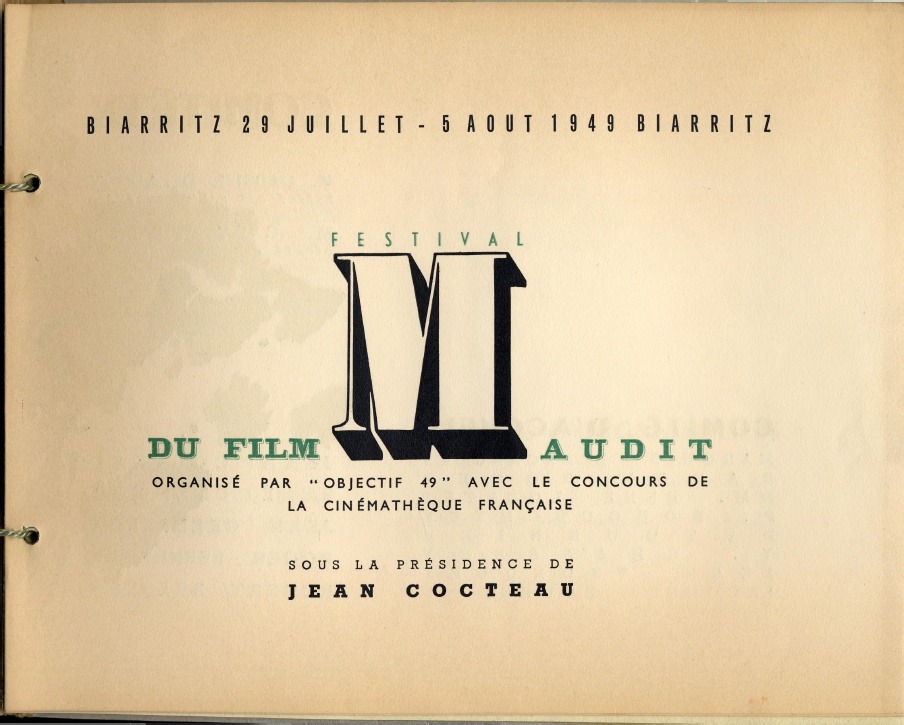
Festival du Film Maudit Catalogue, 1949, via caboose
''The time has come to honour the masterpieces of film art which have been buried alive, and to sound the alarm. Cinema must free itself from slavery just like the many courageous people who are currently striving to achieve their freedom. Art which is inaccessible to young people will never be art." (Jean Cocteau, 1949)
After the end of World War II, the Ciné-club Objectif 49 was founded in Paris. Its members, including Jean Cocteau, Henri Langlois and, as honorary member, Orson Welles, had taken up the cause of propagating a new cinema avant-garde. They were supported by several writers, filmmakers and critics who had joined together under the label Nouvelle Critique, including André Bazin, Raymond Queneau, Jean Grémillon, Alexandre Astruc and Roger Leenhardt. This loosely-bound group planned to stage an independent festival in Biarritz in the summer of 1949; it was to roll out the red carpet for Cinéma maudit, in a nod to Mallarmé's term poètes maudits, the accursed poets.
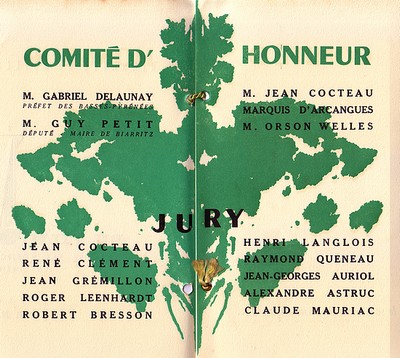
With this festival, the established representatives of Nouvelle Critique intended to “measure, with purity and frenzy, the current battle lines on the field of cinematographic intelligence and sensibility”. They were also aiming for an exchange of ideas with a group of young cinephiles whose names were known to very few at the time: François Truffaut, Jacques Rivette, Jean-Luc Godard, Claude Chabrol, Eric Rohmer and Jean Douchet. The announcement of the event, which was to be both urbane and confrontational, was akin to a cult promise: Biarritz would become a test site to roam with one’s accomplices, in order to track down a new spirit in film, which didn't necessarily have to reveal itself only in the current production. What were the films maudits, the accursed films of 1949? Kuhle Wampe by Slatan Dudow, Lumière d'été by Jean Grémillon,Fireworks by Kenneth Anger, films by Jean Renoir, Clifford Odets, Jean Rouch, John Ford and Helmut Käutner, Les Dames du Bois de Boulogne by Robert Bresson, Ride the Pink Horse by Robert Montgomery and L'Atalante by Jean Vigo, plus ten additional films. Many of these have long since become indisputable standard works in film history.

The festival took place in the luxurious venue of the Casino on the Atlantic coast from July 29 to August 5. A doorman politely checked all guests and detained or turned away those who didn’t belong or were improperly attired. Some who clearly didn’t belong were Rivette, Godard, and Truffaut. All under twenty years old, ‘bohemian’, and vociferous, they started a scene with the doorman until the timely arrival of Cocteau, dressed in tails. He shepherded his young friends in with a wave of his hand and, as president of the festival, succeeded in holding together, or at least at a safe distance, the aristocracy on one hand and the young Turks on the other.” (Dudley Andrew) via filmmuseum
Monday, October 8, 2012
X-Ray Vision
A lovely find from the BFI, also known as 'The X-Ray Fiend', this comedy by G.A. Smith combines two very recent innovations: Wilhelm Roentgen's discovery of X-rays in 1895, and Georges Méliès' realisation of the special-effects potential of the jump-cut in 1896. The couple is played by the Brighton comedian Tom Green and Smith's wife Laura Bayley. I like the way the x-ray even turns the woman's umbrella skeletal. That's attention to detail right there.
Sunday, October 7, 2012
A Trip To The Moon (1902)
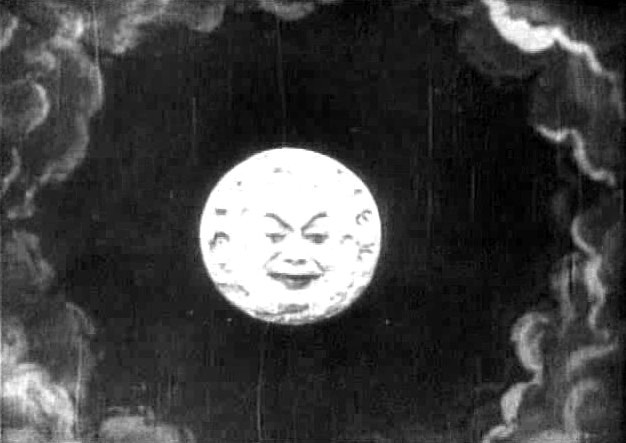
Georges Melies' place in the history of early cinema is secure, of course, as a pioneer of clever trick photography. But he's not really considered a filmmaker as such, a key innovator of film technique. He's more a curiosity, a novelty unto himself. And sure, that camera is resolutely static in all his films, plonked in the stalls like the faithful audience in a Parisienne theatre, but that doesn't mean his mise en scene was primitive. The story of early cinema is usually seen as one of growing narrative sophistication, progress through editing and montage, an evolving visual grammer allowing greater complexity of storytelling. Which is true but has the unfortunate side-effect of marginalising or undervaluing those who don't fit this arc. Melies brought his own talents, obsessions and experience to the medium in the same way Orson Welles utilised radio techniques in Citizen Kane. Melies teeming, inexhaustible imagination, his trickster delight in creating wonder in an audience is the well-spring of cinema every bit as much as Edwin S. Porter's parallel editing in The Great Train Robbery (1903). When the frame is this filled with business, with perspective-stylised scenery, with clever tricks and visual jokes, it seems churlish to ask for movement from the camera too. In this sense he could be seen as a precurser of fellow Frenchman Jacques Tati who similarly loved to fill the static frame with off-centre comic business. (Melies was assuredly comic. Those doddery old scientists with their funny walks and pratfalls have a pantomime charm to them). And yet there is movement of sorts. Check out those dissolves as we travel from earth towards the moon, first seen as a distant orb, then closer with vaguely face-like shadows, and finally that iconic moon-face about to be assaulted by the incoming rocket. There are earlier dissolves too, from the astronomical meeting to the workers making the rocket. But even so, the film doesn't need to justify itself in these terms. The imagination makes the real possible, it's the crucible of the future. Without Melies or HG Wells there wouldn't have been any Neil Armstrong. Which isn't to say he was just a bag of tricks, this is still a narrative film, a story told with breezy economy and impish invention.
Building Up & Demolishing the Star Theatre
'A photograph is not only an image (as a painting is an image) an interpretation of the real; it is also a trace, something directly stencilled off the real, like a footprint or a death mask'
- Susan Sontag, On Photography
In the 21st century we take it for granted that images exist, that we can just record the world around us at will. We've long since lost contact with the spooky magic of this, the unlikely fact that hidden in the chemical world was a process that could capture likenesses, snatch moments out of the flow of time. Do any of us really know how this works? Why it works? Even stranger, that waiting within us all this time was a process called persistence of vision, holding after-images for a fraction of a second on the retina like it knew all along that cinema was coming, that one day we would create our own parallel universe. We hardly think about these things now, or even feel the faintest tremor of dislocation as we move through an image-saturated world, a matrix of visual stimuli from phones, laptops, televisions, internet pages, games consoles, etc. But maybe we should. Maybe we should watch Frederick S. Armitage's pioneering short Building Up and Demolishing the Star Theatre, made in 1901, to give us an inkling of the strangeness we've forgotten. It consists of time-lapse footage of the demolition of the Star Theater at Thirteenth Street and Broadway in New York, filmed from the Biograph Studios office across the street, with exposures taken every four minutes during the course of the thirty day demolition. It was then reversed to create the building-up effect. Theaters were given the option of setting the film order to either Demolish then Build Up or, as in the version above, Build Up then Demolish. Time-lapse is nothing new to any of us, and films like this are ten-a-penny, but this is the first known example and it maintains an eerie air of first disovery, a trace of what it must have been like to see it then, the sheer unprecedented sorcery of it. In the process it brings us back to that sense of wonder, the implications for who we are implicit in the medium, for what we are, what film is, what it does to time, what it tells us about time. The people walking by in the film are dead, yet there they are, caught in a loop of time, forever alive on this day. In this sense, the film is a portal into 1901, into that corner of New York, at Thirteenth Street and Broadway. Except they're walking backwards, the traffic travelling in reverse. It's a premonition. Something strange is about to happen. And then it does, time speeds up. A whirlwind descends on the empty lot across the street and a building starts to take shape, rising out of the ground like an apparition, window arches and connective walls forming through dark pulsating patches of scratchy film-stock, sudden waves of sunlight peeling backwards like a restorative wash. In no time the Star Theatre stands on the corner in all its glory. Calm is restored, but only briefly. The whirlwind descends again. Now the imposing building begins to disappear, whittled away like ants devouring a piece of food. To the left the windows and canopy of the Biograph building flutter in and out, shadows pass through like ominous waves, the traffic a blur, see-through, ghostly. And then it's gone as if it had never been there. The scene reverts to real time, people walk by normally, traffic passes as it should, as if nothing has happened. But it has. We've been shown our place in the universe. Time has been atomised. At this very moment, 1901, Albert Einstein is sitting in a Swiss patent office, surrounded by clocks, formulating his ideas on relativity. Time speeds up and slows down. In fact it bends, dilates, contracts depending on where we are and how fast we're going. Velocity changes time. He's going to write a whole paper on it, his special theory of relativity. With Building Up and Demolishing the Star Theatre Frederick Armitage had beaten him to it. If film was directly stencilled off the real, if it was part of us in some mysterious way, then what happened to it should also happen to us. If film can be sped up, slowed down, reversed, then so can we. Cinema was already proving it. Science just needed to find the mathematics.
Friday, August 31, 2012
Kubrick // One-Point Perspective from kogonada on Vimeo.
Excellent compendium of similar one-point perspective shots in Kubrick films edited to Lux Aeterna by Clint Mansell.
Excellent compendium of similar one-point perspective shots in Kubrick films edited to Lux Aeterna by Clint Mansell.
Wednesday, July 4, 2012
Classic Scene #36
The undoubted highlight of West Side Story, Leonard Bernstein and Stephen Sondheim's America is not only one of the most thrilling song and dance routines in cinema history it's also a better critique of the American immigrant experience than a library-full of academic tomes or well-meaning documentaries. 'Skyscrapers bloom in America, cadillacs zoom in America, industry boom in America, twelve in a room in America.' Beneath the fun it's scathingly sardonic, a switchblade cutting through the platitudes of the American Dream, capturing the giddy schizophrenia of the place, hypocrisy and hope locked in a perpetual dance. And yet, the sheer vitality of the music is like a metaphor, something thrillingly American born out of immigrant anger and desire, metabolised from it, people released from backwards lethergy, from stifling convention or political oppression, channelling, at last, all their wit and talent, their teeming energy, into this new place, capitalism's engine room.
Subscribe to:
Posts (Atom)