Friday, August 9, 2013

Dynamic Erection


In the twenty-four-seven matrix of our media world it's hard to imagine films languishing forgotten, cast out into obscurity, left behind by the forward-moving juggernaut of time. Now everything exists at once. History is a time-line we can traverse at will. Everything of value (and much that isn't) is being championed somewhere, everywhere, as we speak, as the never-ending desire for new stimuli goes on, for new old things even, rediscovered gems, lost classics. How is it possible for a film (or anything else) to remain hidden, gathering dust, a rumour, a secret, a film maudit, the preserve only of dedicated enthusiasts and lovers of the willfully obscure? Even cave paintings locked away for thousands of years are exposed to our prying cameras these days, find themselves on t-shirts, mugs and computer screens. What could possibly escape the voracious, interactive maw of 21st century multi-mediated culture?


Well, nothing probably, to be honest. But things can certainly still fly under the radar, existing on sporadic blog entries, occasional screenings at festivals or a brief appearance on the Guardian's Clip Joint. It was during a recent Clip Joint on The Beatles that I encountered Little Malcolm and his Struggle Against The Eunuchs, the first film produced by George Harrison. The clip shown, this corduroy exchange, stopped me in my tracks. How could something so good have never crossed my path? Surely I'd have heard of it before at least, a film with a Beatles connection starring two stalwarts of British cinema like John Hurt and David Warner? But no. It was a complete mystery to me. I had to investigate more.


What I discovered was a darkly comic political allegory based on David Halliwell's acclaimed 1965 play which marries kitchen sink Northern locations (we're in Oldham) to word-driven scenes of heightened theatricality. Which is to say it doesn't try to normalise the play, but like Glengarry Glen Ross, uses the camera to intensify scenes, to revel in the language and the glorious opportunities for actors to take off into spellbinding monologues. While many films would end up falling between two stools, Little Malcolm manages to achieve a convincing symbiosis between play and film, a third way. Somehow the locations, superbly captured by cinematographer John Alcott (A Clockwork Orange), with their wintry drabness, isolated plots of land, dour high-ceilinged bedsits, industrial red-brick grime, all-pervading misty dampness, anchor the characters, allowing them to breathe and exist as both real people and political allegory. They're the kind of misfits places like this breed, men driven crazy by the never-starting futility of their existences, dreamers and idealists, fantasists, but also blowhards and inadequates, comical in their self-deluded bragging and schemes, their determination to force themselves into the flow of history.


We first see Malcolm Scrawdyke in his cold, run-down flat trying to make himself get out of bed, to trick his mind into moving, to act before thinking. (It's like everything that follows is the result of this desire to act, to avoid the sheer boredom and inertia of his life). We soon learn he's been expelled from Art College for being a disruptive influence. He takes two of his loyal followers, Wick (John McEnery) and Erwin (Raymond Platt) to the pub where they plot their revenge not just on the art college tutor they despise but on the whole country. Malcolm considers himself a leader, a militant revolutionary, and now he sees his expulsion as an opportunity to put into action what they've often spoken about, to start their own political movement, magnificently called - Dynamic Erection.


They bring in Dennis Charles Nipple (David Warner), a duffle-coat-wearing would-be writer, a rival to Malcolm in his ability to use language, his half-hearted participation and argumentativeness. They proceed to rehearse kidnapping their nemesis, stealing a painting, practicing speeches and how to deal with assassination attempts, all the while seeming like overgrown children at play. This is a point it's making of course. So much revolutionary talk and posturing is just that, fantasy and play, childish in essence, and just as threatening or likely to succeed. Malcolm is like a militant Billy Liar, Lancashire rooftops echoing to the cheers of imaginary crowds as he prepares his rousing speech. He's the leader because he's the most eloquent, knows the tricks of oratory, the emphatic hand gestures. But behind all the talk of action, the railing against the eunuchs, he's just as impotent and 'little' as the rest of them.


And yet, despite all this, we kind of like these deluded malcontents. They're in a fine line of British losers railing impotently against their lot from Hancock to Steptoe and Son. In fact only three years after Little Malcolm, the sit-com Citizen Smith would mine a similar seam, making comic hay from the gap between leftist revolutionary ideals and the mundane reality of British life. But beneath the comedy, the sympathy, runs a warning about taking these things for granted. The parallel is with Hitler (an art-school reject himself) and the National Socialists. A laughing stock in 20s Germany basically, little men acting big, until, that is, the political geography altered and they found themselves in power. Then it wasn't funny anymore. And so it is here. As Little Malcolm gets darker, we see how censorship and bullying evolve from the words, from the refusal to see any other reality but their own. They're dreamers but cowards, socially and sexually inadequate, fantasists unable to access or deal with reality.


It's like a cross between Dennis Potter and Harold Pinter. Director Stuart Cooper understands that the words are king, they lead to the performances and the whole thing works from there. The camera is another layer, another visual language, and the play needs to be translated into it, but not transformed into something else altogether. Why shouldn't cinema have the same freedoms of expression as theatre, the right to be an imaginative space not held down by the actual? We seem to have no problem with cinema making the visual more heightened or amazing but if people speak in oddly eloquent ways we seem to find this objectionable.
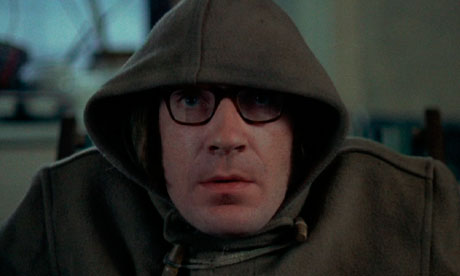


Despite winning the Silver Bear at the 1974 Berlin Film Festival Little Malcolm quickly disappeared from view, only to be resurrected by the BFI in 2011. Yet echoes of it can be found in other films like sarky misanthropic Johnny in Mike Leigh's Naked (Leigh directed the first stage production of Little Malcolm), Withnail and I for the comic verve of the dialogue and even Chris Morris's inept terrorists in Four Lions. Yes it's a filmed play but when the dialogue is this good it doesn't matter and the acting is sensational. You have no idea how great an actor John Hurt is until you see it, or David Warner. When Malcolm gives his would-be speech to the massed ranks of snowy Oldham rooftops Hurt launches into an oratorical tour-de-force while at the same time hand gestures and passionate emphasis of words are pitched just too much to make them ridiculous. It's brilliant. The way he bellows 'seeeeeeize the init-i-a-tive' is both thrilling and hilarious. In its own uncompromising, unique way, it's a classic.

Watch Me Move - Little Nemo (1911)


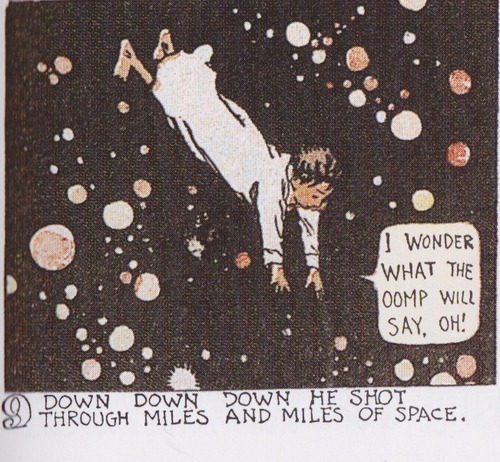
There had been earlier forays into animation, James Stuart Blackton's chalk-drawn Humorous Phases of Funny Faces (1906) or Emile Cohl's Fantasmagorie (1908) before Winsor McCay got in on the act. By 1911 McCay was the most famous cartoonist in America, creator of two hugely popular comic strips, Dream of a Rarebit Fiend and Little Nemo in Slumberland when, apparently inspired by his son's flip books, he decided movement was the logical next step. He hooked up with Blackton at Vitagraph Studios and they set about constructing a film around this process. Winsor McCay, the Famous Cartoonist of the N.Y. Herald and his Moving Comics, as it was called (usually referred to now as Little Nemo) begins with live-action sequences in some kind of club where McCay showcases his quick drawing skills (he was famous from a young age for this) to his artist buddies. He makes a wager that, in just one month, he can create the four thousand drawings required to make these comic characters move. They laugh good-naturedly at this madness. (Note that Cohl used 700 drawings over a four to five month period to make Fantasmagorie). Next we see him hard at work surrounded by cartoon-like props, comically large containers for paper and ink. Finally he's finished. A projector is set up in the club and we see the three famous characters from the strip - Little Nemo, Flip and The Imp - come to life, forming magically out of thin air. What follows is a moment of freedom, liberation. They contort, fight, expand like fair ground mirrors, draw other characters (that's McCay animating a character speed drawing another character) until finally Nemo rides off in the jaws of a dragon with a princess. These are not just chalk drawings but finely-rendered characters, in colour, moving through space with anarchic glee. It's the true birth of animation. Although McCay would go on to more ambitious projects like Gertie the Dinosaur, these two minutes of plotless transformation retain the magic of first moments, the breakthrough wonder of discovery.

Thursday, July 18, 2013

Films Watched 2013: #6

The Prestige (2006)


'Every great magic trick consists of three parts or acts. The first part is called The Pledge. The magician shows you something ordinary: a deck of cards, a bird or a man. He shows you this object. Perhaps he asks you to inspect it to see if it is indeed real, unaltered, normal. But of course it probably isn't. The second act is called The Turn. The magician takes the ordinary something and makes it do something extraordinary. Now you're looking for the secret... but you won't find it, because of course you're not really looking. You don't really want to know. You want to be fooled. But...making something disappear isn't enough; you have to bring it back. That's why every magic trick has a third act, the hardest part, the part we call The Prestige.'

Christopher Nolan's period drama about rival magicians may have it's implausible moments but only professional nitpickers could argue with the overall film, an engrossing, complex fable, a mysterious magic trick itself, playing with identity and obsession in artfully pleasurable ways. The core of the film is the three-part nature of a magic trick. The pledge. The turn. The prestige. Something ordinary does something extraordinary - it disappears - then reappears again. Except it never really went anywhere. That's the trick, and we know it. But we want it to be real. We want to be fooled. The trick, as it were, is to maintain the mystery, the magic, the giddy sense of innocent possibility. In Victorian London Robert Angier (Hugh Jackman) and Alfred Borden (Christian Bale) are apprentice magicians when a tragic accident kills Aungier's wife. He blames Borden and they become enemies, obsessively following each other's careers, sabotaging each other. When Alfred performs a successful trick, The Transported Man, Robert becomes obsessed with finding the secret, ultimately pushing both men towards self-destruction and tragedy. The narrative complexity of plot within plot (within plot) takes some attention at first not to lose where you are, when you are, but your mind soon acclimatises to the pleasure of watching a film that expects you to keep up, that respects your intelligence. Bale is grimly mesmerising as Borden and Jackman has never been better. There's fine support to from Michael Caine as John Cutter, the stage engineer and David Bowie as electricity guru Nikola Tesla. The mystery of Christopher Nolan isn't how he manages to make intelligent blockbusters, but why he's almost the only one.

Tuesday, July 16, 2013

Deckchair Cinema

Last Thursday we did something we've been talking about for years. An outdoor cinema night, or deckchair cinema as we called it, inspired by Darwin's Deckchair Cinema in Australia. For the first time in living memory we had the summer weather, with zero chance of rain, an excellent location, the smoky drift of barbecue food and our long-forsaken inflatable screen which we just managed to fit into the space at the end of the garden thanks to some last minute pruning.


The film we choose to show was Alexander Mackendrick's evergreen Ealing classic The Ladykillers. Having set up the screen we just had to wait for it to get dark enough to see what we were projecting. For awhile, in the evening sunshine it was hard to believe any image was coming out of the projector but eventually as the first hints of dusk entered the sky we could see it in the palms of our hands. 


A half hour later and we were ready to go, people arrived with their deckchairs, candles lit up the garden path and hung in the hedges, insects skittered around us in the dark and the film began. Soon everyone was engrossed in the story. Five criminals, led by smooth-talking but sinister Professor Marcus (Alec Guinness) rent a room in the subsiding cul-de-sac home of dotty old widow Mrs. Wilberforce (Katie Johnson), posing as a string quintet while in reality planning a bank heist in which she is to play a central if unwitting part. 


Watching it for the first time in the communal dark rather than on television what struck home most strongly apart from the faultless performances, set-design and locations, was the cinematography of Otto Heller, an inky-noir colour that adds Gothic menace to proceedings, and the supreme performance of Katie Johnson as Mrs Wilberforce, the blissfully zen centre of the action. Screenwriter Charlie Rose gives her little moments of poignant reminiscence, surrounds her with a cadre of even-dottier old dears, meandering, bird-like ninnies who, by comparison, show her to be a sweetly resourceful and oddly admirable lady living in a twilight state of widowed forgetfulness with her dead husband's parrots. It's a little miracle of a performance and the talk was of little else afterwards.


Sunday, July 14, 2013

Films Watched 2013: #5

The Happening (2008)
People start killing themselves in large numbers in New York and Boston. With fears that it's spreading to other cities mild-mannered scientist Marl Wahlberg, his girlfriend Zooey Deschanal, and fellow scientist John Leguismo evacuate Philadelphia for the safety of smaller towns. But the contagion, whatever it is, follows them, mass suicides confronting them at every turn. Can they escape it? An intriguing, Twilight Zone idea, with an arresting first twenty minutes or so soon comes off the rails in spectacular fashion. Truly as bad as its reputation suggested. There's real competition here is who gives the worst performance. To say Wahlberg is out of his comfort zone is an understatement, arguably the dumbest scientist in cinema history (and that, let us not forget, includes Denise Richards as a nuclear physicist in The World Is Not Enough), Deschanel appears labotomised for most of it, like a startled faun, Leguismo oddly intense, distracted, and as for the old lady in the isolated farm house, well she's just hilarious. By the end the urge to giggle uncontrollably was almost overwhelming. The shame is this could have been a great low-budget sci-fi b-movie but Shamalyan can't decide whether he wants us to take this seriously or tongue-in-cheek. He throws in a semi-humorous interlude in a fake atom-bomb-site house, that might have worked in another film (it's the one moment Wahlberg seems at ease) but in the context of this film it just adds to the general air of giddy uncertainty. The director doesn't seem to know what tone he wants to set, doesn't seem capable of giving the actors direction. So many problems. They realise the trees are out to get them, so they head across fields full of them. And it ends with a whimper where for once some kind of bravura, dumb-ass twist might have saved it.

Monday, July 8, 2013

Classic Scene #37


'I have my dreams while I'm awake...' Jim Jarmusch's first film was shot on 16mm straight after dropping out of film school. (I like to think he only went to film school so he could drop out). I first saw Permanent Vacation many years ago as part of a Jarmusch quadruple bill alongside Stranger Than Paradise, Down by Law and Mystery Train (imagine that). Here we have the film's wandering protagonist (Chris Parker) exchanging words with Leila (Leila Gastil). The soundtrack is an atonal no-wave drone (by Jarmusch and John Lurie), the talk stilted, the silence in the sparse room punctuated by the sound of sirens outside. Then he places the needle on the portable record player and on comes Earl Bostic's Up There in Orbit. Suddenly everything stilted gives way to this hep cat eloquence. He's dreaming while awake. He's lost in the ecstatic music, falls to the ground, takes off his shoes. Afterwards he tells the mirror. 'Sometimes I think I should live fast and die young. Go out in a three-piece white suit, like Charlie Parker.' It's adolescent narcissism, of course, but it's more than that. In the mirror he's the dream of himself, just as cinema is the dream of ourselves. This is how the poor and artistic survived on New York's Lower East Side in 1980, that wasteland of cheap rent and cheap drugs. They searched out meaning in what they loved, what they discovered for themselves, in dance moves and coded gestures. You know he places the cigarette in his mouth the wrong way round so she can put it right, right? That's part of the cool. It's what she's there for.

Saturday, June 8, 2013

Ten Minute Childhood


Looking forward to seeing Mark Cousins's 'film-essay' A Story of Children and Film. One of its inspirations is Ten Minutes Older, Herz Frank's short film from 1978, a single-take look at Latvian childrens' faces as they watch a puppet show. While the camera pans across a number of children it lingers mostly on one in particular, his face an unselfconscious display of emotions; alarm, fascination, fear, attentiveness. It's about as low-tech and simple a concept as you could get and yet the purity of the child's responses speaks to a desire in all of us to return to that unmediated immersion in things. 'He that increases knowledge', as the man says, 'increases sorrow.'