Friday, August 9, 2013
Watch Me Move - Little Nemo (1911)
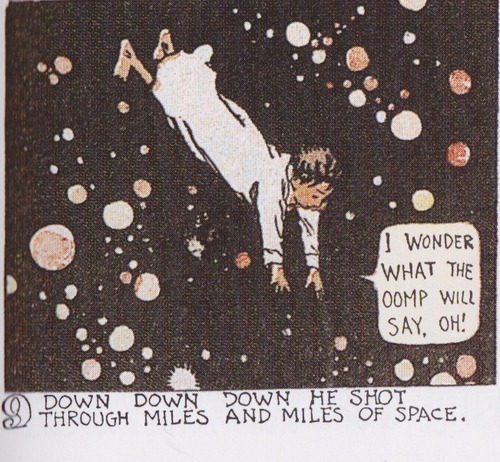
There had been earlier forays into animation, James Stuart Blackton's chalk-drawn Humorous Phases of Funny Faces (1906) or Emile Cohl's Fantasmagorie (1908) before Winsor McCay got in on the act. By 1911 McCay was the most famous cartoonist in America, creator of two hugely popular comic strips, Dream of a Rarebit Fiend and Little Nemo in Slumberland when, apparently inspired by his son's flip books, he decided movement was the logical next step. He hooked up with Blackton at Vitagraph Studios and they set about constructing a film around this process. Winsor McCay, the Famous Cartoonist of the N.Y. Herald and his Moving Comics, as it was called (usually referred to now as Little Nemo) begins with live-action sequences in some kind of club where McCay showcases his quick drawing skills (he was famous from a young age for this) to his artist buddies. He makes a wager that, in just one month, he can create the four thousand drawings required to make these comic characters move. They laugh good-naturedly at this madness. (Note that Cohl used 700 drawings over a four to five month period to make Fantasmagorie). Next we see him hard at work surrounded by cartoon-like props, comically large containers for paper and ink. Finally he's finished. A projector is set up in the club and we see the three famous characters from the strip - Little Nemo, Flip and The Imp - come to life, forming magically out of thin air. What follows is a moment of freedom, liberation. They contort, fight, expand like fair ground mirrors, draw other characters (that's McCay animating a character speed drawing another character) until finally Nemo rides off in the jaws of a dragon with a princess. These are not just chalk drawings but finely-rendered characters, in colour, moving through space with anarchic glee. It's the true birth of animation. Although McCay would go on to more ambitious projects like Gertie the Dinosaur, these two minutes of plotless transformation retain the magic of first moments, the breakthrough wonder of discovery.



Thursday, July 18, 2013
Films Watched 2013: #6
The Prestige (2006)
'Every great magic trick consists of three parts or acts. The first part is called The Pledge. The magician shows you something ordinary: a deck of cards, a bird or a man. He shows you this object. Perhaps he asks you to inspect it to see if it is indeed real, unaltered, normal. But of course it probably isn't. The second act is called The Turn. The magician takes the ordinary something and makes it do something extraordinary. Now you're looking for the secret... but you won't find it, because of course you're not really looking. You don't really want to know. You want to be fooled. But...making something disappear isn't enough; you have to bring it back. That's why every magic trick has a third act, the hardest part, the part we call The Prestige.'
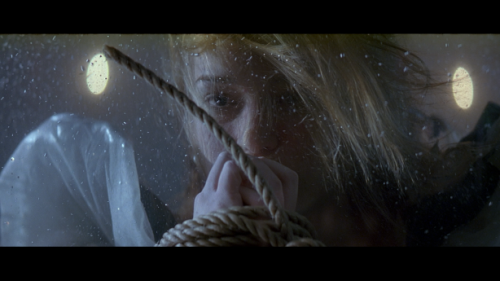
Christopher Nolan's period drama about rival magicians may have it's implausible moments but only professional nitpickers could argue with the overall film, an engrossing, complex fable, a mysterious magic trick itself, playing with identity and obsession in artfully pleasurable ways. The core of the film is the three-part nature of a magic trick. The pledge. The turn. The prestige. Something ordinary does something extraordinary - it disappears - then reappears again. Except it never really went anywhere. That's the trick, and we know it. But we want it to be real. We want to be fooled. The trick, as it were, is to maintain the mystery, the magic, the giddy sense of innocent possibility. In Victorian London Robert Angier (Hugh Jackman) and Alfred Borden (Christian Bale) are apprentice magicians when a tragic accident kills Aungier's wife. He blames Borden and they become enemies, obsessively following each other's careers, sabotaging each other. When Alfred performs a successful trick, The Transported Man, Robert becomes obsessed with finding the secret, ultimately pushing both men towards self-destruction and tragedy. The narrative complexity of plot within plot (within plot) takes some attention at first not to lose where you are, when you are, but your mind soon acclimatises to the pleasure of watching a film that expects you to keep up, that respects your intelligence. Bale is grimly mesmerising as Borden and Jackman has never been better. There's fine support to from Michael Caine as John Cutter, the stage engineer and David Bowie as electricity guru Nikola Tesla. The mystery of Christopher Nolan isn't how he manages to make intelligent blockbusters, but why he's almost the only one.
'Every great magic trick consists of three parts or acts. The first part is called The Pledge. The magician shows you something ordinary: a deck of cards, a bird or a man. He shows you this object. Perhaps he asks you to inspect it to see if it is indeed real, unaltered, normal. But of course it probably isn't. The second act is called The Turn. The magician takes the ordinary something and makes it do something extraordinary. Now you're looking for the secret... but you won't find it, because of course you're not really looking. You don't really want to know. You want to be fooled. But...making something disappear isn't enough; you have to bring it back. That's why every magic trick has a third act, the hardest part, the part we call The Prestige.'
Christopher Nolan's period drama about rival magicians may have it's implausible moments but only professional nitpickers could argue with the overall film, an engrossing, complex fable, a mysterious magic trick itself, playing with identity and obsession in artfully pleasurable ways. The core of the film is the three-part nature of a magic trick. The pledge. The turn. The prestige. Something ordinary does something extraordinary - it disappears - then reappears again. Except it never really went anywhere. That's the trick, and we know it. But we want it to be real. We want to be fooled. The trick, as it were, is to maintain the mystery, the magic, the giddy sense of innocent possibility. In Victorian London Robert Angier (Hugh Jackman) and Alfred Borden (Christian Bale) are apprentice magicians when a tragic accident kills Aungier's wife. He blames Borden and they become enemies, obsessively following each other's careers, sabotaging each other. When Alfred performs a successful trick, The Transported Man, Robert becomes obsessed with finding the secret, ultimately pushing both men towards self-destruction and tragedy. The narrative complexity of plot within plot (within plot) takes some attention at first not to lose where you are, when you are, but your mind soon acclimatises to the pleasure of watching a film that expects you to keep up, that respects your intelligence. Bale is grimly mesmerising as Borden and Jackman has never been better. There's fine support to from Michael Caine as John Cutter, the stage engineer and David Bowie as electricity guru Nikola Tesla. The mystery of Christopher Nolan isn't how he manages to make intelligent blockbusters, but why he's almost the only one.
Tuesday, July 16, 2013
Deckchair Cinema
Last Thursday we did something we've been talking about for years. An outdoor cinema night, or deckchair cinema as we called it, inspired by Darwin's Deckchair Cinema in Australia. For the first time in living memory we had the summer weather, with zero chance of rain, an excellent location, the smoky drift of barbecue food and our long-forsaken inflatable screen which we just managed to fit into the space at the end of the garden thanks to some last minute pruning.


The film we choose to show was Alexander Mackendrick's evergreen Ealing classic The Ladykillers. Having set up the screen we just had to wait for it to get dark enough to see what we were projecting. For awhile, in the evening sunshine it was hard to believe any image was coming out of the projector but eventually as the first hints of dusk entered the sky we could see it in the palms of our hands.


A half hour later and we were ready to go, people arrived with their deckchairs, candles lit up the garden path and hung in the hedges, insects skittered around us in the dark and the film began. Soon everyone was engrossed in the story. Five criminals, led by smooth-talking but sinister Professor Marcus (Alec Guinness) rent a room in the subsiding cul-de-sac home of dotty old widow Mrs. Wilberforce (Katie Johnson), posing as a string quintet while in reality planning a bank heist in which she is to play a central if unwitting part.


Watching it for the first time in the communal dark rather than on television what struck home most strongly apart from the faultless performances, set-design and locations, was the cinematography of Otto Heller, an inky-noir colour that adds Gothic menace to proceedings, and the supreme performance of Katie Johnson as Mrs Wilberforce, the blissfully zen centre of the action. Screenwriter Charlie Rose gives her little moments of poignant reminiscence, surrounds her with a cadre of even-dottier old dears, meandering, bird-like ninnies who, by comparison, show her to be a sweetly resourceful and oddly admirable lady living in a twilight state of widowed forgetfulness with her dead husband's parrots. It's a little miracle of a performance and the talk was of little else afterwards.


Sunday, July 14, 2013
Films Watched 2013: #5
The Happening (2008)
 People start killing themselves in large numbers in New York and Boston. With fears that it's spreading to other cities mild-mannered scientist Marl Wahlberg, his girlfriend Zooey Deschanal, and fellow scientist John Leguismo evacuate Philadelphia for the safety of smaller towns. But the contagion, whatever it is, follows them, mass suicides confronting them at every turn. Can they escape it? An intriguing, Twilight Zone idea, with an arresting first twenty minutes or so soon comes off the rails in spectacular fashion. Truly as bad as its reputation suggested. There's real competition here is who gives the worst performance. To say Wahlberg is out of his comfort zone is an understatement, arguably the dumbest scientist in cinema history (and that, let us not forget, includes Denise Richards as a nuclear physicist in The World Is Not Enough), Deschanel appears labotomised for most of it, like a startled faun, Leguismo oddly intense, distracted, and as for the old lady in the isolated farm house, well she's just hilarious. By the end the urge to giggle uncontrollably was almost overwhelming. The shame is this could have been a great low-budget sci-fi b-movie but Shamalyan can't decide whether he wants us to take this seriously or tongue-in-cheek. He throws in a semi-humorous interlude in a fake atom-bomb-site house, that might have worked in another film (it's the one moment Wahlberg seems at ease) but in the context of this film it just adds to the general air of giddy uncertainty. The director doesn't seem to know what tone he wants to set, doesn't seem capable of giving the actors direction. So many problems. They realise the trees are out to get them, so they head across fields full of them. And it ends with a whimper where for once some kind of bravura, dumb-ass twist might have saved it.
Monday, July 8, 2013
Classic Scene #37
'I have my dreams while I'm awake...' Jim Jarmusch's first film was shot on 16mm straight after dropping out of film school. (I like to think he only went to film school so he could drop out). I first saw Permanent Vacation many years ago as part of a Jarmusch quadruple bill alongside Stranger Than Paradise, Down by Law and Mystery Train (imagine that). Here we have the film's wandering protagonist (Chris Parker) exchanging words with Leila (Leila Gastil). The soundtrack is an atonal no-wave drone (by Jarmusch and John Lurie), the talk stilted, the silence in the sparse room punctuated by the sound of sirens outside. Then he places the needle on the portable record player and on comes Earl Bostic's Up There in Orbit. Suddenly everything stilted gives way to this hep cat eloquence. He's dreaming while awake. He's lost in the ecstatic music, falls to the ground, takes off his shoes. Afterwards he tells the mirror. 'Sometimes I think I should live fast and die young. Go out in a three-piece white suit, like Charlie Parker.' It's adolescent narcissism, of course, but it's more than that. In the mirror he's the dream of himself, just as cinema is the dream of ourselves. This is how the poor and artistic survived on New York's Lower East Side in 1980, that wasteland of cheap rent and cheap drugs. They searched out meaning in what they loved, what they discovered for themselves, in dance moves and coded gestures. You know he places the cigarette in his mouth the wrong way round so she can put it right, right? That's part of the cool. It's what she's there for.
Saturday, June 8, 2013
Ten Minute Childhood
Looking forward to seeing Mark Cousins's 'film-essay' A Story of Children and Film. One of its inspirations is Ten Minutes Older, Herz Frank's short film from 1978, a single-take look at Latvian childrens' faces as they watch a puppet show. While the camera pans across a number of children it lingers mostly on one in particular, his face an unselfconscious display of emotions; alarm, fascination, fear, attentiveness. It's about as low-tech and simple a concept as you could get and yet the purity of the child's responses speaks to a desire in all of us to return to that unmediated immersion in things. 'He that increases knowledge', as the man says, 'increases sorrow.'
Wednesday, April 3, 2013
Films Watched 2013: #4
Down in the Valley (2005)
Summer in the San Fernando Valley and seventeen-year-old Tobe (Evan Rachel Wood) is heading to the beach with her girlfriends when she meets thirty-something cowboy Harlan (Ed Norton) at the gas station. Instinctively she asks him to join them and he does, quitting his job on the spot. An idyllic day leads to sex and soon Harlan is being introduced to Tobe's father Wade (David Morse) and younger brother Lonnie (Rory Culkin). The romance is immediate and intense, Tobe fascinated by the novelty of Harlan, his country charm and simple philosophy. He's like something from a movie. Harlan, for his part, can't believe his luck, that this pretty girl has latched onto him. She's like a fate foretold, the key to another life. But Wade, a law enforcement officer, is suspicious of Harlan straight away. He tries to control his daughter but she rebels. Soon though, Harlan's inability to tell reality from fantasy becomes clearer and things escalate dangerously. For much of the way Down in the Valley is a peach of a film, romantic, complex, with a 70s feel for ordinary lives, long summer days and the twilight glow of taillights as evening traffic floods the valley. The direction is confident, the acting uniformly fine, especially Norton, who gives one of his best performances here, part Travis Bickle, part Joe Buck (Midnight Cowboy). Unfortunately the film becomes less convincing in the last third, straining too hard for symbolism, spelling out the cowboy/modern world, fantasy/reality clashes too literally. It isn't a disaster but the realism and emotional truth built up are sacrificed for the sake of plot. While Harlan thought he was in a western it was okay, but when the film thinks it is too that's when it loses its way. Still an underrated film, I think, certainly one that deserves better reviews than it got at the time.
Summer in the San Fernando Valley and seventeen-year-old Tobe (Evan Rachel Wood) is heading to the beach with her girlfriends when she meets thirty-something cowboy Harlan (Ed Norton) at the gas station. Instinctively she asks him to join them and he does, quitting his job on the spot. An idyllic day leads to sex and soon Harlan is being introduced to Tobe's father Wade (David Morse) and younger brother Lonnie (Rory Culkin). The romance is immediate and intense, Tobe fascinated by the novelty of Harlan, his country charm and simple philosophy. He's like something from a movie. Harlan, for his part, can't believe his luck, that this pretty girl has latched onto him. She's like a fate foretold, the key to another life. But Wade, a law enforcement officer, is suspicious of Harlan straight away. He tries to control his daughter but she rebels. Soon though, Harlan's inability to tell reality from fantasy becomes clearer and things escalate dangerously. For much of the way Down in the Valley is a peach of a film, romantic, complex, with a 70s feel for ordinary lives, long summer days and the twilight glow of taillights as evening traffic floods the valley. The direction is confident, the acting uniformly fine, especially Norton, who gives one of his best performances here, part Travis Bickle, part Joe Buck (Midnight Cowboy). Unfortunately the film becomes less convincing in the last third, straining too hard for symbolism, spelling out the cowboy/modern world, fantasy/reality clashes too literally. It isn't a disaster but the realism and emotional truth built up are sacrificed for the sake of plot. While Harlan thought he was in a western it was okay, but when the film thinks it is too that's when it loses its way. Still an underrated film, I think, certainly one that deserves better reviews than it got at the time.
Subscribe to:
Comments (Atom)