Tuesday, June 28, 2011

Scenes From The Suburbs


Just watched Scenes From The Suburbs over at MUBU, Spike Jonze's short film based on Arcade Fire's recent album. Obviously meant to be the fragmentary recollection of one of those teenage summers that change everything, it portrays the relationship between two suburban boys as a dystopian military state tightens its grip around them, the violent, repressive atmosphere beginning to erode their sense of humanity. Beautifully shot, with fine performances from the young cast, Scenes From The Suburbs still left me a little frustrated, maybe because it was rich enough to have been a full length film. Although then we'd loose the eliptical nature of the narrative, supposed to replicate how we only remember the past in confusing fragments, some intensely present to us after years, some vague, others absent altogether. Why do we remember some things vividly, and other things, often as important or even more so, not at all? It's a fascinating question and Jonze uses it to create tension and unease very well, the real touched by the nightmarish. I'd like to see it again to get a clearer idea of whether it stands up as a short or whether the richness discovered deserves to be explored in full. Still, even now it's an engrossing half hour that captures perfectly the intensity of teenage friendships and the world-threatening pain of change.

Footnote: actually, watching the video below, there are several scenes and moments not in the film, which leads me to believe there may well be a full length film and that Scenes From The Suburbs is a kind of extended trailer, a teaser for the fuller experience to come.

Monday, June 20, 2011

Clip Joint Round-Up: Pianos


Hello. It's been a while. Been busy with proper life stuff and general brain freeze. To get back in the groove I thought I might do a round-up of last weeks's Clip Joint over at The Guardian, one of the few things I've had the attention span to contribute to recently. So, the task, choose five from all the suggested clips. This week's theme was pianos, which turned out to be an inspired one. As the great clips kept coming I thought to myself, god, I wouldn't want to have to pick five from this lot. And then I thought, but if I had to, what would they be? So here I am, doing that. The five chosen by Tess can be found here, just scroll down a bit to see them.


First up for me has to be Jean Arthur and Cary Grant in Only Angels Have Wings. It was hard picking just one Howard Hawks scene as I've had to leave out Hoagy Carmichael and Lauren Bacall's iconic double-act from To Have And Have Not but in the end that undulating thing Arthur does with her arm and Grant yelling PEA-NUT! swung the deal. In two minutes the piano tells us plenty about her; that she's a tougher cookie than she first appears, a practised performer who's been around plenty of those disreputable rogues, musicians. And the brief bit of introspective noodling tells us she's been hurt in love too, almost certainly by one of those musicians. Here then, we not only have the Hawksian world-view encapsulated in one scene but also an example of the way pianos act as social hubs, focal points for gathering around, starting parties, lining up shots glasses. A piano, this scene tells us, is more than an instrument, it's a test of character, a hurt unlocker, a standing invitation.


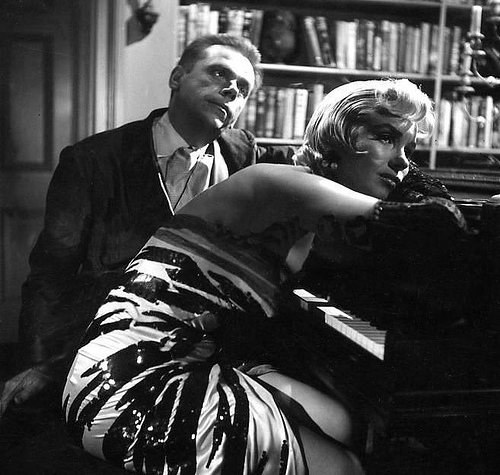
Or, in the case of The Seven Year Itch, a libido unlocker. That's certainly how Tom Ewell sees it, or imagines it. This was the scene posted, but we forgot about an earlier one, where Ewell fantasises about the effect Rachmaninoff will have on Monroe, how its deep romantic seriousness will induce shakes and quakes and goosebumps, leaving her helpless putty in his arms. Here we have the less exalted reality. Instead of Rachmaninoff we get chopsticks, instead of a fantasy sex goddess there's a girl having thoughtless fun. Marilyn still gets goosebumps, though. And how! But Ewell ends up flat on his face. Monroe's girlish enjoyment is infectious. She's not some pretentious siren of desire, classical dream-cords reverberating through her body. She's the simple, surface fun of chopsticks. The piano, in this case, is a personality decoder, an arena of (would-be) seduction, a reservoir of lost childhood pleasure.


As I said above, the piano is a standing invitation. Especially in an empty room. And double-especially in an empty bar. It seems to call to certain people, to tempt them away from reality, like Alain Delon in this scene from Jean Pierre Melville's Un Flic. It's a homage I'm sure to Sinatra, who invented (or crystalised) this tough-guy-reveals-sensitive-side-playing-piano-in-an-empty-bar schtick. It's a moment of private reverie, time holding its breath, Delon playing an introspective, jazzy piece, cigarette in his mouth, Catherine Deneuve listening unseen in the shadows, falling for him with every note. The piano, this tells us, is an interzone, a world unto itself, touchstone of timeless cool, summoner of goddesses from the dark.


'It hurts', Ingrid Bergman explains to Liv Ulmann, 'but he doesn't show it.' The film is Ingmar Bergman's Autumn Sonata, the he is Chopin, the piece is his Prelude No. 2. which Ulmann has been playing just before this, every halting note clearly torture to her concert pianist mother, who is now going to show how it should be played. What follows is a lesson and a humiliation. As she plays, Ulmann gazes at her. The look is mesmerising, total; need, resentment, love, hurt, all held in sway by those hypnotic, mysterious notes. Just look at me, notice me. It's almost unbearable, the longing for her mother to pay her the same attention she does the piano, to touch her with the same tenderness, the same care. 'Total restraint the whole time,' Bergman emphasises, surely aware of the naked gaze, but refusing to acknowledge it. 'Feeling is very far from sentimentality,' she lectures, as her daughter sits meekly, saying nothing, craving sentimental connection, reduced to a mousy nothing by her elegant, brilliant mother. This piano is a cuckoo in the nest, an all-consuming lover, an instrument of pain, both exalted and plain.


And finally, I've gone for this old gag from Ballot Box Bunny, so good Looney Tunes used it more than once. I like this one best mainly because Yosemite Sam says pie-anna but also because his volcanic temper makes what he does in the end wonderfully inevitable. It's all in the timing. Get that right and it'll be funny forever. I've watched this ten times in the last week and laughed every time. Why when I know what's coming? Well, partly because I do know it's coming and partly it's the rhythm of it. Bugs plays the tune slow, Sam plays it fast. That's part of it too. So, what does this scene tell us about the pie-anna? That it's a potential booby-trap, a punisher of impatience, and comedy's favourite slapstick musical instrument.

Friday, May 6, 2011

The Big Clock


In J.G. Ballard's short story Chronopolis,the inhabitants of a run-down city live without clocks. Time-keeping has been outlawed. But a young man's curiousity (his name is Newman) leads him to a deserted part of the city where time once ruled peoples' lives absolutely. Clocks are everywhere here, on the side's of skyscrapers and in the central plaza that was ground zero for a civilisation controlled by time. All the clocks have long since stopped at the exact time of the revolution that overthrew them. Newman sets his sights on restoring the enormous central clock through which all the others were once run. The idea of the story is that free of the tyranny of time, people gradually stagnate, society runs down, that while a society controlled by time may be highly efficent it is nevertheless soulless, a fascist state where human autonomy is virtually outlawed. Let time take over and it will rule you like a dictator, ignore it and you'll sink into boundless lethargy. It captures our natural fascination with clocks, with questing minds setting out in search of answers, but it also articulates our unease with time as a personal and political tool of oppression. I thought of it the other day while reading about Christian Marclay's amazing art piece The Clock, a video installation sampling thousands of time-related film clips to create a metaphysical meditation on time. It also happens to be a twenty-four-hour clock merging real time with its more elastic cousin, cinema time, creating in the process a kind of Venn diagram, an interzone where life and art meet, a world where clocks are everywhere and every minute is not only catalogued and synchronised but significant. It sounds amazing and I'd love to see it but unfortunately being an art piece it's only on exhibition in certain galleries in big cities, so I don't have much hope. Some considerate person has, however, uploaded about six minutes of it onto Youtube.


Even this short excerpt is hypnotic, time hovering behind everything surreptitiously. (We're not watching time; time's watching us). The ingenuity is compelling enough but what I really like is the way time links each clip to the next, creating a sense of inevitability, like these random clips from past and present are meant to go together, like there's meaning here, a narrative just out of reach. There's no past, present or future, it seems to suggest, only time, continuous, backwards and forwards, where Laurel & Hardy and Roger Moore are in the same film and cinema has been engaged in a secret process of accumulating clips for this very project all along, a High Noon-style countdown across cinematic history. 'Time is the substance from which I am made,' Jorge Luis Borges once wrote. 'Time is a river which carries me along, but I am the river; it is a tiger that devours me, but I am the tiger; it is a fire that consumes me, but I am the fire.' Substitute cinema for time in that and you might have an answer. Cinema carries us along too, devours us. Maybe it's our collective dream of escaping the heartbeat ticking of clocks, of re-entering the timeless flow of eternity, floating away on it like Michel Simon's anarchic tramp at the end of Renoir's Boudu Saved From Drowning. On the other hand, we like the sense of control clocks give us too, the sense of purpose, which is probably what makes a cinematic clock such a potent idea, the best of both worlds, mysterious and accurate, a Chronopolis we can escape from.

Saturday, April 9, 2011

Classic Scene #29

In honour of Sidney Lumet, who died today, here's my favourite scene from Dog Day Afternoon, not only one of the great 1970s movies but one of the great 1970s New York movies, that sub-genre that captured the great metropolis in kinetic meltdown. Pacino is marvellous here, feeding off the tension, giddy with fear, an actor revelling in the stage. It's still electric to this day, as quintessentially New York as Lumet himself. Everybody now: 'Attica! Attica!'

Wednesday, March 30, 2011

Classic Scene #28


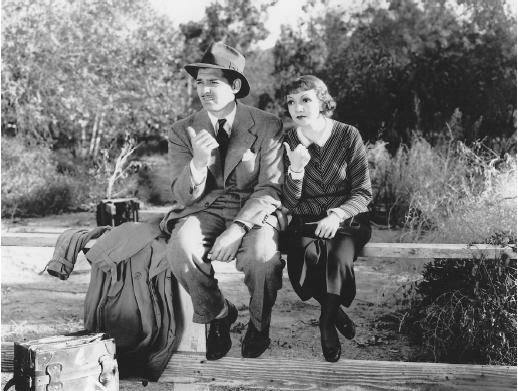
Clark Gable attempts to teach Claudette Colbert the subtleties of hitchhiking in Frank Capra's It Happened One Night (1934), the unbeatable template for romantic comedy ever since, an evergreen road trip through 30s America which tells us plenty about the rich and the working class, men and women too, with Gable in his prime and Colbert in his pyjamas. As the critic Pauline Kael observed:
'It made audiences happy in a way that only a few films in each era do. In the mid-30s, the Colbert and Gable of this film became American's idealised view of themselves - breezy, likeable, sexy, gallant, and maybe just a little harebrained. It was the Annie Hall of its day - before the invention of anxiety.'

Sunday, March 27, 2011

Classic Scene #27


The great Lotte Lenya singing Seeräuber Jenny from G.W. Pabst's 1931 version of Brecht and Weill's Die Dreigroschenoper (The Threepenny Opera). It's her stillness, I think, that's so spellbinding, and the veiled look in her eyes, like she's seeing that ship in her mind as clear as a vision, like it's not a dream but a promise.
You can imagine this woman at the French Revolution, at every bloody uprising of the poor and exploited before and since, her vengeance pure and justified, watching tyrants' heads roll one by one, crying out as each one falls - hoppla!

Friday, March 18, 2011

Last Five Films #5

1. No Man Of Her Own (1932)


Likeable pre-code fare with Clark Gable in full virile mode as big city card sharp, Babe Stewart, wooing small-town librarian Connie Randall (Carole Lombard) with some full-on flirtation. ('Do your eyes bother you?' he says, leaning close to her in the library. 'No, why?' 'Because they bother me.') She resists him, but in truth it's all she can do to not buckle at the knees every time he comes near. 'The girl who lands him will say no and put an anchor on it,' she tells a friend, 'but isn't it tough when all you can think of is yes?' Which is exactly what makes the first half of this film so enjoyable. The aching knowledge that she wants to say yes, even though (or precisely because) he's a predatory heel who'll high-tail it back to New York as soon as he gets his way. There's an animal intensity between them in these scenes that's a pleasure to behold, a blatent sexiness that holds the film spellbound. Unfortunately, on the toss of a coin, ('I never go back on a coin') they get married instead, and he brings her to the big city. Despite some funny scenes the film peters out somewhat after this trying to redeem Gable, who goes from criminal badass to charming rogue to love-sick good guy willing to endure prison and even work for a living! In the process the film looses much of the heat that made it such good sexy fun. Still, well worth a look, if only to see Lombard in her undies!

2. Bombshell (1933)


Cheerfully cynical early screwball with everyone involved rattling off the zippy dialogue at breakneck speed. The plot is meta before its time with Jean Harlow playing Hollywood star Lola Burns, dragged down by mooching family and thieving employees, torn between tough-guy director Jim Brogan (Pat O'Brien), continental lothario Hugo (Ivan Lebedeff) and studio press agent E.J. Hanlon (Lee Tracy). Tracy is the engine of the film, an endlessly scheming Iago with an angle for everything, manipulating Lola at every turn while professing to love her. We're on the edge of a corrosive truth about the Hollywood machine here but the film never stops moving or talking long enough to admit it. You can see fact and fiction already beginning to blur in the Hollywood sun. Lola profits from the scandal Hanlon creates around her but she craves respectibility, the realness of domesticity (posing for kitchen photo-shoots), the ideal of motherhood (trying to adopt a baby), the sanity of being unknown (she runs away to a spa resort). All these fantasies end in failure. The idea is Hanlon is saving Lola from herself by sabotaging her desires for class and stability, helping her realise that where she really belongs, where she's really happy, is in the mad-house of vulgar chaos that is Hollywood. Fast and funny, Bombshell is a love letter to that vulgar chaos, a brazen celebration of deception and bullshit that can't entirely hide the truth in its meta twists and turns, the shadow of fame's devouring neon hovering over it all.

3. My Man Godfrey (1936)


'Life is but an empty bubble,' sighs Carole Lombard's spoilt socialite in Gregory La Cava's My Man Godfrey, casually summing up the philosophy at the heart of the screwball comedies of the '30s. In fact, this is probably the prototype '30s film, a Depression-fuelled screwball romance with all the blithe wit of a Broadway play leavened with scabrous contempt for the rich and blessed with that mysterious light touch that the best directors of the era seemed to have in abundance. It's a classic. William Powell plays homeless bum Godfrey Smith living at the city dump and minding his own business when snobby rich girl Cornelia Bullock turns up and offers him five dollars to be her 'forgotten man' for a scavenger hunt. He refuses and she storms off. But her younger sister Irene (Lombard) stays behind, intrigued by this strange man. Touched by something sweet-natured in her (and by a curiosity to see such an event at first hand) Godfrey offers to help her beat Cornelia. In the ballroom of the Waldorf-Ritz Hotel we're treated to a scene of undignified chaos as hundreds of socialites push and shove and argue over who gets to register their scavenger hunt items first. Irene's father Alexander (Eugene Pallette) observes, 'all you need to start an asylum is an empty room and the right kind of people'. And that's the film right there, the rich are crazy (with greed and boredom), American capitalism is teetering on the brink of savagery, but the poor, the forgotten men, have had all the crazy knocked out of them. It's touch and go as to who should be pitied more. Only Irene is absolved, she's a kind of holy innocent who offers Godfrey a job as their butler so she can have a protege like her empty-headed mother (Alice Brady), who has free-loading poet Carlo (Mischa Auer) as hers. As the new butler in the Bullock madhouse Godfrey is the most refined character in sight. No one had the elegant poise and knowing intelligence of William Powell. He moves through the film with the careful reserve of an adult trapped at a children's party. And Lombard is sensational, a ditzy dope with a big heart, a loveable child prone to funny moods and irrational fits of mania. There are twists and turns that ultimately let the rich off the hook somewhat, lessons learned, the social satire softened, but somehow it doesn't matter as the faultless direction pulls us through to the kind of perfectly delivered last-line closer most films would kill for.

4. Easy Living (1937)


Poor Mitchell Leisen. So many good films, so little credit for any of them. With Easy Living the reason is screenwriter Preston Sturges. The film feels so much like a forerunner of the Sturges style he has to get much of the kudos. Smart lines, farcical plot, slapstick shenanigans? It's all here along with several of the Sturges stock company. But then, Leisen trained as an architect before going into movies and surely he's responsible for the amazing rooms Jean Arthur is shown around by hotel owner Louis Louis. They're a dream of opulent elegance, the kind of insane luxury that makes it obvious why Louis is going bankrupt. The only possible response is Arthur's when left alone in this impossibly swish suite; a half-awed, half-appalled 'Golly!' Wealth here is like a fairy-tale. You are always only a lucky break away from riches. It's a lottery that can fall on anyone. There's little of the moral distain that fuels My Man Godfrey, no forgotten men, just a good girl struggling to get by whose life is changed forever when fate lands a fur coat on her head. The coat in question belongs to the third richest banker in New York, J.B. Ball (Edward Arnold), who throws it off the roof of his penthouse apartment in a row with his wife. It lands on Arthur as she passes by in an open-topped bus, breaking her hat. When J.B. tells her to keep the coat and takes her to buy a new expensive hat rumours spread that she's his mistress. As newspaperman Van Buren brilliantly puts it, 'the bull of broad street, with a girl, in the sable-est sable coat they ever sabled!' As a result she loses her job but gets offered the hotel suite by Louis as a way of insuring J.B. doesn't foreclose on the hotel. Suddenly everyone wants to cash in on her notoriety while she remains oblivious as to why. Add in a romance with J.B.'s cheerfully useless son (Ray Milland), a near riot in an automat, a run on the stock exchange and plenty of shouting, outrage and confusion and you have a cock-eyed cocktail to savour. The end is too neat (a Leisen failing) but Arnold's manic bluster, Milland's boyish charm and Arthur's sweet smile are what will stay with you afterwards.

5. Nothing Sacred (1937)


'For good clean fun, there's nothing like a wake,' declares newspaperman Wally Cook in William A. Wellman's Nothing Sacred, supplying this acid satire with the perfect tagline. In this case the wake is Hazel Flagg's (Carol Lombard) except she isn't dead yet, just dying (of radium poisoning). And, frankly, everyone couldn't be more pleased about it. There's just one thing; she isn't dying, she was misdiagnosed. But the chance to escape her small town, to enjoy the big city delights of New York, prove too tempting, so she lies to Cook (Fredric March), a once great reporter in need of a big story. She's exploiting everyone's sympathy while the newspaper exploits her, and the public get to bask in the glow of her 'bravery' and cry crocodile tears at her impending death. No one escapes in this savage film. You only have to think of the recent Jade Goody story (hated loud-mouth celebrity transformed by cancer into brave mother and national heroine) to see how on the money this was and is still. The only other film I can think of that displays the same contempt for the malign influence of the media and the baser instincts of its audience is Network (1976) but unlike that film's atmosphere of intense, shrill seriousness Nothing Sacred maintains its era's fast-paced, crazy spirit throughout. Ben Hecht's script zings with great lines while tough-guy director Wellman keeps all sentiment at bay. It doesn't waver for a second. As the man says to the Dutch girl; 'Show them the finger babe'. And it sure does.