The famous dance scene from Godard's Bande a Part (1964), has a lovely spontaneous feel to it, a found moment, choreographed magic entering ordinary life, like none of them had any idea they were going to do it until suddenly they were, transported by the music into synchronised grace. 'Franz thinks of everything and nothing,' the narrator tells us, 'uncertain if reality is becoming dream, or dream reality.'
Twenty-eight years later Hal Hartley re-enacted the scene in Simple Men (1992). In the original the music was an R&B number composed for the film by Michel Legrand and christened the Madison dance by the actors. Here the jukebox is playing Kool Thing by Sonic Youth.
This dance is less ineffably cool than the Godard, perhaps, more shambolically awkward, more contrived in the way anything that's a copy rather than the original will inevitably be, but this makes it its own thing, I think, an outburst of defiant energy and noise in a dead-ass country town. One's magic, the other's release. What both scenes have in common, though, is the way the men seem to take their cue from the women. Their un-selfconscious spontaneity seems to create a space, a moment, where dream and reality can meet.
There's something almost religious about this, an age-old connection between dance and altered states. Consider the word dervish. It means doorway to god or enlightenment. The dervish dancers of the Sufi religion whirl incessantly while repeating the name of god until they fall into a trance, a state of deep worship. Surely there's a fragment of this idea in these scenes, the trance state of music and dance taking them towards a more modern state of enlightenment, a place where they feel intensely alive but also blessed by something greater than themselves, something not of this world.
Friday, May 28, 2010


Wednesday, May 26, 2010
The Kino Eye

A film is never really any good unless the camera is an eye in the head of a poet
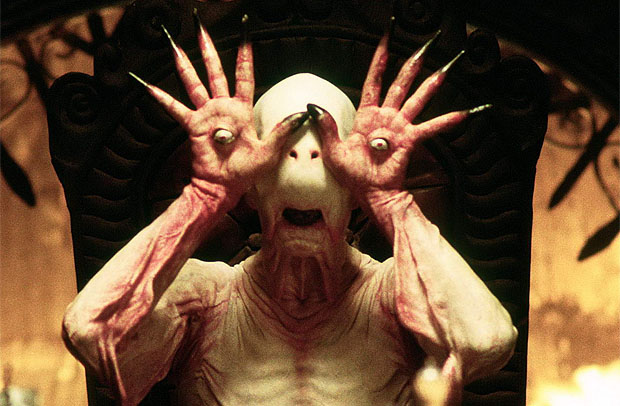
Pupil, from the Latin pupilla, 'a little doll'. When the Romans looked into one another's eyes they saw a doll-like reflection of themselves. The old Hebrew expression for pupil is similar: eshon ayin, which means 'little man of the eye'

To me, one of the cardinal sins for a scriptwriter, when he runs into some difficulty, is to say ‘We can cover that by a line of dialogue.’ Dialogue should simply be a sound among sounds, just something that comes out of the mouths of people whose eyes tell the story in visual terms.

There are many explanations for what inspired the legend of the Cyclopes - the one-eyed monsters of classical mythology - invoking everything from an ancient find of mysterious dwarf elephant skulls, to the blacksmith's habit, in the days before protective goggles, of protecting one eye with a patch. But the most likely inspiration is also the saddest; occasionally a human cyclops survives in the womb long enough to emerge visibly disfigured. Once upon a time, someone got a good look at what they had aborted - and for ever after wished they hadn't

In the early 50s two research teams stumbled independently on a way to stabilise images on the retina. They fastened tiny spotlights to the contact lenses their volunteers wore. It didn't matter how much the volunteers moved their eyes: the little spots of light would always be stabilised at exactly the same places on the retinas. The results could not have been more spectacular: after about a second of this curious, frozen vision, the volunteers lost sight of the lights. The eye exists to detect movement. Any image, perfectly stabilised on the retina, vanishes. Our eyes cannot see stationary objects, and must tremble constantly to bring them into view.
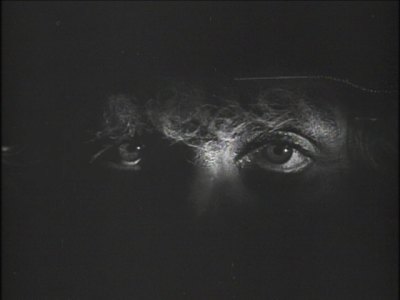
Dr. Mabuse is a master of disguise like Fantômas and a master of telepathic hypnosis, not unlike the hypnotist Dr. Caligari. Like Fu Manchu, Mabuse commits very few of his crimes in person, instead operating primarily through a network of agents acting out schemes he has laid down for them. Mabuse's agents range from career criminals following him for money, to innocents blackmailed or hypnotized into cooperation, to dupes so successfully manipulated they do not realize that they are doing exactly what Mabuse planned for them to do

Both Peeping Tom and Vertigo preface their narratives with the extreme close-up of an eye, as if to announce at once the themes of vision and subjectivity. In Peeping Tom we can detect, below the closed lid, the rapid eye movement that denotes dreaming; the eye thereupon opens wide, introducing a story that has the intensity and condensed logic of dream, or nightmare

As Vertigo's credits begin, the camera moves across the face of an unidentified woman. After first framing the mouth, it moves up to a close-up of the right eye, which opens wide, as if in shock; then moves further in, as if into its interior depths, from which galaxy-like spirals emerge.

Our eyes see very little and very badly – so people dreamed up the microscope to let them see invisible phenomena; they invented the telescope…now they have perfected the cinecamera to penetrate more deeply into he visible world, to explore and record visual phenomena so that what is happening now, which will have to be taken account of in the future, is not forgotten.

No one knows how we focus our attention. No one even knows how to ask the right questions. If the eye is an outpost of the brain, it is - by the same logic - an incursion of the light. When our eyes are drawn to a change in the scene, what draws them: our desire to see, or the change in the scene? Is one a cause, the other an effect? Or - in Goethe's memorable phrase - do 'the two together constitute the indissoluble phenomenon'?

Stand about eight to ten inches from a mirror and look at your left eye. Now look at your right eye, and then back at your left eye. Do this five or six times in quick succession. You will not notice any movement - your eyes will seem to be completely still. But this is in fact not the case, as an observant friend will immediately tell you: your eyes move quite a lot with each shift of focus. The blurred swish during the movement of the eye is somehow snipped from our conscious awareness, and we are left with just the significant images before and after the movement. Not only do we not see the blurred movement, we are unaware that anything has been removed. And this is happening all the time: with every movement of our eyes, an invisible editor is at work, cutting out the bad bits before we can even see them

I am eye. I am a mechanical eye. I, a machine, am showing you a world, the likes of which only I can see.
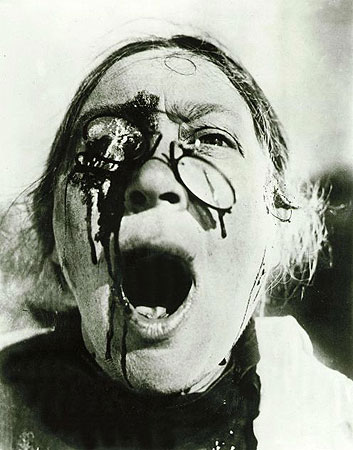
In 1875 the Viennese physiologist Sigmund Exner showed that two brief, stationary flashes, provided they are not too far away from each other, are seen as a single object in motion. This habit of fusing stationary dots into moving objects makes a great deal of sense in nature, where prey and predators disappear and reappear constantly as they move through grass, run behind trees, and peer around rocks. But the power of the phenomenon (called the phi phenomenon) will perhaps best be demonstrated the moment you turn on the television. Every film and TV programme ever made depends on phi. Both display still images quickly enough for our eyes to read them as a single moving image.

Perhaps our eyes are merely a blank film which is taken from us after our deaths to be developed elsewhere and screened as our life story in some infernal cinema
Images: Orson Welles, Pan's Labyrinth, Psycho, Clash Of The Titans, Repulsion, Dr Mabuse The Gambler, Peeping Tom, Vertigo, The Crawling Eye, Grandma's Reading Glasses, Un Chien Andalou, The Man With The Movie Camera, The Battleship Potemkin, A Clockwork Orange
Quotes: Orson Welles, A Natural History of the Senses by Diane Ackerman, Alfred Hitchcock, The Eye: A Natural History by Simon Ings, The Eye: A Natural History, Dr Mabuse Wikipedia page, Vertigo (BFI Film Classics) by Charles Barr, Dziga Vertov, The Eye: A Natural History, The Conversations: Walter Murch And The Art Of Editing Film by Michael Ondaatje, Dziga Vertov, The Eye: A Natural History, Jean Baudrillard
Monday, May 24, 2010
Saturday, May 22, 2010
The Killer Elite
Cinema is, as we all know, the stuff that dreams are made of, all our romantic reveries and adventurous daydreams come to life, a projection of the perfect world we'd ideally love to be living in, full of excitement and happy endings. Or it would be if it wasn't for one little problem: not all our dreams are so wholesome. In fact some are downright dark and scary. And nothing can get at the malign impulses that lurk in our subconscious quite like cinema. It's something filmmakers have known since the earliest days, audiences love the vicarious thrill of illicit acts just as much as wholesome ones.

Which brings us to the horror and fascination we have with those who disobey the most serious of all the Ten Commandments. As Ernest Hemingway once observed, ''when a man is still in rebellion against death he has pleasure in taking to himself one of the Godlike attributes, that of giving it. This is one of the most profound feelings in those men who enjoy killing.'' What he neglected to mention was the pleasure an audience often experiences, whether it's in the bullring or the omniplex, while watching this rebellion against death. It's a primeval experience, a ritualistic act, one that connects cinema to ancient rites and religious transfiguration. The cinematic killer enacts our hidden desire to kill and our hidden relief that the victim is someone else. They die for us, so we don't have to. They kill for us, so we don't have to.
So whether it's the serial killer, the vigilante or the hitman, the killer is always with us, haunting our dreams, charming our worst instincts, hunting us down with remorseless determination. With Michael Winterbottom's The Killer Inside Me set to be the latest profile of one of cinema's most troubling and enduring residents, it's time to look back on five of the more memorable ones.
1. Speaking of Hemingway, his famous short-story The Killers was the basis for one of the great film noirs of the 1940s. Two hitmen arrive in a small town to kill someone called 'the Swede'. They wait in a diner for him to arrive. The film goes on to expand on this simple set-up, giving us the back story as to why the Swede has ended up here, (it's all a girl's fault wouldn'tcha know) but it starts with a faithful recreation of the original story in all its noirish menace.
2. We can't talk killers, of course, without talking Hitchcock. Killers were one of specialities and I could easily pick five clips from his films alone. In the end I choose Bruno Anthony from Strangers On A Train. It's in incomparable performance from Robert Walker, the killer as psychopath, victim and charmer all in one. Hitchcock was always trying to implicate us in his murderous schemes, manipulating us to identify with killers, and here as Bruno murders the woman at the carnival, Hitch literally lowers her body into our laps, presents her to us as a sacrifical offering.
3. It's hard to imagine the western without killers. The gunslinger, the outlaw and the gun-for-hire were staples of pretty much every western ever made. So an enormous wealth of ornery so-and-sos in black hats to choose from then. I've gone for an Italian take on this most American of genres. Surely few killers have ever had a cooler (or better soundtracked) entrance than blue-eyed Frank in Sergio Leone's Once Upon A Time In The West. The fact that Frank is played by Henry Fonda, that paragon of liberal justice in films like The Grapes of Wrath and Twelve Angry Men only makes it all the better.
4. Not all movie killers are human, of course. Monsters, alien creatures and pissed-off animals have all menaced mankind over the years. Most of these can be explained by the unpredictability of nature or our instinctual fear of the unknown. Movies where we imagine being preyed upon by our own technology, on the other hand, are harder to explain. John Carpenter's Christine (1983) is a good example of this. In Stephen King's original book the car was haunted. In the film, however, it has no discernable reason for turning on humanity. It's just bad and it wants to kill us. Technophobia was clearly in the air. Maybe Christine travelled back from the same future depicted the following year in The Terminator, where all our machines have finally risen up against us?
5. And finally, a more recent phenomenon is the arrival of the female killer. It's been a staple of exploitation movies and comic books for some time of course, but it's been gradually making its way into the mainstream as trash aesthetics and comic book sensibilities have taken over popular culture. It's female empowerment meets geek boy fantasy in an unholy alliance and it surely reached a new zenith this year with Hit Girl's gleeful carnage in the wonderful Kick Ass.

Which brings us to the horror and fascination we have with those who disobey the most serious of all the Ten Commandments. As Ernest Hemingway once observed, ''when a man is still in rebellion against death he has pleasure in taking to himself one of the Godlike attributes, that of giving it. This is one of the most profound feelings in those men who enjoy killing.'' What he neglected to mention was the pleasure an audience often experiences, whether it's in the bullring or the omniplex, while watching this rebellion against death. It's a primeval experience, a ritualistic act, one that connects cinema to ancient rites and religious transfiguration. The cinematic killer enacts our hidden desire to kill and our hidden relief that the victim is someone else. They die for us, so we don't have to. They kill for us, so we don't have to.
So whether it's the serial killer, the vigilante or the hitman, the killer is always with us, haunting our dreams, charming our worst instincts, hunting us down with remorseless determination. With Michael Winterbottom's The Killer Inside Me set to be the latest profile of one of cinema's most troubling and enduring residents, it's time to look back on five of the more memorable ones.
1. Speaking of Hemingway, his famous short-story The Killers was the basis for one of the great film noirs of the 1940s. Two hitmen arrive in a small town to kill someone called 'the Swede'. They wait in a diner for him to arrive. The film goes on to expand on this simple set-up, giving us the back story as to why the Swede has ended up here, (it's all a girl's fault wouldn'tcha know) but it starts with a faithful recreation of the original story in all its noirish menace.
2. We can't talk killers, of course, without talking Hitchcock. Killers were one of specialities and I could easily pick five clips from his films alone. In the end I choose Bruno Anthony from Strangers On A Train. It's in incomparable performance from Robert Walker, the killer as psychopath, victim and charmer all in one. Hitchcock was always trying to implicate us in his murderous schemes, manipulating us to identify with killers, and here as Bruno murders the woman at the carnival, Hitch literally lowers her body into our laps, presents her to us as a sacrifical offering.
3. It's hard to imagine the western without killers. The gunslinger, the outlaw and the gun-for-hire were staples of pretty much every western ever made. So an enormous wealth of ornery so-and-sos in black hats to choose from then. I've gone for an Italian take on this most American of genres. Surely few killers have ever had a cooler (or better soundtracked) entrance than blue-eyed Frank in Sergio Leone's Once Upon A Time In The West. The fact that Frank is played by Henry Fonda, that paragon of liberal justice in films like The Grapes of Wrath and Twelve Angry Men only makes it all the better.
4. Not all movie killers are human, of course. Monsters, alien creatures and pissed-off animals have all menaced mankind over the years. Most of these can be explained by the unpredictability of nature or our instinctual fear of the unknown. Movies where we imagine being preyed upon by our own technology, on the other hand, are harder to explain. John Carpenter's Christine (1983) is a good example of this. In Stephen King's original book the car was haunted. In the film, however, it has no discernable reason for turning on humanity. It's just bad and it wants to kill us. Technophobia was clearly in the air. Maybe Christine travelled back from the same future depicted the following year in The Terminator, where all our machines have finally risen up against us?
5. And finally, a more recent phenomenon is the arrival of the female killer. It's been a staple of exploitation movies and comic books for some time of course, but it's been gradually making its way into the mainstream as trash aesthetics and comic book sensibilities have taken over popular culture. It's female empowerment meets geek boy fantasy in an unholy alliance and it surely reached a new zenith this year with Hit Girl's gleeful carnage in the wonderful Kick Ass.
Saturday, April 24, 2010
Classic Scenes #8
A friend of mine has this blanket hatred of musicals, across the board, no exceptions. I used to try reasoning with him, but recently I've started coming around to his way of thinking. Our culture is under attack from the song-and-dance stormtroopers. It's a bandwagon (rather than The Band Wagon) and it's all getting out of hand. Everyone wants to wallow in second-hand showbiz glamour, hide their heads from the economic crisis, happily watch an entire X-Factor generation sing and dance their little hearts out for a chance in the fame spotlight. And sometimes I just get fed up with it, never want to hear a character break into song ever again, never want to see some second-rate celebrity hoofing for all their worth ever again. But then I come across this and I remember why I always argued against that friend of mine. Because this is the antidote to all of the above. It's mesmerising, Fred so graceful, so God-like, I genuinely believe he makes the cane rise into his hand on his own. What we see today isn't even related to this. There should be a different name for it. Art or something.
Friday, April 23, 2010
Classic Scene #7
Recently I've been taking part in the Guardian's Clip Joint. Every week someone picks a theme, giving five example clips, and then it's open to the rest of us to come up with the best clips we can find. The following week the best clip is chosen and the triumphant winner is showered in prizes and fame and...well, okay, the winner gets nothing but the sweet nerd satisfaction of victory itself. I mention this because, a few weeks back, I was that nerd, the subject was twins, and this was my winning clip, the coolest cinematic twins if you please, the coolest cinematic twins if you don't please.
Sunday, April 18, 2010
The Film Club Reviews #6: Ten Thoughts Inspired By: A Bout de Souffle
1. Before I ever saw the film I saw this poster. A classic of graphic design. As soon as I laid eyes on it I knew I had to see the film. It radiated cool energy. And that title. At once a declaration of the film's style and the viewer's response to it. A promise and a boast. Stylish. Sexy. Breathless.

But its original title, A Bout de Souffle, translates as Out Of Breath. That's a B-movie title, slang for death, like Chandler's The Big Sleep. Consider if they'd used that as the English title instead. Would the film have attained such a cool reputation? Just imagine it on the poster. Stylish. Sexy. Out Of Breath.
Suddenly it's not so much an intimation of awed wonder as middle-aged decline. My younger self probably wouldn't have been so impressed, but so what? Does it matter? A title's just a title, after all, a way of identifying one film from another. Sure, mostly, but it's not always that simple. Consider these titles for example: Stranger Than Paradise. Some Like It Hot. White Heat. Touch of Evil. Now each of these could, at a push, describe what happens in their respective films, but I don't think that's what's going on when we read them. They're not merely labels, they're suggestive, free-floating, haikus of compressed mood. Yes, a good title can define a film, capture its essence, but it can also add to it, deepen it, complicate it. It's a chemical reaction. Just think of the mysterious, symbiotic relationship we have with names and they have with us. Do they shape us, do we grow into them? If you don't believe this then consider these possible alternative titles for the films above; Losers. TransAmerica. Mother Love. The Mexican. Does it make a difference? It's hard to say, but this much is clear, the anonymous translator tasked with finding an English version for A Bout de Souffle clearly thought so.
2. The film of tomorrow will not be directed by civil servants of the camera, but by artists for whom shooting a film constitutes a wonderful and thrilling adventure. - Francois Truffaut
The famous dedication is to Monogram Pictures. Monogram were a poverty row studio specialising in cheap genre flicks, serials and westerns. So what was the attraction for serious French cinephiles like Truffaut and Godard?

Well, for starters, because they were largely ignored or unknown they were an undiscovered continent, ripe for reappraisal. They often relied on genre conventions, offering rich ground for theorising, for detecting encoded meanings, hidden ideas, themes build up across a body of work. Also because they had less to lose they could show the seemier side of existence more freely than bigger studio productions, the kind of exploitation subjects considered beneath proper art. The French saw passed all that bourgouis respectability, understood that the life of a petty thief could be as worthy of great art as the noblest king, that an absence of craft or style might represent a film's phychological meaning, its hard indifference to the lies of romance. They were the first to realise that serious artists could exist outside the mainstream, might find the fertile confines of genre more to their liking, might prefer playful indifference to highbrow pretention.
But even the worst of these films taught them about innocent enjoyment, the pleasure of transformation, how much easier it was to bring the moves, clothes and dialogue into your life when they were ritualised, repeated, how cliches spoke to the yearnings inside ordinary people. By dedicating his film to Monogram Godard was sticking two fingers up at the industry, rejecting its middlebrow concerns with craft and rules, alligning himself with the outsiders, the dreamers, with those great American values of outrage, adventure and play. This is a game, he's telling us. We're playing here. So can you.
3. The famous opening line is: I'm an asshole, a provocation from the start, followed by a close up of a skantily clad girl on the front of a newspaper, lowered to reveal our hero, Michel, hat over his eyes, puffing on an enormous cigarette. He's cool, but posing too, a kid playing dress-up.

Then he runs the side of his thumb across his lips. It's a signal. To us. Thumb across lips. That's all it takes. Your Bogie. Your life is a movie. It's hard to appreciate now the impact of this message. A Bout de Souffle was the first film to acknowledge people's desire for movie grace in their lives, wanting their everyday existence transfigured by it, blessed with purpose and shape, ordinary personas imbued with unified glamour. You don't need to be famous, a star. The magic isn't out there somewhere, owned by producers, studios, agents, fans. It's in you now, once you've seen the film, it's yours, a gift, not a privilege. This is what cinema is, the democratisation of play. It's an evolutionary tool, teaching poor regional kids moves and gestures to help them escape impoverished lives, to face the twin terrors of adolescence and neighbourhood streets. After all, when you live in a non-verbal environment knowing how to stand on corners with cool indifference is a vital art. This is another thing the film is already telling us. The street is a movie set too.
4. We first see Patricia ambling down the Champ-Elysees in her flat shoes, sweetly calling 'New York Herald Tribune! New York Herald Tribune!' She's played by Jean Seberg, proof that nationality is a notional concept at best. She's supposed to be the American chick but comes across, in her clothes, her manner, her cropped hair, as ineffably French. It's hard to imagine any other contemporary American actress playing the part, actually American but spiritually in tune with the Frenchness of the whole enterprise. (The film too is at once American in its conventions and French in its style and ideas.)

It was that way from the start. Her screen debut was as Saint Joan (1957), hand-picked from 18,000 hopefuls by Otto Preminger. It was Preminger again who brought her to France the following year to play the spoiled Celine in Bonjour Tristesse. The same year she married film director Francois Moreuil. By the time of A Bout de Souffle they were divorced and she'd taken up with French author Romain Gary, marrying him in 1962. Was it fate or inclination that drew her to the French and them to her? Or was it the hair? The gamine prettiness? Whatever it was, it went on, until her tragic, mysterious death in 1979, found dead in her car on the same Parisienne streets she'd watched Belmondo play dead on all those years before, back when they were all young enough to think of death as a romantic game, something to be bargained with.
5. Leaving Patricia behind Michel passes a poster for a film called Ten Seconds To Hell (1959), its tagline proclaiming 'Live dangerously till the end!'

It's a lovely moment, not just for the renegade cheek of using the poster without permission, but for the serendipity of it being there in the first place, articulating the film's key theme - defying death. (You know you're in the zone when the world starts to speak to you like this, send you secret messages, when you see connections everywhere, when you start to believe there's no such thing as a coincidence, that luck, in fact, is just fate in disguise).
6. Once you accept the rule of death thou shalt not kill is an easily and naturally obeyed commandment. But when a man is still in rebellion against death he has pleasure in taking to himself one of the Godlike attributes, that of giving it. This is one of the most profound feelings in those men who enjoy killing. - Ernest Hemingway, 'Death in the Afternoon'
'It is solely by risking life that freedom is obtained,' Hegel wrote, somehow defining the essence of A Bout de Souffle over a century before it was made. The spirit of the film may be its exhilerating sense of freedom, it's jazzy liberation from social, artistic and cinematic conventions, but it's also obsessed with death, from its title to its conclusion. Or rather, with invoking it in order to feel more alive. If the taking of life could, as Hemingway suggests, ward off your own death, than so could acting it out. In this sense, the film is as ritualistic as a bullfight, a bloodless rebellion against death.
Just as ancient Greek rites evolved into formalised drama, the death of a tragic hero offered to the gods rather than the sacrifice of a goat, so too with cinema. It may be a game, Godard suggests, but it isn't frivilous. It's as serious as any religion, as vital to our happiness as freedom itself. It was a message that hit the new decade like a molotov cocktail, starting a creative blaze that lasted twenty years and engulfed the old Hollywood studio system in its wake.
7. 'What is your greatest ambition?' Patricia asks the novelist (played by director Jean-Pierre Melville) at the kind of pretentious press conference only the French would have. 'To become immortal', he replies, looking straight into the camera, 'and then to die'.
It's a joke, a contradiction. He might as well have said his ambition was 'to wake and then to dream'. It's an impossibility, mutually exclusive states, waking/dreaming, immortality/death. Except, of course, there is one place where the impossible can happen. When we watch a film, especially in the dark of a cinema, what else are we doing but dreaming while still awake? And when we watch the great stars of the silver screen like James Cagney, Bette Davis or Steve McQueen, what else are we doing but watching the dead walk again, forever alive in their films, made immortal by them?
8. Which is what Bogart represents in the film, not just a role model but an icon of immortality. Dead only three years when A Bout de Souffle was made, already he's becoming a cult, his moves, clothes and dialogue remembered, repeated and fetishised.

But why Bogie? What was it about him that so obsessed the French? Maybe he was, in some way, more French than other Hollywood stars, more ironic, fatalistic, ugly? Maybe the characters he played, men with secrets, with shadowy pasts, were more in keeping with a nation haunted by defeat, collaboration and existential dread? Whatever it was it went deep, just think of the hats and coats in Melville's own films like Le Samourai.

Of course, the Bogart of The Maltese Falcon, Casablanca and The Big Sleep was also the coolest man on the planet, a dream of tough grace under pressure. He crystallised the essence of cool long before Brando and Dean turned up, a man's cool, not a grumpy adolescent's, someone who's lived, seen things, been betrayed by events, by his own heart, hides his honour like a dirty secret. But we know it's there, we know he does care, does know which side is right, he just won't be played for a sap anymore. Being a man, he seems to say, is a moral act. If you don't know how to read people, if you don't know when to keep quiet, if you don't understand that sometimes cynicism is just the truth no one wants to hear, then you deserve what you get, you leave yourself wide open, cannon fodder for conmen, Nazis and certain kinds of women.
9. Then there's the lovely extended scene in Patricia's apartment. She arrives home to find Michel in her bed. What follows is spontaneity, calculation and natural light, cultural allusions everywhere. She poses before a poster of Renoir's Mlle Irene Cahen d'Anvers and asks who's the prettier. He caresses her bum and asks can he piss in her sink. She washes her feet and tell him she's pregant. He sits beneath a Picasso figure wearing a mask. She quotes from The Wild Palms by William Faulkner: 'Between grief and nothing, I will take grief.' Michel says he'd choose nothing. 'Grief', he adds, 'is a compromise'. They talk, flirt, test each other and eventually make love, fumbling under the covers like kids, not sure what their parents really do under there.

The claim that capturing Seberg's beauty on film matches Renoir's achievement on canvass is hardly worth noting now. But it's a reminder of a time before the triumph of popular culture when film was considered an upstart medium, devoid of true craft, a nickelodeon distraction for immigrant hordes and over-excited housewifes, not something to be taken seriously as high art. This was the fight Godard, Truffaut and the rest of the Cahiers du Cinéma critics were waging in the late 50s, rescuing great artists like Hitchcock and Hawks from the neglect this pompous snobbery had consigned them to.

And what about Michel's claim that grief is a compromise? Is it an existential statement, like Beckett's 'every word is like an unnecessary stain on silence and nothingness', or is he just trying to sound cool. Is he suggesting that emotions are a refuge, a refusal to accept the truth? It's an interesting idea in an age when personal grief has become everyday currency. Would Bogie give in to grief, cry and wail, take to his bed, sell his story to the tabloids? No, he wouldn't. He'd take it inside him, order a drink, light a cigarette, another lesson learned, another test passed.
The cigarette is vital of course. Just consider how important they were in all this. Michel smokes non-stop throughout the film. Even his dying breath is a puff of smoke. Can you imagine a time when smoking was this cool? When things weren't ghosted by consequences, by health warnings, when people drank at work and smoked in cinemas, weren't constantly fretting about their health, short-changing their youth for a few extra years at the end? When looking cool now was more important than being alive then? It's all about how you look, y'see, masks, uniforms, encoded signs, the transformative power of objects and faces. 'The mystery of the world is in the visible, not the invisible,' as Oscar Wilde rightly pointed out. Open your eyes (and dream). We're being movie stars here. They're immortal. They never die of cancer or liver failure.
10. 'The film of tomorrow will be an act of love - Truffaut
Above all it's a film about love, love of cinema, love of life through cinema. There really was no difference to these young men. Cinema was life. Watching a beautiful woman and capturing her on film was the same thing to them. It was very chauvinistic, of course, but very romantic too (essentially the same thing). Romance has no time for feminist aspirations. It wants to be taken out of this crappy world, wants to idealise, heighten, improve. It's foolish, a youthful folly, but where would we be without it?
For a few brief years, as the world woke up from it's post-war slumber, a handful of young men believed that cinema was the new language of happiness and truth. A Bout de Souffle bottled that moment. It's a time machine. The spirit and energy of that moment can be revisited every time you watch it. You could even say it's immortal. Or to put it another way: Devil in the Flesh. Rififi. And God Created Woman. Scarface. A Bout de Souffle. The best film around.
But its original title, A Bout de Souffle, translates as Out Of Breath. That's a B-movie title, slang for death, like Chandler's The Big Sleep. Consider if they'd used that as the English title instead. Would the film have attained such a cool reputation? Just imagine it on the poster. Stylish. Sexy. Out Of Breath.
Suddenly it's not so much an intimation of awed wonder as middle-aged decline. My younger self probably wouldn't have been so impressed, but so what? Does it matter? A title's just a title, after all, a way of identifying one film from another. Sure, mostly, but it's not always that simple. Consider these titles for example: Stranger Than Paradise. Some Like It Hot. White Heat. Touch of Evil. Now each of these could, at a push, describe what happens in their respective films, but I don't think that's what's going on when we read them. They're not merely labels, they're suggestive, free-floating, haikus of compressed mood. Yes, a good title can define a film, capture its essence, but it can also add to it, deepen it, complicate it. It's a chemical reaction. Just think of the mysterious, symbiotic relationship we have with names and they have with us. Do they shape us, do we grow into them? If you don't believe this then consider these possible alternative titles for the films above; Losers. TransAmerica. Mother Love. The Mexican. Does it make a difference? It's hard to say, but this much is clear, the anonymous translator tasked with finding an English version for A Bout de Souffle clearly thought so.
2. The film of tomorrow will not be directed by civil servants of the camera, but by artists for whom shooting a film constitutes a wonderful and thrilling adventure. - Francois Truffaut
The famous dedication is to Monogram Pictures. Monogram were a poverty row studio specialising in cheap genre flicks, serials and westerns. So what was the attraction for serious French cinephiles like Truffaut and Godard?

Well, for starters, because they were largely ignored or unknown they were an undiscovered continent, ripe for reappraisal. They often relied on genre conventions, offering rich ground for theorising, for detecting encoded meanings, hidden ideas, themes build up across a body of work. Also because they had less to lose they could show the seemier side of existence more freely than bigger studio productions, the kind of exploitation subjects considered beneath proper art. The French saw passed all that bourgouis respectability, understood that the life of a petty thief could be as worthy of great art as the noblest king, that an absence of craft or style might represent a film's phychological meaning, its hard indifference to the lies of romance. They were the first to realise that serious artists could exist outside the mainstream, might find the fertile confines of genre more to their liking, might prefer playful indifference to highbrow pretention.
But even the worst of these films taught them about innocent enjoyment, the pleasure of transformation, how much easier it was to bring the moves, clothes and dialogue into your life when they were ritualised, repeated, how cliches spoke to the yearnings inside ordinary people. By dedicating his film to Monogram Godard was sticking two fingers up at the industry, rejecting its middlebrow concerns with craft and rules, alligning himself with the outsiders, the dreamers, with those great American values of outrage, adventure and play. This is a game, he's telling us. We're playing here. So can you.
3. The famous opening line is: I'm an asshole, a provocation from the start, followed by a close up of a skantily clad girl on the front of a newspaper, lowered to reveal our hero, Michel, hat over his eyes, puffing on an enormous cigarette. He's cool, but posing too, a kid playing dress-up.

Then he runs the side of his thumb across his lips. It's a signal. To us. Thumb across lips. That's all it takes. Your Bogie. Your life is a movie. It's hard to appreciate now the impact of this message. A Bout de Souffle was the first film to acknowledge people's desire for movie grace in their lives, wanting their everyday existence transfigured by it, blessed with purpose and shape, ordinary personas imbued with unified glamour. You don't need to be famous, a star. The magic isn't out there somewhere, owned by producers, studios, agents, fans. It's in you now, once you've seen the film, it's yours, a gift, not a privilege. This is what cinema is, the democratisation of play. It's an evolutionary tool, teaching poor regional kids moves and gestures to help them escape impoverished lives, to face the twin terrors of adolescence and neighbourhood streets. After all, when you live in a non-verbal environment knowing how to stand on corners with cool indifference is a vital art. This is another thing the film is already telling us. The street is a movie set too.
4. We first see Patricia ambling down the Champ-Elysees in her flat shoes, sweetly calling 'New York Herald Tribune! New York Herald Tribune!' She's played by Jean Seberg, proof that nationality is a notional concept at best. She's supposed to be the American chick but comes across, in her clothes, her manner, her cropped hair, as ineffably French. It's hard to imagine any other contemporary American actress playing the part, actually American but spiritually in tune with the Frenchness of the whole enterprise. (The film too is at once American in its conventions and French in its style and ideas.)
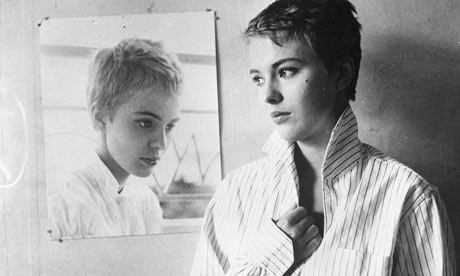
It was that way from the start. Her screen debut was as Saint Joan (1957), hand-picked from 18,000 hopefuls by Otto Preminger. It was Preminger again who brought her to France the following year to play the spoiled Celine in Bonjour Tristesse. The same year she married film director Francois Moreuil. By the time of A Bout de Souffle they were divorced and she'd taken up with French author Romain Gary, marrying him in 1962. Was it fate or inclination that drew her to the French and them to her? Or was it the hair? The gamine prettiness? Whatever it was, it went on, until her tragic, mysterious death in 1979, found dead in her car on the same Parisienne streets she'd watched Belmondo play dead on all those years before, back when they were all young enough to think of death as a romantic game, something to be bargained with.
5. Leaving Patricia behind Michel passes a poster for a film called Ten Seconds To Hell (1959), its tagline proclaiming 'Live dangerously till the end!'

It's a lovely moment, not just for the renegade cheek of using the poster without permission, but for the serendipity of it being there in the first place, articulating the film's key theme - defying death. (You know you're in the zone when the world starts to speak to you like this, send you secret messages, when you see connections everywhere, when you start to believe there's no such thing as a coincidence, that luck, in fact, is just fate in disguise).
6. Once you accept the rule of death thou shalt not kill is an easily and naturally obeyed commandment. But when a man is still in rebellion against death he has pleasure in taking to himself one of the Godlike attributes, that of giving it. This is one of the most profound feelings in those men who enjoy killing. - Ernest Hemingway, 'Death in the Afternoon'
'It is solely by risking life that freedom is obtained,' Hegel wrote, somehow defining the essence of A Bout de Souffle over a century before it was made. The spirit of the film may be its exhilerating sense of freedom, it's jazzy liberation from social, artistic and cinematic conventions, but it's also obsessed with death, from its title to its conclusion. Or rather, with invoking it in order to feel more alive. If the taking of life could, as Hemingway suggests, ward off your own death, than so could acting it out. In this sense, the film is as ritualistic as a bullfight, a bloodless rebellion against death.
Just as ancient Greek rites evolved into formalised drama, the death of a tragic hero offered to the gods rather than the sacrifice of a goat, so too with cinema. It may be a game, Godard suggests, but it isn't frivilous. It's as serious as any religion, as vital to our happiness as freedom itself. It was a message that hit the new decade like a molotov cocktail, starting a creative blaze that lasted twenty years and engulfed the old Hollywood studio system in its wake.
7. 'What is your greatest ambition?' Patricia asks the novelist (played by director Jean-Pierre Melville) at the kind of pretentious press conference only the French would have. 'To become immortal', he replies, looking straight into the camera, 'and then to die'.
It's a joke, a contradiction. He might as well have said his ambition was 'to wake and then to dream'. It's an impossibility, mutually exclusive states, waking/dreaming, immortality/death. Except, of course, there is one place where the impossible can happen. When we watch a film, especially in the dark of a cinema, what else are we doing but dreaming while still awake? And when we watch the great stars of the silver screen like James Cagney, Bette Davis or Steve McQueen, what else are we doing but watching the dead walk again, forever alive in their films, made immortal by them?
8. Which is what Bogart represents in the film, not just a role model but an icon of immortality. Dead only three years when A Bout de Souffle was made, already he's becoming a cult, his moves, clothes and dialogue remembered, repeated and fetishised.
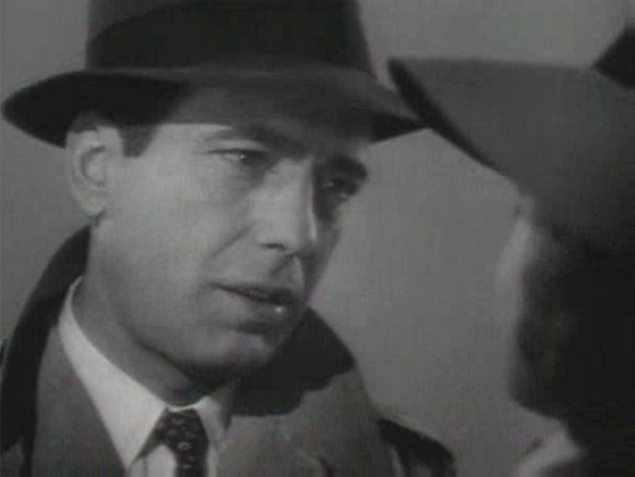
But why Bogie? What was it about him that so obsessed the French? Maybe he was, in some way, more French than other Hollywood stars, more ironic, fatalistic, ugly? Maybe the characters he played, men with secrets, with shadowy pasts, were more in keeping with a nation haunted by defeat, collaboration and existential dread? Whatever it was it went deep, just think of the hats and coats in Melville's own films like Le Samourai.

Of course, the Bogart of The Maltese Falcon, Casablanca and The Big Sleep was also the coolest man on the planet, a dream of tough grace under pressure. He crystallised the essence of cool long before Brando and Dean turned up, a man's cool, not a grumpy adolescent's, someone who's lived, seen things, been betrayed by events, by his own heart, hides his honour like a dirty secret. But we know it's there, we know he does care, does know which side is right, he just won't be played for a sap anymore. Being a man, he seems to say, is a moral act. If you don't know how to read people, if you don't know when to keep quiet, if you don't understand that sometimes cynicism is just the truth no one wants to hear, then you deserve what you get, you leave yourself wide open, cannon fodder for conmen, Nazis and certain kinds of women.
9. Then there's the lovely extended scene in Patricia's apartment. She arrives home to find Michel in her bed. What follows is spontaneity, calculation and natural light, cultural allusions everywhere. She poses before a poster of Renoir's Mlle Irene Cahen d'Anvers and asks who's the prettier. He caresses her bum and asks can he piss in her sink. She washes her feet and tell him she's pregant. He sits beneath a Picasso figure wearing a mask. She quotes from The Wild Palms by William Faulkner: 'Between grief and nothing, I will take grief.' Michel says he'd choose nothing. 'Grief', he adds, 'is a compromise'. They talk, flirt, test each other and eventually make love, fumbling under the covers like kids, not sure what their parents really do under there.

The claim that capturing Seberg's beauty on film matches Renoir's achievement on canvass is hardly worth noting now. But it's a reminder of a time before the triumph of popular culture when film was considered an upstart medium, devoid of true craft, a nickelodeon distraction for immigrant hordes and over-excited housewifes, not something to be taken seriously as high art. This was the fight Godard, Truffaut and the rest of the Cahiers du Cinéma critics were waging in the late 50s, rescuing great artists like Hitchcock and Hawks from the neglect this pompous snobbery had consigned them to.

And what about Michel's claim that grief is a compromise? Is it an existential statement, like Beckett's 'every word is like an unnecessary stain on silence and nothingness', or is he just trying to sound cool. Is he suggesting that emotions are a refuge, a refusal to accept the truth? It's an interesting idea in an age when personal grief has become everyday currency. Would Bogie give in to grief, cry and wail, take to his bed, sell his story to the tabloids? No, he wouldn't. He'd take it inside him, order a drink, light a cigarette, another lesson learned, another test passed.
The cigarette is vital of course. Just consider how important they were in all this. Michel smokes non-stop throughout the film. Even his dying breath is a puff of smoke. Can you imagine a time when smoking was this cool? When things weren't ghosted by consequences, by health warnings, when people drank at work and smoked in cinemas, weren't constantly fretting about their health, short-changing their youth for a few extra years at the end? When looking cool now was more important than being alive then? It's all about how you look, y'see, masks, uniforms, encoded signs, the transformative power of objects and faces. 'The mystery of the world is in the visible, not the invisible,' as Oscar Wilde rightly pointed out. Open your eyes (and dream). We're being movie stars here. They're immortal. They never die of cancer or liver failure.
10. 'The film of tomorrow will be an act of love - Truffaut
Above all it's a film about love, love of cinema, love of life through cinema. There really was no difference to these young men. Cinema was life. Watching a beautiful woman and capturing her on film was the same thing to them. It was very chauvinistic, of course, but very romantic too (essentially the same thing). Romance has no time for feminist aspirations. It wants to be taken out of this crappy world, wants to idealise, heighten, improve. It's foolish, a youthful folly, but where would we be without it?
For a few brief years, as the world woke up from it's post-war slumber, a handful of young men believed that cinema was the new language of happiness and truth. A Bout de Souffle bottled that moment. It's a time machine. The spirit and energy of that moment can be revisited every time you watch it. You could even say it's immortal. Or to put it another way: Devil in the Flesh. Rififi. And God Created Woman. Scarface. A Bout de Souffle. The best film around.
Subscribe to:
Posts (Atom)